
Hi everyone,
I have some thoughts on how to tackle this problem. The previous owner patched the underside of the balcony with some strange mortar and then also painted a thick layer of something like latex paint...
They also used fiberglass and epoxy (or polyester) on the top side, but didn't make it watertight. So last fall, I tore off the plastic and had to chip away the tile floor that was underneath, because it was constantly damp under the plastic + frost damage.
Anyway, the top side won't be a problem, but how do I repair the underside? It feels like the holes are too big to fill with putty and I don't know how to make the repair mortar stay up/stick.
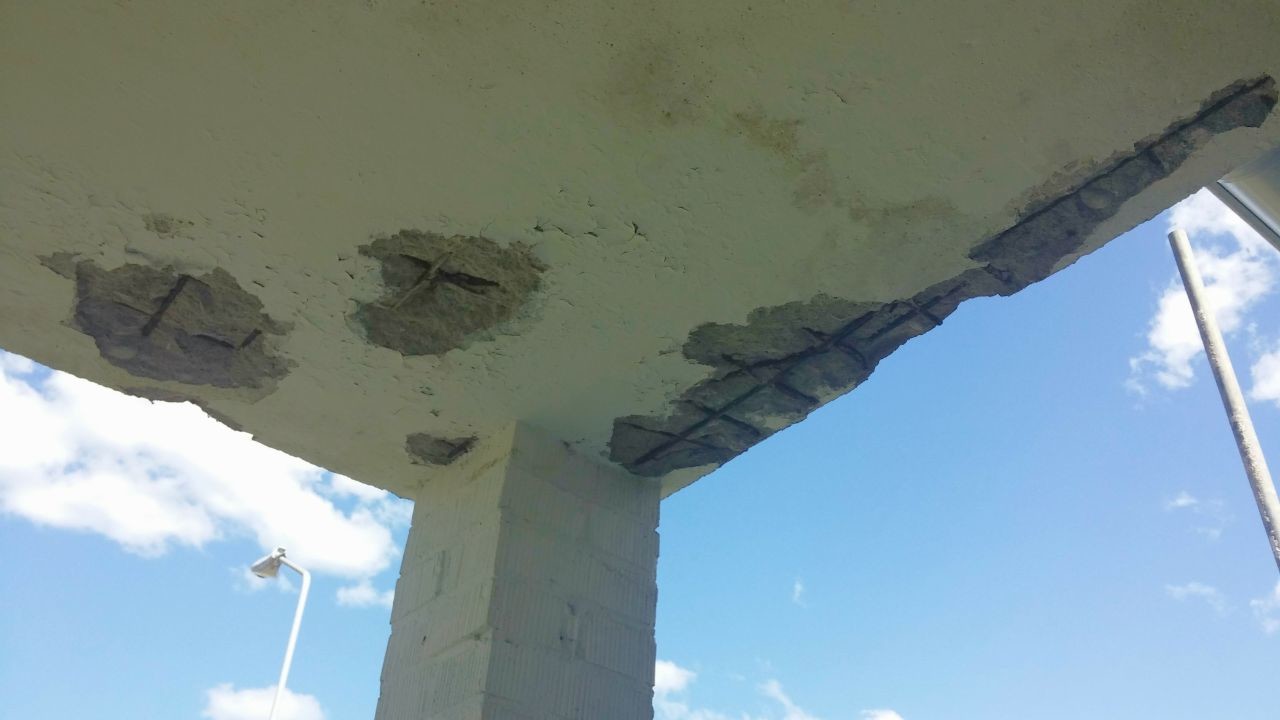
As you can see in the photo, there has been significant damage to the concrete, and the exposed reinforcing bars have rusted quite a bit.
Thanks in advance!
Alex
I have some thoughts on how to tackle this problem. The previous owner patched the underside of the balcony with some strange mortar and then also painted a thick layer of something like latex paint...
They also used fiberglass and epoxy (or polyester) on the top side, but didn't make it watertight. So last fall, I tore off the plastic and had to chip away the tile floor that was underneath, because it was constantly damp under the plastic + frost damage.
Anyway, the top side won't be a problem, but how do I repair the underside? It feels like the holes are too big to fill with putty and I don't know how to make the repair mortar stay up/stick.
As you can see in the photo, there has been significant damage to the concrete, and the exposed reinforcing bars have rusted quite a bit.
Thanks in advance!
Alex
You don't need to fill the entire damage all at once, as the weight of your patching compound will likely be higher than the absorption ability to make it stay. Buy a patching compound/plastering mortar and spread it with a trowel, making sure to press well so that all the air behind disappears. You will be surprised at how well it manages to "stay." The damages you don't manage to fill directly can be addressed when it starts to dry again. First, brush generously with an adhesion primer and make sure it's clean and cleared of any loose debris.
Thanks Snål-Jocke!S Snål-Jocke said:You don't need to fill the entire damage all at once, the weight of your repair mortar is likely to be higher than the suction ability can handle to keep it in place. Buy a repair mortar/plaster and spread it with a flat trowel, make sure to press well so that all the air behind disappears. You will be surprised at how well it can "hang," the damages you don't manage to fill right away you can address when it starts to dry again. First, brush generously with an adhesion primer, and make sure it is clean and cleared of all loose debris.
Yes, that's true. I've been on that track before too, but in all the confusion, completely forgot about it. I have the adhesion primer, so I just need to get the mortar. The plan now is to cast a slightly sloping surface on the balcony and then probably use tar paper to start with. Once it's sealed on top, I plan to repair the holes underneath.
The top side should preferably be able to be leveled with self-leveling compound.
That's right.
I have seen how professionals do it when renovating bridge pillars and the like, they have sandblasted the rust off all visible reinforcement. It might be a bit overkill for you, but why not spend an extra few hundred kronor to brush on some rust stopper? Available at Biltema etc.
I have seen how professionals do it when renovating bridge pillars and the like, they have sandblasted the rust off all visible reinforcement. It might be a bit overkill for you, but why not spend an extra few hundred kronor to brush on some rust stopper? Available at Biltema etc.
Self-leveling compound, yes, that was actually the first thing that came to mind for me, but I'm not entirely sure I dare to try it.S Snål-Jocke said:
Sandblasting would be convenient; I'll see if I can manage it without damaging things around it.
I assume Biltema rust stopper is better than nothing, but I've tried it before and wasn't particularly impressed. But, maybe there's something else, I'll take a look around!
You dare to self-level, and you will love that you did it. It will turn out insanely well.
I find it hard to see how to fail...

I find it hard to see how to fail...
No iron should protrude into daylight, there should be no frost bursting. Aim for a thickness of one centimeter over the reinforcement, preferably two.
You mean reinforce the leveling compound?S Snål-Jocke said:
We'll see how I do then, the leveling compound is significantly more expensive than something like fine concrete, about 1000 SEK per cm on the balcony.
It's not that I'm stingy, but in the past year we've replaced the roof, got new windows, and soon will have the whole house replastered. All without borrowing, and on top of that, child no. 2 is due any day now. I also need to build a new deck roof and renovate the concrete stairs before fall sets in for real. Phew...
No, I meant the original construction's reinforcement. As for flyt, there are different types where some don't require their own reinforcement, but I'm not very good with that part.
Great job with the house, truly impressive
Great job with the house, truly impressive
I have a similar problem, so I'm following this thread! If you don't want to build up too much on the balcony's surface, how do you make it watertight then?
Well, I don't have this down pat. But I would let the top float and have a water-repellent surface layer like epoxy or something. I would also ensure that the underside allows the construction to breathe, and have a functional drip edge, so running water cannot creep along the underside.

I can highly recommend Betoheft or similar for the top side of the balcony. Used without an adhesive. Before that, milling away of the old surface layer with a diamond cutter. Surface treatment with some epoxy paint.
Betoheft may possibly also work on the underside if applied in thin layers.
Betoheft may possibly also work on the underside if applied in thin layers.
There are several different mortars and fillers that only build up 5mm. For my part, it's mostly as a leveling layer, as I only have the cast slab left, the rest I demolished last fall.ricebridge said:
Got it! I have seen that many leveling compounds have "built-in" reinforcement, that's why I was a bit confused.S Snål-Jocke said:
Thanks
Thanks Pen for the tip! It might be a good product to apply first and on all exposed rebar.
Last edited:
Click here to reply