
6,089 views ·
10 replies
6k views
10 replies
Repair joint in brick fireplace.
Hello,
We have an old tile stove where the joints in the firebox are no longer in the best condition. I was thinking of re-grouting with some new mortar, but what should be used?
We have an old tile stove where the joints in the firebox are no longer in the best condition. I was thinking of re-grouting with some new mortar, but what should be used?
Best answer
Member
· Västernorrland
· 12 060 posts
use regular hydraulic lime mortar. It is soft and flexible and can be worked and improved as many times as needed. Unlike cement-based mortars that become rock-hard and stay in place.
Hello everyone, I'm taking over the thread a bit as I couldn't find a better one to fit my topic and didn't want to start a new one. I have gotten hold of a large batch of bricks, but they are a bit unusual. It's yellow perforated brick with 9 holes (I know there can be a maximum of 21 holes in a "regular" brick to be used for building a fireplace). I'm including a picture. What do you think, can this be used to build a fireplace indoors? The brick weighs 1.2 kg.
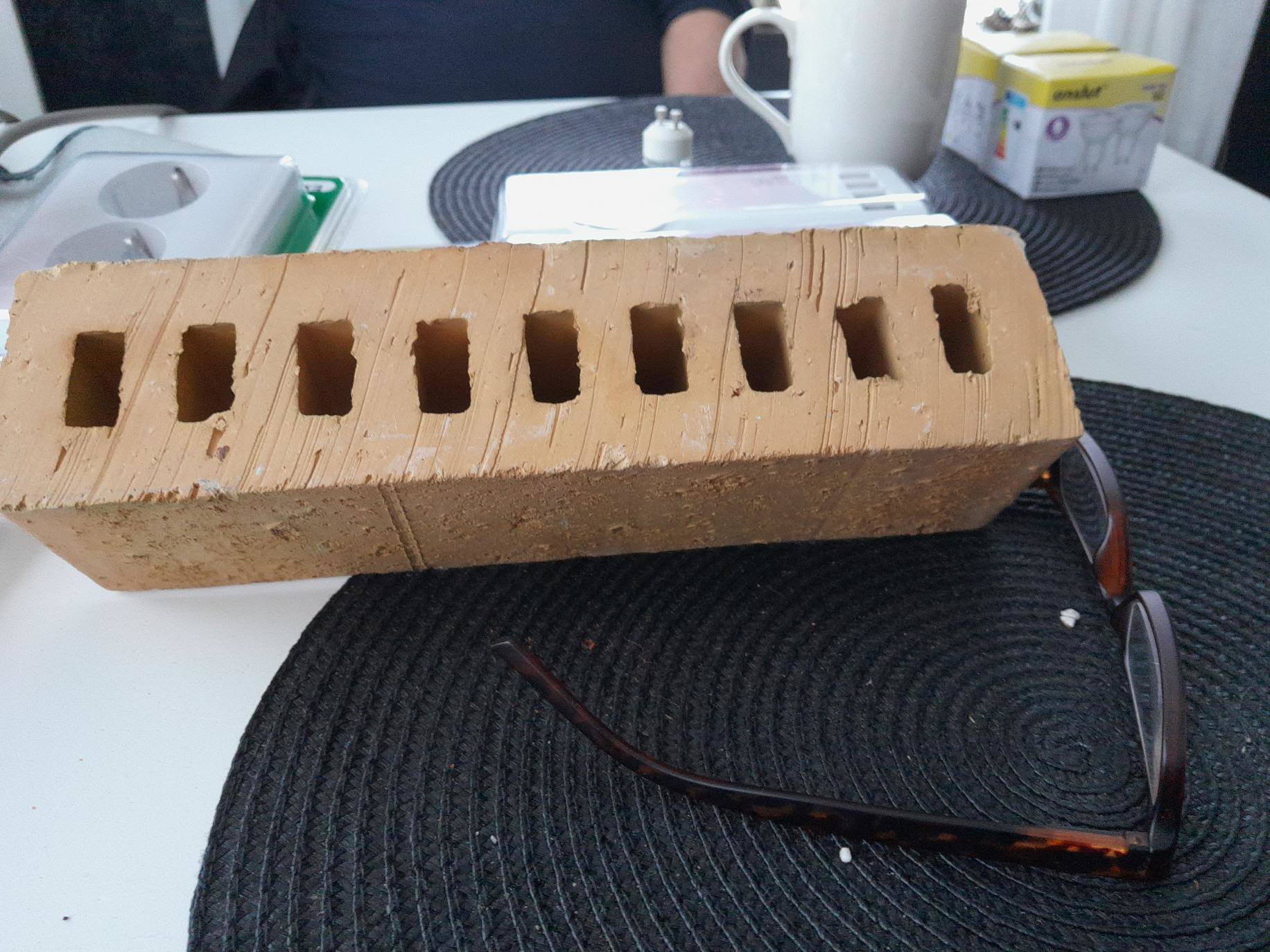
Yes, I know, unfortunately, I don't know what kind of brick it is. Luckily, I haven't paid for or picked it up yet. I have asked the seller to wait until I check the specifications of the brick. I've been googling like crazy but can't find anything similar. According to the seller, it should be dimensions 80mmx80mmx240mm.B BSOD said:
I'm waiting for an answer from him.
There are very high demands on firebrick. I wouldn't take a chance.
If I had to guess, I would guess that it is some form of facade brick, but that's a guess, and I am faaaar from sure.
Firebrick is usually without holes, solid bricks, quite often narrower. Are you building a fireplace?
If I had to guess, I would guess that it is some form of facade brick, but that's a guess, and I am faaaar from sure.
Firebrick is usually without holes, solid bricks, quite often narrower. Are you building a fireplace?
Yes, something like that, I'm going to build a masonry heater. It's not necessarily required to use firebrick. However, it is commonly used at the bottom of the firebox if I've understood correctly. In the rest of the heater, the temperatures don't reach the levels needed for firebrick to be necessary.
The principle of such a heater is to direct the flue gases a long way (up and then down the sides) like in a tile stove, in order to extract all the heat and achieve maximum heat storage.
The principle of such a heater is to direct the flue gases a long way (up and then down the sides) like in a tile stove, in order to extract all the heat and achieve maximum heat storage.
S
sinuslinus
Träskalle
· Östergötlands län
· 6 085 posts
sinuslinus
Träskalle
- Östergötlands län
- 6,085 posts
S
sinuslinus
Träskalle
· Östergötlands län
· 6 085 posts
sinuslinus
Träskalle
- Östergötlands län
- 6,085 posts
Looks like facing stone or facade stone used in facades when you don't want to significantly increase the wall thickness.M mhoglund said:Yes, something like that, I plan to build a mass heater. It's not really a requirement to use firebrick. However, it's usually placed at the bottom of the firebox if I've understood it correctly. In the rest of the stove, you don't reach the temperatures that require firebrick.
The principle of such a stove is to guide the smoke gases a long way (up and then down the sides) like in a tile stove, to extract all the heat and achieve maximum heat storage.
Swedish regulations for stoves involve 120 mm thick stones. These are likely experience-based rules that have been used before, and it's known that they work.
Okay, thanks for the info. Yeah, then it's just a matter of continuing to searchS sinuslinus said:
 darn that brick has to be so expensive!!
Clay mortar is what is used by those who set tile stoves. This is partly because if you need to reset the tile stove for some reason, you can just moisten the mortar and it will release on its own. Easy to work with and easy to clean up after yourself. A nice natural product, in short.Ulltand said:
Click here to reply