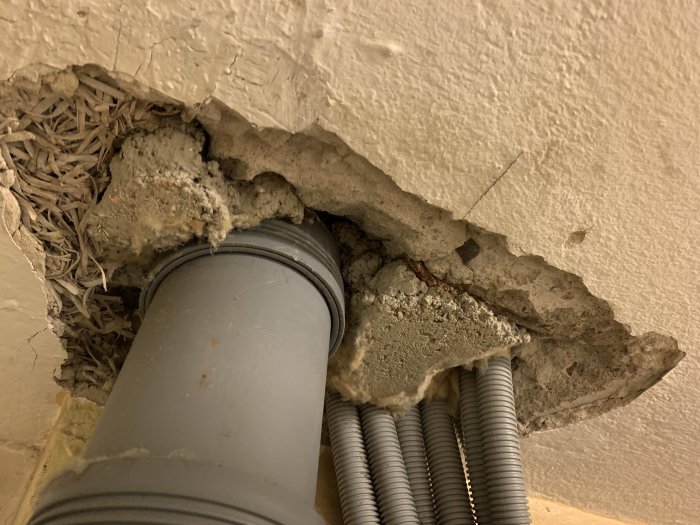
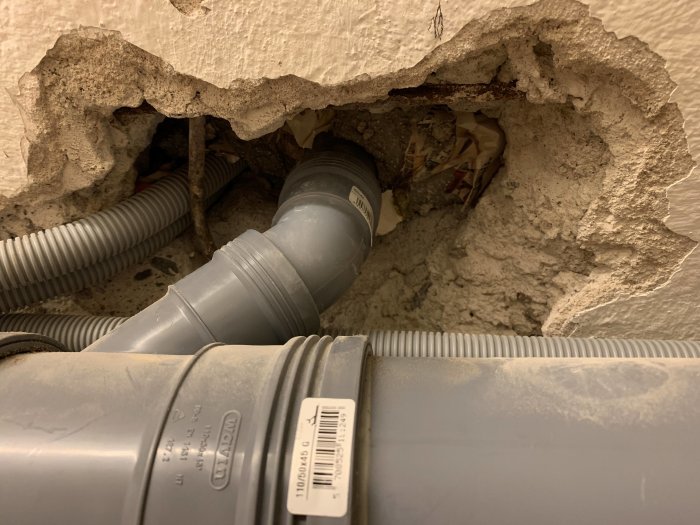
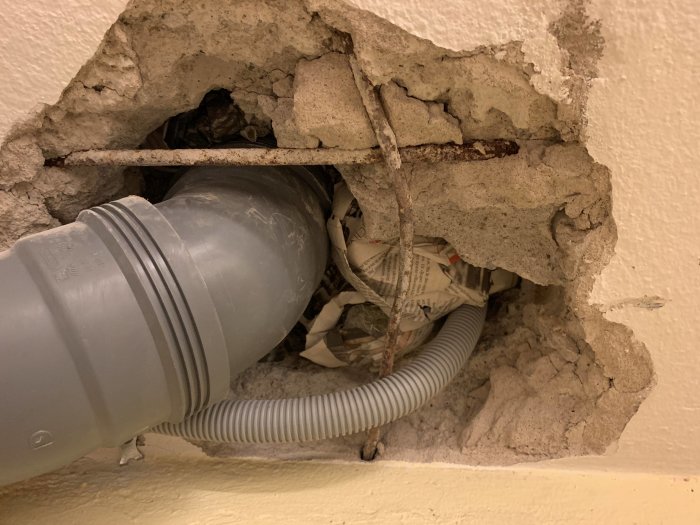
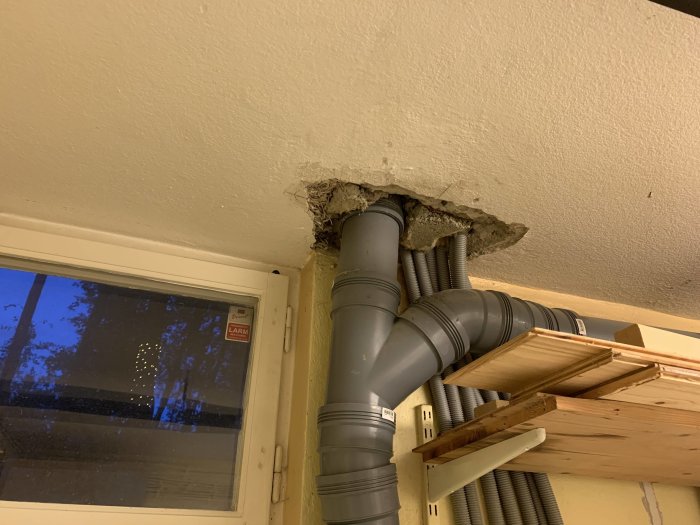
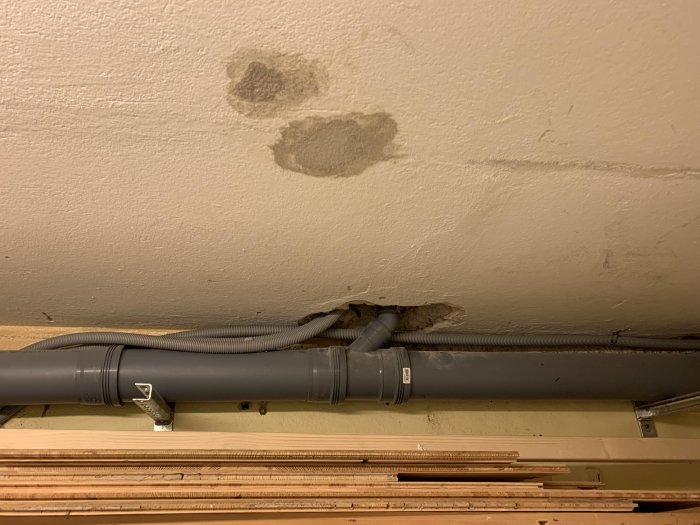
The previous owner carried out a bathroom renovation after a water damage just over 6 years ago, during which new drain and water lines were installed to the bathroom, kitchen, and WC. The lines run through the concrete slab between the basement and the ground floor.
I plan to entertain myself this winter by patching up the holes from below. Above, it is plastered/(cast?) and there is new tile in the WC, sealed in the kitchen under the cabinet, and insulated with foam but the basement ceiling remains unfinished.
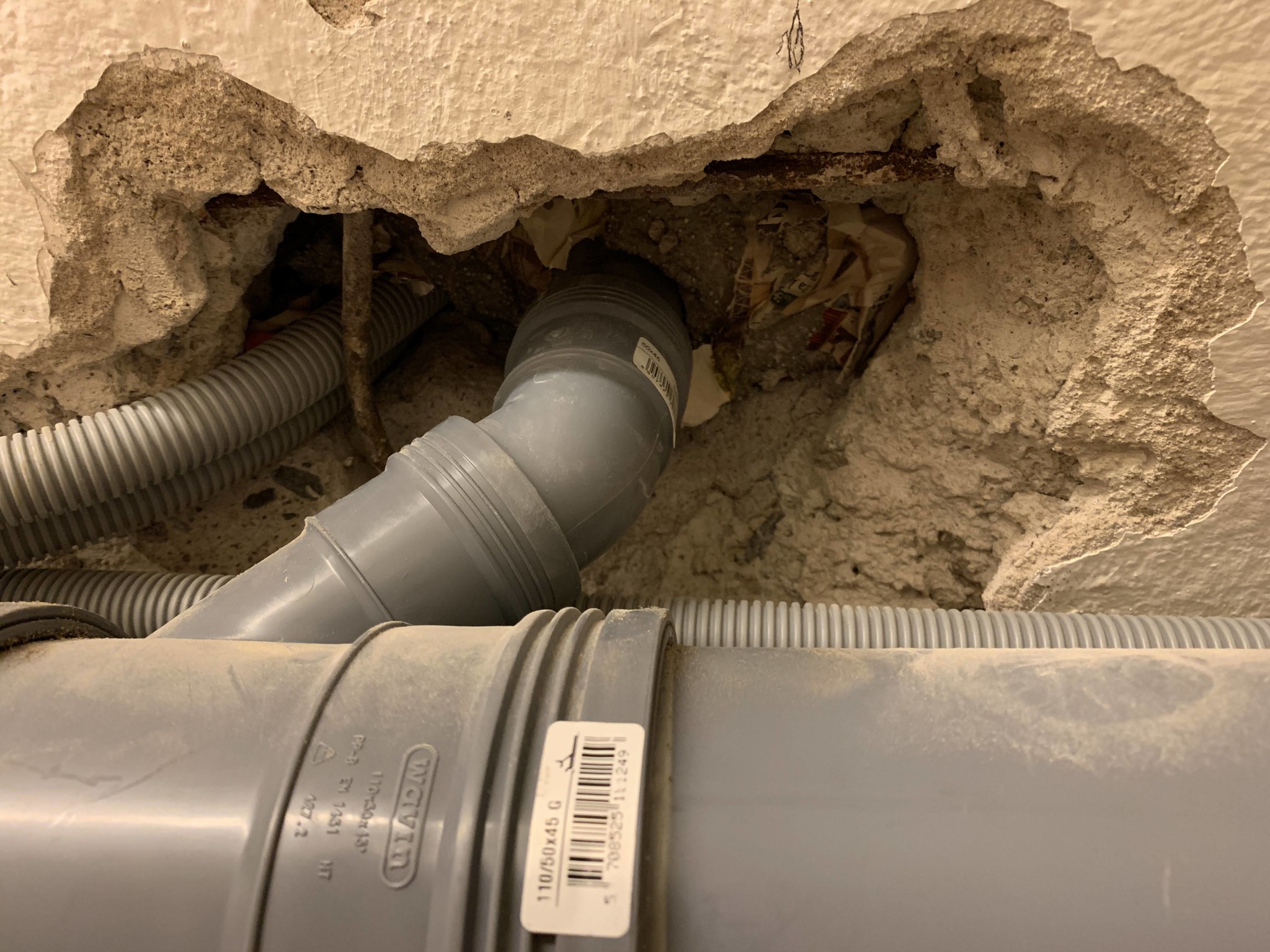
I am thinking of patching the hole with cement mortar-A in stages and then plastering with rendering mortar-C to get an even surface. The choice of rendering mortar-C is because it should work with the existing plaster in the basement ceiling, especially at the part above the basement window where there is träullit.
Does cement mortar-A work for filling in or should I try to plaster with fine concrete or coarse concrete, which I suspect will be too loose to plaster with and must be cast?
Ideally, of course, it would have been best if those who did the contract work had properly sealed the holes from above when it was open, but that was before my time.
In the last picture, you can see a small repair I made a few years ago with rendering mortar-C, which I had left over from another plastering job. It worked well, so I plan to finish with that when I fix the large holes.
Apply plaster mortar C straight through. But you need to fill the large cavities with something because the mortar shrinks. For example, fieldstone, brick that you have cut to fit, or a piece of leca that fits.
Run plaster mortar C throughout. But the large cavities you should fill with something because the mortar shrinks. For example, granite, bricks that you've chopped to fit, or a piece of lecablock.
Hm, fill from below? You mean press smaller pieces of brick/leca/lightweight concrete, with as good a fit as possible, into C-mortar? You'll probably need support from below before the mortar sets, right?
Hm, fill from underneath? You mean pressing smaller pieces of brick/leca/light concrete, with as good a fit as possible, in mortar? You probably need support from below before the mortar sets?
If you wet the surface (spray bottle) and apply the mortar, you can build a couple of cm at a time without it falling down.
Ok, after doing some googling on materials, I’ve decided on the following solution.
Scrape off loose concrete/plaster.
Thin coat with plaster mortar-A (I have half a bag left from summer's repairs/completion of plaster on the outdoor plinth), let dry.
Then water and apply masonry/plaster mortar-C and fit in suitable pieces of leca to fill the holes (leca should bind better than lightweight concrete).
Then finish by plastering with the same plaster and mortar C (weber base 224).
Why not just a bag of gypsum plaster and then you're basically done? Significantly stickier than a cement-based product and much easier to work with on the ceiling. A little chicken wire or similar in the worst-case scenario if there are larger holes to fill so it stays in place.
Why not just a bag of gypsum plaster and then you're basically done? Much stickier than a cement-based product and much easier to work with on ceilings. A little chicken wire or similar in the worst case if there are larger holes to be filled so it stays put
Because I'm cheap No kidding, doesn't it shrink in the same way as plaster? When I've repaired with gypsum plaster, it usually sinks quite a lot, deeper holes always need to be plastered in stages.
It is difficult to plaster ceilings as they are a very hard surface to apply regular mortar (even a or c as you mentioned), and since it is concrete, there are plenty of good products (Sika Quick, sto gm1, ardex a46, Weber ef 260) that you can build up to 5 cm at a time with and are very sticky (still, put some stones in the holes where it is too deep to save money). The ceiling appears to be plastered with c-mortar, so you should keep the concrete a bit away from the finished surface to complete it with c-mortar.
Because I'm cheap Seriously though, doesn't it shrink in the same way as plaster mortar? When I've repaired with gypsum plaster, it usually sinks quite a bit; deeper holes always need to be plastered in rounds.
Is it really gypsum plaster you've used before? Gypsum plaster doesn't shrink, and with suitable mesh or filler material, you can do everything with one bag in one go.
Is it really gypsum plaster you've used before? Gypsum plaster doesn't sink, and with suitable mesh or filling material, you can do everything with one bag in one go.
When I repair smaller holes in plaster, like after tearing down a baseboard, I always use gypsum plaster. It's easier to work with than mortar and dries more quickly. No matter how I mix it, it sinks slightly, so if you want a smooth surface, you have to plaster in stages.
Gypsum plaster doesn't sink!
I would have used it but left the last millimeters and done it in a second round to get a nice surface.
Water with a spray bottle and throw small blobs into the hole. Mix gypsum plaster so you can turn the putty knife upside down and it doesn't wobble if you shake the putty knife.
Click here to reply
Vi vill skicka notiser för ämnen du bevakar och händelser som berör dig.





Claes Sörmland said:
 No kidding, doesn't it shrink in the same way as plaster? When I've repaired with gypsum plaster, it usually sinks quite a lot, deeper holes always need to be plastered in stages.