
11,443 views ·
13 replies
11k views
13 replies
Repair basement wall - which filler/plaster?
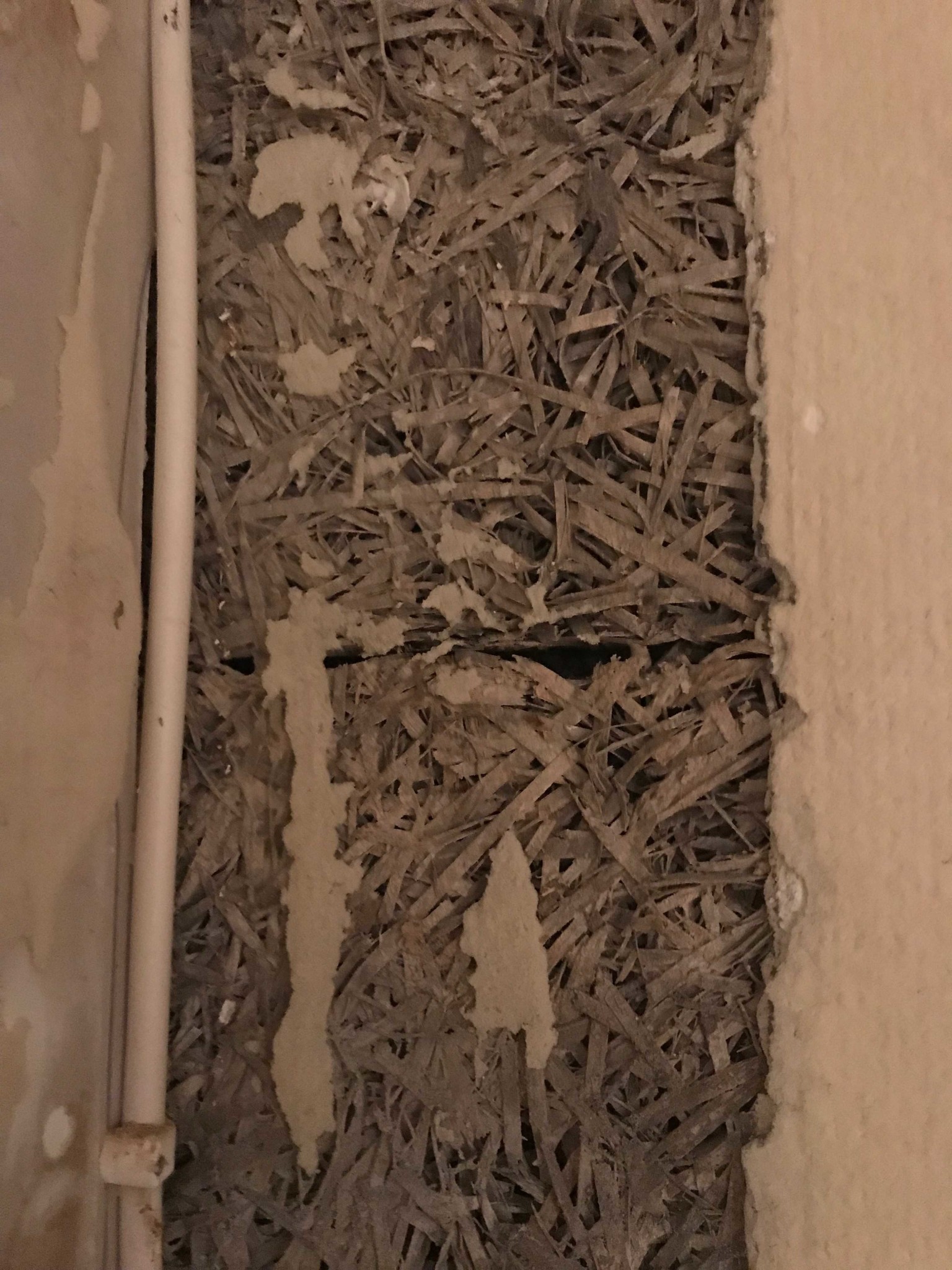
I need to "fill in" a piece of a basement wall (see image) in a house from '68. The base is made of träullit on the wall, but this small piece is unplastered because there was an adjoining wall before that has been removed afterwards.
The thickness of the layer needs to be about 3 cm at its deepest. What should I use? Is there some form of putty that can fix this, or is plaster the way to go? If so, what type of plaster? It would be nice if it could be sanded down fairly easily once it has set.


Well, according to the original poster, this is a basement wall, and if it's a basement wall where moisture might penetrate, I would really stay away from plaster and regular filler due to the risk of it dissolving and falling off over time. However, if there's no risk of penetrating moisture, the products are entirely correct. Otherwise, I would recommend a concrete-based product like Putsbruk.anders07 said:
True in general, but with träullit in the wall, gypsum plaster is probably the least of your worries if moisture were to seep through...slacker said:
Well, according to TS, this is a basement wall, and if it's a basement wall where moisture might potentially seep through, I would really steer clear of gypsum plaster and regular filler due to the risk of them dissolving and eventually detaching. However, if there is no risk of penetrating moisture, then the products are entirely correct. Otherwise, I would recommend a concrete-based product like plaster mortar.
The wood wool appears to be unreinforced, leading me to assume that the house is older. Up until the 1950s, lime mortar/lime plaster was dominant. You can take a piece and try to crumble it between your fingers; if it crumbles easily and you're left with sand and dust, it's likely lime mortar or possibly a very lean KC-mortar. It wasn't as finely industrialized before, and many plasters were mixed on-site, and cement was expensive, making it hard to determine how much cement the plaster might contain.
The "rules" for plastering are to repair with the same quality or weaker. I would look at a hydraulic lime mortar, or a KC50-50, i.e., cement mortar at the strongest. Plaster is not sanded afterward; you scrub to achieve the right surface texture before it hardens too much, i.e., within the first few hours after application depending on the substrate absorption. I would avoid gypsum plaster and filler on exterior walls, which I assume this concerns considering the wood wool.
For lime mortar, the thickness is usually 3 times the grain size per application; cement mortars are generally more generous with thickness. The wood wool should be primed before the real applications, you can visit Träullit's website to download the instructions there.
It’s not specified how large the area is, but if it’s just like the picture, i.e., 15-20cm wide, I would ignore reinforcing if the other walls do not show tendencies of cracking at the joints between wood wool panels. But if it concerns significantly larger areas, I would reinforce at least the joints with a plaster mesh that is about 19x19mm with 1mm thickness on the wires, like serpo 323 or the roll from Biltema which costs 35% of Weber's price for an equivalent product.
The "rules" for plastering are to repair with the same quality or weaker. I would look at a hydraulic lime mortar, or a KC50-50, i.e., cement mortar at the strongest. Plaster is not sanded afterward; you scrub to achieve the right surface texture before it hardens too much, i.e., within the first few hours after application depending on the substrate absorption. I would avoid gypsum plaster and filler on exterior walls, which I assume this concerns considering the wood wool.
For lime mortar, the thickness is usually 3 times the grain size per application; cement mortars are generally more generous with thickness. The wood wool should be primed before the real applications, you can visit Träullit's website to download the instructions there.
It’s not specified how large the area is, but if it’s just like the picture, i.e., 15-20cm wide, I would ignore reinforcing if the other walls do not show tendencies of cracking at the joints between wood wool panels. But if it concerns significantly larger areas, I would reinforce at least the joints with a plaster mesh that is about 19x19mm with 1mm thickness on the wires, like serpo 323 or the roll from Biltema which costs 35% of Weber's price for an equivalent product.
That matches very well; the plaster is white-colored and easy to crumble (you can run your nails on it and see the impression). Could it be lime plaster, then? Do you have an example of a suitable product?K KjellTimell said:The wood wool appears to be unreinforced, leading me to assume that the house is older. Up until the 1950s, lime mortar/lime plaster was dominant. You can take a piece and try to crumble it between your fingers, if it crumbles easily and what's left is sand and dust, it's likely lime mortar, or alternatively a very lean KC mortar. In the past, it wasn't as finely industrialized, and many plasters were mixed on-site plus cement was expensive, making it hard to assess how much cement the plaster might contain.
The "rules" for plastering are to repair with the same quality or weaker. I would have looked at a Hydraulic lime mortar or a KC50-50, i.e., C-mortar as the strongest. Plaster is not sanded down afterward; instead, you scrub to achieve the correct surface texture before it becomes too hard, i.e., within the first few hours after application depending on the substrate's absorption. I would avoid gypsum plaster and filler on exterior walls, which I assume this concerns considering the wood wool.
For lime mortar, it's usually 3 times the grain size in thickness per application, cement mortars tend to be more generous with thickness. The wood wool should be primed before the actual applications; you can visit Träullit's website and download the instructions there.
It doesn't specify how large the surface is, but if it's just like the picture, i.e., 15-20cm wide, I would skip reinforcing if the remaining walls don't show tendencies to crack at the joints between wood wool panels. However, if it's significantly larger areas, I would have reinforced at least the joints with a plaster net that's about 19x19mm and 1mm thickness on the wires, like Serpo 323 or the roll from Biltema, which costs 35% of Weber's price for an equivalent product.
It's a limited area of about 20 cm x 1.5 m that needs to be plastered.
Yes, it sounds like lime plaster. However, it's difficult to say if it contains a touch of cement as well without doing a 10kkr analysis, which is a bit overkill. But if you go with a lime mortar, you can't go wrong.
A regular C-mortar is almost impossible to crumble between your fingers or scratch with a nail and has a greyer shade, while lime plaster has a whiter shade.
A hydraulic lime mortar from Finja or Weber would probably work, these correspond to NHL5, i.e., a strong hydraulic mortar. You should actually use a slightly weaker one if you can scratch it with a nail without damaging the nail. Rather NHL2 or NHL3.5.
I had similar plaster like yours in the basement that I repointed this week, I went with an NHL2 mortar after a recommendation from Målarkalk. Their mortars are more geared towards restorations and listed buildings and are thus more expensive than Finja and Weber. If you live in Stockholm, you can buy these from Bygma brick sales in Högdalen.
A regular C-mortar is almost impossible to crumble between your fingers or scratch with a nail and has a greyer shade, while lime plaster has a whiter shade.
A hydraulic lime mortar from Finja or Weber would probably work, these correspond to NHL5, i.e., a strong hydraulic mortar. You should actually use a slightly weaker one if you can scratch it with a nail without damaging the nail. Rather NHL2 or NHL3.5.
I had similar plaster like yours in the basement that I repointed this week, I went with an NHL2 mortar after a recommendation from Målarkalk. Their mortars are more geared towards restorations and listed buildings and are thus more expensive than Finja and Weber. If you live in Stockholm, you can buy these from Bygma brick sales in Högdalen.
It can work, and it can crack at the seam. Lime and C-mortar have different elasticity/movement abilities. Even when repairing facades, it is recommended not to mix types of mortar; it is common to knock off loose parts and replaster.
Sure, you get 3 sacks of C-mortar for the price of one lime mortar sack. But in your case, it's such a small area, so one sack should be enough. If the availability of lime mortar is inconvenient, check with Beijer if you have one nearby, they usually have a good range of mortars.
Sure, you get 3 sacks of C-mortar for the price of one lime mortar sack. But in your case, it's such a small area, so one sack should be enough.
If the availability of lime mortar is inconvenient, check with Beijer if you have one nearby, they usually have a good range of mortars.
Click here to reply