

Hobby carpenter
· Västmanland
· 214 posts
I have some plans for my little workshop. When we moved to this house, one of the things I looked forward to was a bigger workshop (compared to a corner in our old garage).
And even though I can dream about building a properly large workshop, one should make the best of what they have. Right now, I've put up benches along the walls and the saw table against one of them. It's not exactly cramped, but it feels a bit thoughtless. So, I have plans!
The Storage
The workshop is in what used to be the storage for the house, and we also have a shed out back where things stored in the storage are kept. So this space can be just a workshop, which is wonderful.
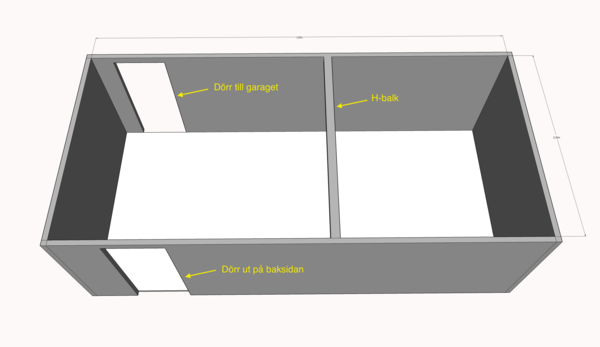
Through the room runs a large H-beam that won't be moving anytime soon. Then we have two doors at one end. Otherwise, it's free for the imagination
Work Area
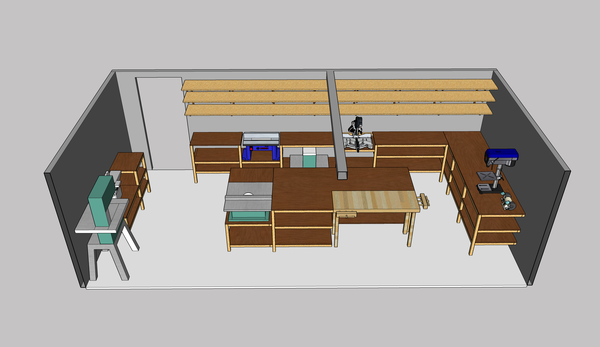
So here's the idea: bring in a large work table in the middle, which is 240x120cm to accommodate whole sheets when needed. Integrated into it is a joinery bench from Sjöbergs.
Then a bench along one wall to cut longer boards. Then a smaller table between the doors and a larger table at the higher end for various bench tools.
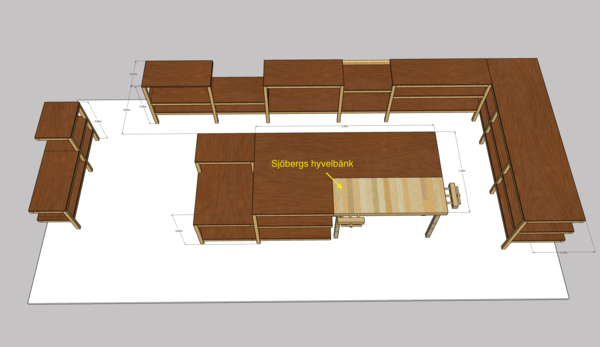
All tables are attached to beams screwed directly to the wall
Tools
The placement of tools is thought so that the miter saw should obviously be on the long side (where I actually have it today) along with the router table which has no height adjustment. Under that table, a planing machine is placed on a shelf that can be pulled out when needed, it's okay that it's not at bench level.
On the small table stands a jointer that must be adjustable in height and therefore doesn't fit in the same line as the miter saw, and next to it stands the band saw.
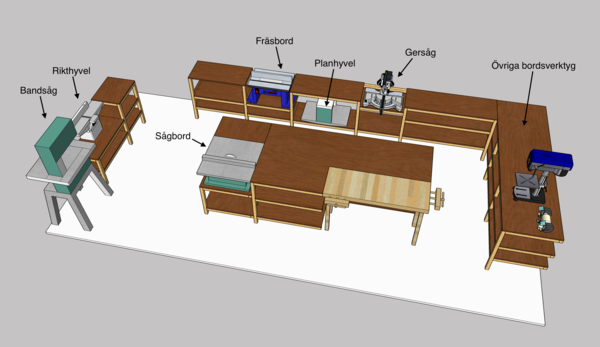
In the middle, of course, is the saw table integrated into the large work table.
Sheet Material
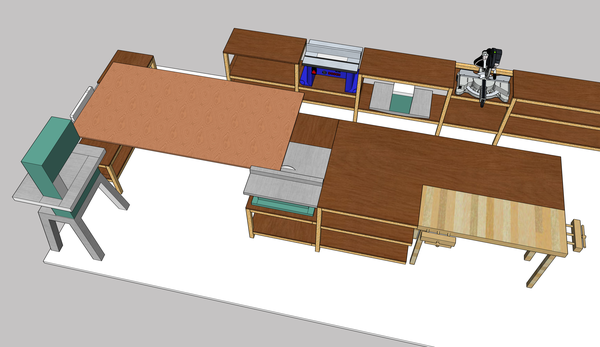
I worked a lot to get it so I can cut sheet material on the table saw, and with this setup, the sheet can lean against the jointer, which then functions as a little input table to the saw.
Shelves
And then a plethora of shelves for lumber and other things. On the other walls, there will be tool boards as needed.
Dust Collection
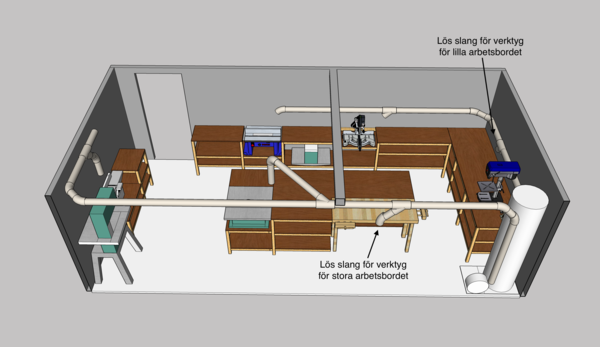
Then we come to the dust collection system. Today I have a tiny one standing under a table with a bunch of flexible pipes running everywhere, but they get clogged all the time, and I want to get a proper dust collector. In the sketch here, I have run the pipes over the machines along the wall and avoided 90-degree bends. The idea is that where each pipe ends, there should be a gate and then a flexible hose down to the machine.
The collector for the saw is a bit trickier, though. The pipe needs to continue to the jointer but must also go under the H-beam. Since I don't want to make a turn "around" the beam, it must be mounted on the wall at a height below the beam, then from the saw table, a branch goes out and then comes down from the ceiling, so I'll have a hole in the work table for the hose then.
But I welcome comments on the setup of the workshop and so on, have I thought correctly, what am I missing, etc.?
And even though I can dream about building a properly large workshop, one should make the best of what they have. Right now, I've put up benches along the walls and the saw table against one of them. It's not exactly cramped, but it feels a bit thoughtless. So, I have plans!
The Storage
The workshop is in what used to be the storage for the house, and we also have a shed out back where things stored in the storage are kept. So this space can be just a workshop, which is wonderful.
Through the room runs a large H-beam that won't be moving anytime soon. Then we have two doors at one end. Otherwise, it's free for the imagination
Work Area
So here's the idea: bring in a large work table in the middle, which is 240x120cm to accommodate whole sheets when needed. Integrated into it is a joinery bench from Sjöbergs.
Then a bench along one wall to cut longer boards. Then a smaller table between the doors and a larger table at the higher end for various bench tools.
All tables are attached to beams screwed directly to the wall
Tools
The placement of tools is thought so that the miter saw should obviously be on the long side (where I actually have it today) along with the router table which has no height adjustment. Under that table, a planing machine is placed on a shelf that can be pulled out when needed, it's okay that it's not at bench level.
On the small table stands a jointer that must be adjustable in height and therefore doesn't fit in the same line as the miter saw, and next to it stands the band saw.
In the middle, of course, is the saw table integrated into the large work table.
Sheet Material
I worked a lot to get it so I can cut sheet material on the table saw, and with this setup, the sheet can lean against the jointer, which then functions as a little input table to the saw.
Shelves
And then a plethora of shelves for lumber and other things. On the other walls, there will be tool boards as needed.
Dust Collection
Then we come to the dust collection system. Today I have a tiny one standing under a table with a bunch of flexible pipes running everywhere, but they get clogged all the time, and I want to get a proper dust collector. In the sketch here, I have run the pipes over the machines along the wall and avoided 90-degree bends. The idea is that where each pipe ends, there should be a gate and then a flexible hose down to the machine.
The collector for the saw is a bit trickier, though. The pipe needs to continue to the jointer but must also go under the H-beam. Since I don't want to make a turn "around" the beam, it must be mounted on the wall at a height below the beam, then from the saw table, a branch goes out and then comes down from the ceiling, so I'll have a hole in the work table for the hose then.
But I welcome comments on the setup of the workshop and so on, have I thought correctly, what am I missing, etc.?
One thing I react to is the size of the workbench in the middle. If it's that big just to handle splitting entire sheets, it's unnecessarily large, which makes it more cramped around it.
As long as there's support under 51% of the sheet, it will stay put. For sheets of standard size, 130cm measured from the rear edge of the blade is enough. Then, of course, it can be practical to have a larger surface for other reasons. But it looks a bit unnecessarily cramped, especially considering that, according to the sketch, you have to place the sheet all the way against the wall to be able to split it.
As long as there's support under 51% of the sheet, it will stay put. For sheets of standard size, 130cm measured from the rear edge of the blade is enough. Then, of course, it can be practical to have a larger surface for other reasons. But it looks a bit unnecessarily cramped, especially considering that, according to the sketch, you have to place the sheet all the way against the wall to be able to split it.
Hobby carpenter
· Västmanland
· 214 posts
I understand your thinking, but my idea is that if the workbench is exactly 120x240, I can work with entire sheets directly on the table. If I'm splitting them in width, it would be so nice to lay them down and use the plunge saw with 100% support everywhere.Emil_K said:One thing I notice is the size of the workbench in the middle. If it's that large just to handle the splitting of entire sheets, then it's unnecessarily large, making it more cramped around it.
As long as there's support under 51% of the sheet, it will stay in place. For standard-sized sheets, 130cm from the back edge of the blade is sufficient. Of course, it can be practical to have a larger surface for other reasons as well. But it looks somewhat unnecessarily cramped, especially considering that, according to the sketch, you have to place the sheet right against the wall to split it.
And since the saw table's blade is not on the right edge, but rather about 40 cm in from the right edge, if I want to cut 10 cm off the length of a sheet, I'm only using 70 cm of the table's width, which is just over 50%
 I know you meant lengthwise in your example, but the same applies widthwise.
As for space, there's 80+ cm around the long sides and 90+ cm on the high short side to move around. In my head, it sounds okay, but of course, I will measure it when the room is empty and feel it out to be sure. Thanks for your feedback!
Hobby carpenter
· Västmanland
· 214 posts
They will be placed in a sheet rack I'm going to build in the garage, which is wall-to-wall with the workshop; they simply don't fit inside the workshop. The shelves on the far wall will hold some wood that fits, but sheet materials will be in the garage.Oldboy said:
Hobby carpenter
· Västmanland
· 214 posts
Now I have torn everything out! Here is a video about my workshop remake, part one:
Hobby carpenter
· Västmanland
· 214 posts
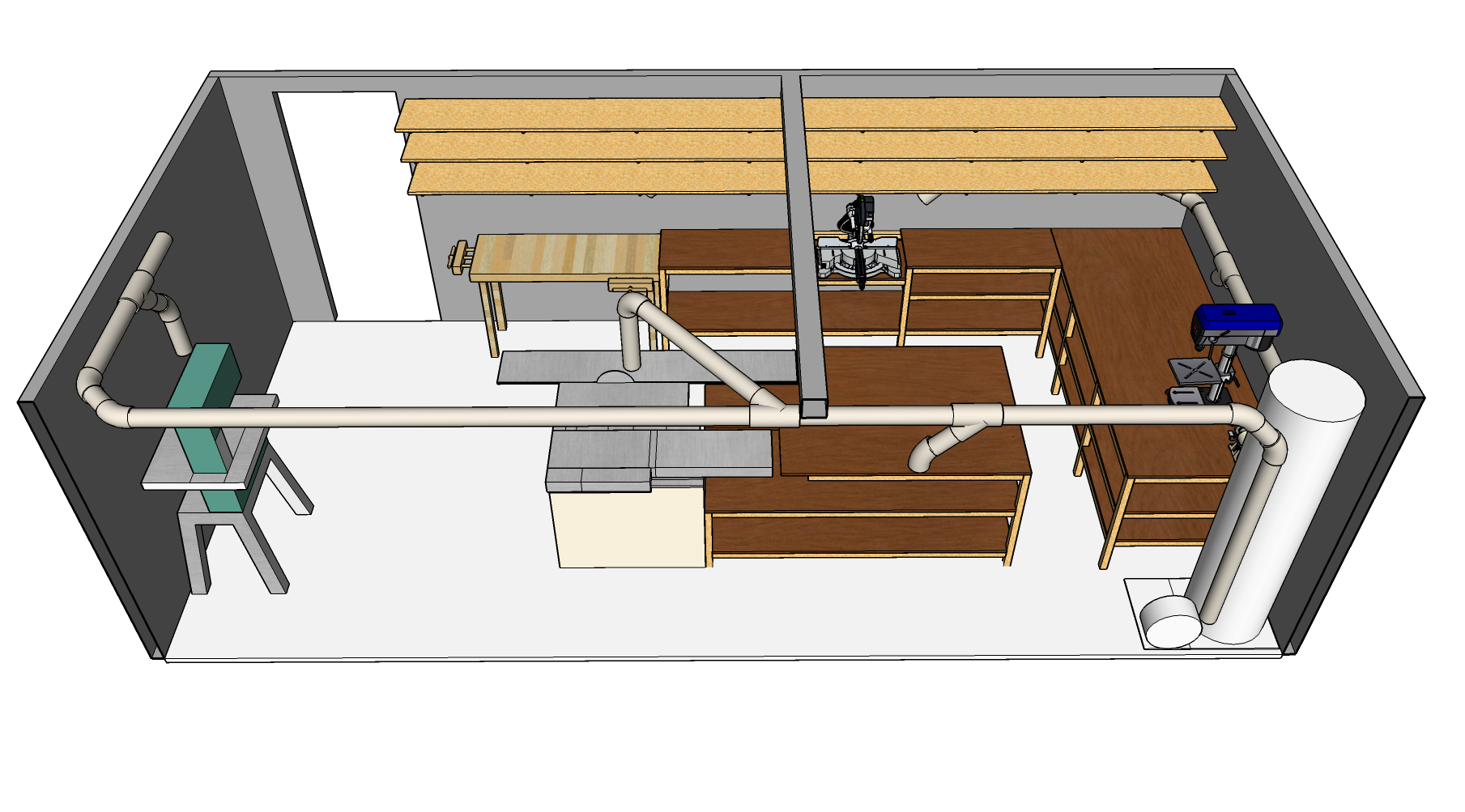
The new plans for the workshop look like this:
A couple of thoughts:
The bandsaw seems to be facing the wrong way, or is it just the picture?
Since it's against the wall, you can't cut longer than about 30 cm?
Shouldn't it be turned so you can continue with the wood pieces out through the door?
Or is it on wheels?
Perhaps the most important aspect is what you will be doing in the workshop?
There's quite a difference between house building, furniture making, and, for example, model building. Both in space requirements and in the machine park, as well as access to shelves and cabinets.
For me, mostly doing house fixes, I think a centrally located moderately sized workbench and plenty of space all around is best. Then some movable roller stands and preferably a couple of sawhorses. The trickiest part is handling and turning 3-5 m long boards and beams.
The bandsaw seems to be facing the wrong way, or is it just the picture?
Since it's against the wall, you can't cut longer than about 30 cm?
Shouldn't it be turned so you can continue with the wood pieces out through the door?
Or is it on wheels?
Perhaps the most important aspect is what you will be doing in the workshop?
There's quite a difference between house building, furniture making, and, for example, model building. Both in space requirements and in the machine park, as well as access to shelves and cabinets.
For me, mostly doing house fixes, I think a centrally located moderately sized workbench and plenty of space all around is best. Then some movable roller stands and preferably a couple of sawhorses. The trickiest part is handling and turning 3-5 m long boards and beams.
Hobby carpenter
· Västmanland
· 214 posts
I usually don't saw larger pieces of wood on the bandsaw, which is a smaller model, and yes, it is movable if neededOldboy said:
As a workshop, it is small, definitely, but I think I have arranged things to suit my needs best. Previously, I only had the benches along the walls but missed the possibility that a large central bench provides, where you can work from multiple sides. So I have worked based on that logicPerhaps the most important aspect is what you will be doing in the workshop?
There's a big difference between house construction, furniture making, and model building. Partly in space requirements and partly in the machinery, as well as access to shelves and cabinets.
For me, mostly working with house repairs, I think a centrally located moderately large workbench and plenty of space in all directions is best. Then some movable roller supports and preferably a couple of sawhorses. The trickiest part is handling and turning/rotating 3-5 m long boards and beams.
Hobby carpenter
· Västmanland
· 214 posts
Here are parts two and three of my workshop remake:
And the first little project in the new workshop:
And the first little project in the new workshop:
Click here to reply