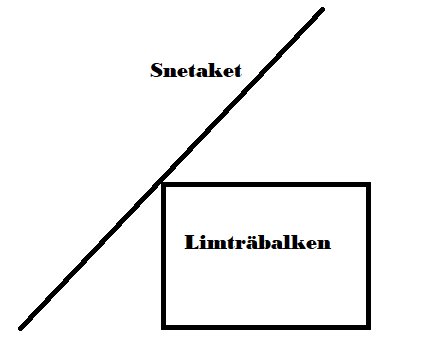
I have a house from the 1930s where I want to dismantle a dormer. The wall that supports the rafters is slanted with about a 45-degree angle. The wall is load-bearing. I'm wondering how you relieve a slanted roof? Do I cut out a fitting piece for the entire wall that should be between the glulam beam and the roof, or do I open up the roof and expose each rafter and then cut notches in the glulam beam for each rafter? (The latter option feels a bit off).
If you have an original sectional drawing as well as a floor plan of the attic, that is the best basis. Also, let us know how you want to use the space when you remove the "kattvinden". Information about the snow zone is also important.
The problem with load-bearing changes is that the roof loads need to be redirected to the foundation another way, which can lead to quite extensive measures.
Here are drawings from 1942. It is the wall with the red arrow that I want to remove and use the space as a closet. The snow zone is 1.5 according to boverket.
There are three different ways to do it. One, replace the knee wall with a beam. The ends of the beam must rest on columns or existing walls so that the loads can be transferred down to the foundation. Two, reinforce the rafters' struts so that they can handle the extended span that will occur. Three, replace the wall with columns in the middle of each floor joist. The second option is a better solution because the roof loads are more evenly distributed and the reinforcement encroaches less on the free height in the room. The third option is incomparably the cheapest and least invasive.
Thank you so much for the answers! I was thinking about option 1, how do I attach the beam upwards to the sloping wall? As I showed in the picture in my first post.