
6,929 views ·
22 replies
7k views
22 replies
Recasting drainage channels ????
Hehe, 90% is probably just Portland cement, aggregate, and water, and maybe a superplasticizer.2 2 loud said:TOTALLY RIGHT, the whole city is full of concrete. BUT, as I was informed in the "specialty store world," it must be frost-resistant. And sure, you see a lot of concrete everywhere but there is hardly a "content list" painted on it, so ... there are lots of different concretes, but now I feel fairly confident in your answers.
It’s a bit like you only have one attempt. You can mix a few liters first and pour it into an ICA bag and feel how it behaves.
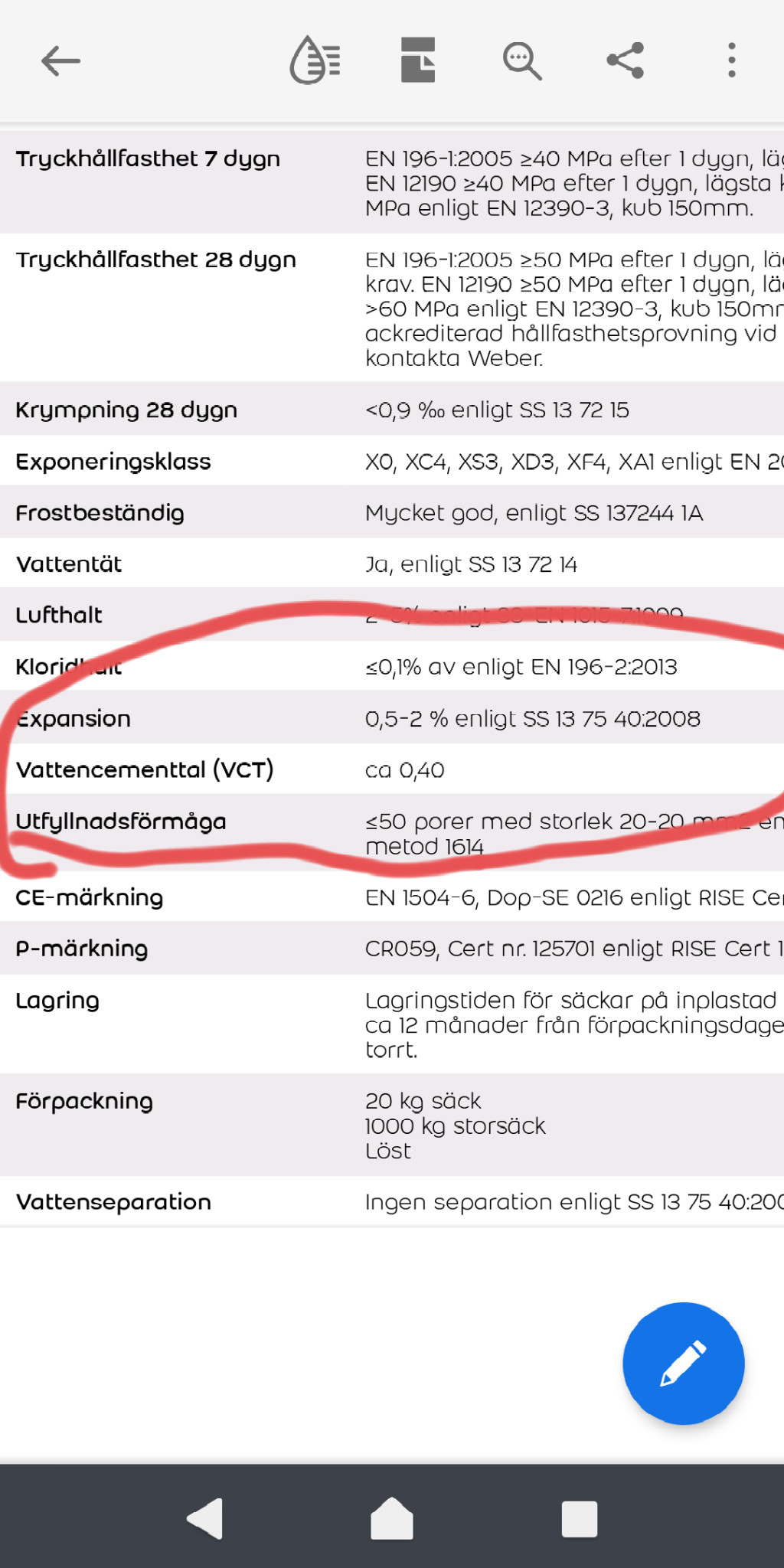
So, if you read the specification, it states that the different expansive concrete I've seen expands about the same amount as regular concrete shrinks, around 1%. Weber, for example.C C.Lundin said:
Then you need to read again. Since you use Weber as an example, we can continue on that track.Andreas Lundgren said:
It only states that it doesn't shrink more than 0.09%.
If you've read something else, feel free to link to it.
As an addition, I can also point out that far from all concrete is frost-resistant. However, most ready-made expanding concrete products usually are.
That's good, but you should be critical online and check sources! I picked the product sheet of a product at random from Weber, https://www.se.weber/produkter-betongcementvagglagning/expanderbetongelementfog/weber-exm-702C C.Lundin said:
I'm not so stubborn that I can't admit I was wrong.That's good, but be critical online and check the source!
I randomly took the product sheet for a product from weber, [link]
[image]
Do you have any example of concrete that is not frost-resistant? You're probably right that it exists, I've just never seen any. But I'm certainly not claiming to have seen everything that's out there, I would have gladly learned.
I must have found some reduced data sheet because it wasn't in what I read.
But regardless, a few percent, if you use this product, are negligible on such a small casting.
Are you thinking of bag now? If so, the answer is no, I don't know anyone off the top of my head. It's probably the case that most bags are at least XF2 or XF3. But otherwise, there is no reason to order frost-resistant concrete if the need isn't there.
I agree that it is largely negligible; here, it has somewhere to expand too.C C.Lundin said:I'm not above admitting that I was wrong.
I must have found some condensed data sheet because it wasn't in what I read.
But regardless, some %, if you're using this product, is negligible in such a small casting.
Are you thinking about a sack now? If so, the answer is no, I don't know anyone off the top of my head. It's certainly the case that most sacks are at least on XF2 or XF3. But otherwise, there's no reason to order frost-resistant concrete if there's no need for it.
[/QUOTE][/QUOTE]That's good, but you should be critical on the internet and check the source!
I took the datasheet of a product at random from weber, [link]
[image]
Do you have any examples of concrete that is not frost-resistant? You're probably right that it exists, I've just never seen any. But I absolutely don't claim to have seen everything that exists, I would love to learn.
In the datasheet, you have highlighted Expansion 0.5-2.0%
Six lines above it says Shrinkage 28 days <0.9%
How does that work? Does the concrete expand first during curing and shrink a little when it dries out, with a small expansion remaining?
Now I've learned something new, and @C.Lundin is probably the one who was most correct on the matter!
First of all, the shrinkage is in permille, not percent as written above, but the fact remains.
Asked Weber and got the following reply:
Hello again! Here comes an explanation from Martin who is in charge of Weber's concrete range.
Weber EXM 725 is an expansive concrete whose function, among other things, is to slightly expand during the fresh mortar time (about 30 minutes after mixing), this is to properly fill any formwork or underpinning and prevent gaps or air pockets from occurring. Thereafter, the material begins to harden or set as it is called in concrete terms. When the concrete sets, there is a slight shrinkage in connection with the water being chemically bound in the concrete matrix, this shrinkage is what is indicated on the product sheet.
So in short, the concrete swells in fresh condition and shrinks in hardened condition. The expansion is measured in the fresh state and the shrinkage is measured according to the standard after one day, which is why these values set against each other are a bit contradictory. If you were to measure shrinkage from the time you just mixed EXM 725 it would thus only be a matter of expansion.
Sincerely,
Maria, Weber
First of all, the shrinkage is in permille, not percent as written above, but the fact remains.
Asked Weber and got the following reply:
Hello again! Here comes an explanation from Martin who is in charge of Weber's concrete range.
Weber EXM 725 is an expansive concrete whose function, among other things, is to slightly expand during the fresh mortar time (about 30 minutes after mixing), this is to properly fill any formwork or underpinning and prevent gaps or air pockets from occurring. Thereafter, the material begins to harden or set as it is called in concrete terms. When the concrete sets, there is a slight shrinkage in connection with the water being chemically bound in the concrete matrix, this shrinkage is what is indicated on the product sheet.
So in short, the concrete swells in fresh condition and shrinks in hardened condition. The expansion is measured in the fresh state and the shrinkage is measured according to the standard after one day, which is why these values set against each other are a bit contradictory. If you were to measure shrinkage from the time you just mixed EXM 725 it would thus only be a matter of expansion.
Sincerely,
Maria, Weber
Click here to reply