
24,726 views ·
40 replies
25k views
40 replies
Raising the ground over basement window, building a "light well"
Page 1 of 3
S
SueCia
Electronics enthusiast
· Dalarna
· 5 534 posts
SueCia
Electronics enthusiast
- Dalarna
- 5,534 posts
As the topic states, I need to raise the ground a bit above my basement window because the slope is wrong. I was thinking of building a small "frame" around the window so I can raise the ground around it without the window getting flooded. I have never done any masonry work, though, are lecablocks good for this purpose? I saw that byggmax had a fairly narrow lecablock, but without grooves for reinforcement, how do you reinforce such a block? I assume I need to reinforce? Should I attach the construction to the house foundation or should it be standalone? If I attach it to the house, I'm worried that settlements will crack the house wall.

Self-builder
· Stockholm
· 8 592 posts
Haven't built anything like that myself, but consider the ground pressure - there can be quite a bit of soil pressing - lecablock might not be the sturdiest? Maybe it can be reinforced so these work, but I've probably never seen such a caisson made of leca - they are usually concrete.
L-elements, where the L-part is underground, might be the best, or casting - the question is if there aren't ready-made caisson parts (e.g., http://www.steriks.se/sv/Produktsortiment/Murar/Stodmurar-L-stod/L-stod-20-kNm2-not-not/)?
Saw another discussion that might be relevant...
https://www.byggahus.se/forum/grund-markarbeten/13840-stodmur-lattklinker-eller-l-block.html
/K
L-elements, where the L-part is underground, might be the best, or casting - the question is if there aren't ready-made caisson parts (e.g., http://www.steriks.se/sv/Produktsortiment/Murar/Stodmurar-L-stod/L-stod-20-kNm2-not-not/)?
Saw another discussion that might be relevant...
https://www.byggahus.se/forum/grund-markarbeten/13840-stodmur-lattklinker-eller-l-block.html
/K
Last edited:
There's not really any ground pressure to speak of when you're going to pour a "well" in front of a basement window?
The window is currently above ground level and the well is (probably?) just going to be dug a bit below the window and then raised enough to allow for the ground level to be elevated a couple of decimeters?
If you then excavate in front of the window and lay a foundation with compacted crushed stone, then build a form for the well and pour it, it should be strong enough, right?
You can/should probably tie the well's reinforcement with some rebar drilled into the basement wall (depending on the material, maybe some fasteners are needed?).
I find it hard to see that it would bear so much load that it couldn't withstand the slight ground pressure. A little platonmatta or similar on the outside and an embedded drainage for rainwater should take care of water/moisture.
If you want to stack some narrow lecablock as mentioned, you would at least need to pour a slab to set them on and then plaster the outside before platon and the inside as well, right?
With blocks leaning against the basement wall and then blocks perpendicular outside supporting them is an alternative, but it must be reinforced if the blocks aren't full-length, and reinforcement between layers becomes tricky as there aren't any grooves in those blocks.
As I see it, in that case, it's probably just as well to pour everything in one piece?
The window is currently above ground level and the well is (probably?) just going to be dug a bit below the window and then raised enough to allow for the ground level to be elevated a couple of decimeters?
If you then excavate in front of the window and lay a foundation with compacted crushed stone, then build a form for the well and pour it, it should be strong enough, right?
You can/should probably tie the well's reinforcement with some rebar drilled into the basement wall (depending on the material, maybe some fasteners are needed?).
I find it hard to see that it would bear so much load that it couldn't withstand the slight ground pressure. A little platonmatta or similar on the outside and an embedded drainage for rainwater should take care of water/moisture.
If you want to stack some narrow lecablock as mentioned, you would at least need to pour a slab to set them on and then plaster the outside before platon and the inside as well, right?
With blocks leaning against the basement wall and then blocks perpendicular outside supporting them is an alternative, but it must be reinforced if the blocks aren't full-length, and reinforcement between layers becomes tricky as there aren't any grooves in those blocks.
As I see it, in that case, it's probably just as well to pour everything in one piece?
S
SueCia
Electronics enthusiast
· Dalarna
· 5 534 posts
SueCia
Electronics enthusiast
- Dalarna
- 5,534 posts
My thought (have exactly zero masonry experience, never even participated in it) was just to dig out and then add macadam and level it, then build with lecablocks standing on the gravel. What I was unsure about was whether this would hold. And it seems like it might not.Testarn said:There's not really any ground pressure to speak of when you're going to cast a "well" in front of a basement window, right?
The window is above ground today, and the well should (probably?) go a bit below the window and then up just enough so that you can raise the ground level a few decimeters.
If you then dig out in front of the window and lay a foundation with compacted macadam, and then build a form for the well and cast it, it should be strong enough, right?
You can/should probably tie the well's reinforcement with some rebar drilled into the basement wall (depending on the material, maybe some fastening element is needed?).
I find it hard to see that there would be so much load on it that it wouldn't hold against the little ground pressure that there is. Some Platon mat or similar on the outside and an embedded drainage for rainwater should take care of water/moisture.
If you want to stack some narrow lecablocks as mentioned, you must at least cast a slab to place them on and then plaster the outside before Platon and the inside as well?
With blocks standing against the basement wall and then blocks perpendicular outside supporting against them, it's indeed an alternative, but it has to be reinforced unless the blocks are full-length, and reinforcement between shifts becomes tricky as there are no grooves in those blocks.
As I see it, in that case, it's just as well to cast everything in one piece?
Casting in concrete sounds like a better idea then, the question is, does it need to be anchored to the house foundation at all? I'm a bit worried about frost heave underneath pushing against the "well" and breaking the house foundation.
No, the concrete caisson does not need to be anchored to the house foundation. You can cast the concrete all the way up but with a piece of construction plastic in between. However, the gap should be sealed so that no water runs in that way.
You probably don't need to tie the basement wall to the caisson if you're worried; you can use a soft joint between the parts. However, this would probably require a better foundation with gravel and packing it so that the caisson doesn't sink after a season and create a larger gap between the wall and the caisson.
I wouldn't be concerned about frost heave on that small area pushing against the basement wall, but I don't know what your ground conditions are or, for that matter, what type of basement wall it is.
I wouldn't be concerned about frost heave on that small area pushing against the basement wall, but I don't know what your ground conditions are or, for that matter, what type of basement wall it is.

Not my area of expertise, but if you place cellular plastic under the concrete slab, the risk of frost heave should also decrease. If you place Platon mat on the outside of the caisson and extend it a meter onto the basement wall on either side of the caisson and seal with suitable sealing goo at the ends of the Platon mat, it should prevent any water from coming in that might risk leaking out of any gap between the caisson and the basement wall.
I am quite convinced that leca will suffice in this case. I assume that the "well" is to be built as a U, therefore it will naturally get support against the ground pressure.
Of course, it will be better and have a longer lifespan with concrete, but it's significantly more work to build a form and cast than to build a leca wall that is then rendered.
Of course, it will be better and have a longer lifespan with concrete, but it's significantly more work to build a form and cast than to build a leca wall that is then rendered.
S
SueCia
Electronics enthusiast
· Dalarna
· 5 534 posts
SueCia
Electronics enthusiast
- Dalarna
- 5,534 posts
I don't really know what kind of cellar wall it is, it's easy to drill with a regular hammer drill anyway.Testarn said:You probably don't need to connect the cellar wall with the caisson if you're worried; you can put a flexible sealant between the parts, but this might require better groundwork with macadam and packing it so that the caisson doesn't sink after a season and create a larger gap between the wall and the caisson.
I wouldn't be worried about frost heave on the small area that could damage the cellar wall, but I don't know what your ground conditions are or what kind of cellar wall you have?
I was thinking of starting this project tomorrow, is this the right method if I'm going to cast a slab:
Dig down a couple of decimeters, fill up with macadam, is it enough to just tamp it down a bit to compress? Should give a better result than a lighter vibrating plate anyway?
On top of the macadam, I lay insulation foam that is a few cm larger than the caisson is supposed to be.
Build a wooden frame to match the bottom of the caisson, prepare with drain pipes and grate and reinforcement.
Cast a slab of 5-10 cm? What is sufficient here?
Wait until it has set enough, maybe 48 hours?
Build a frame for the walls of the caisson that I place on the slab and get it right somehow.
I've probably decided to cast, mostly because it feels like a manageable project to learn how to cast.

Absolutely right
Just an addition: after you've leveled the concrete on the slab, insert rebar (about every 20 cm) around the edge of the slab, which should then end up in the middle of the upcoming wall. Then bend rebar into large U-shapes that will run horizontally in the wall, tying these to the protruding rebars to form a mat with large mesh.
Remember that rebar should not be closer than 3 cm to the finished concrete surface, preferably 5, due to the risk of rusting and resulting cracked concrete. The slab doesn't need to be too thick, but 5 cm is probably the minimum.
EDIT: Yes, it's enough to tamp down the macadam, but don't spread more than a few cm thick layers at a time if you're packing it with your feet.
Just an addition: after you've leveled the concrete on the slab, insert rebar (about every 20 cm) around the edge of the slab, which should then end up in the middle of the upcoming wall. Then bend rebar into large U-shapes that will run horizontally in the wall, tying these to the protruding rebars to form a mat with large mesh.
Remember that rebar should not be closer than 3 cm to the finished concrete surface, preferably 5, due to the risk of rusting and resulting cracked concrete. The slab doesn't need to be too thick, but 5 cm is probably the minimum.
EDIT: Yes, it's enough to tamp down the macadam, but don't spread more than a few cm thick layers at a time if you're packing it with your feet.
Last edited:

S
SueCia
Electronics enthusiast
· Dalarna
· 5 534 posts
SueCia
Electronics enthusiast
- Dalarna
- 5,534 posts
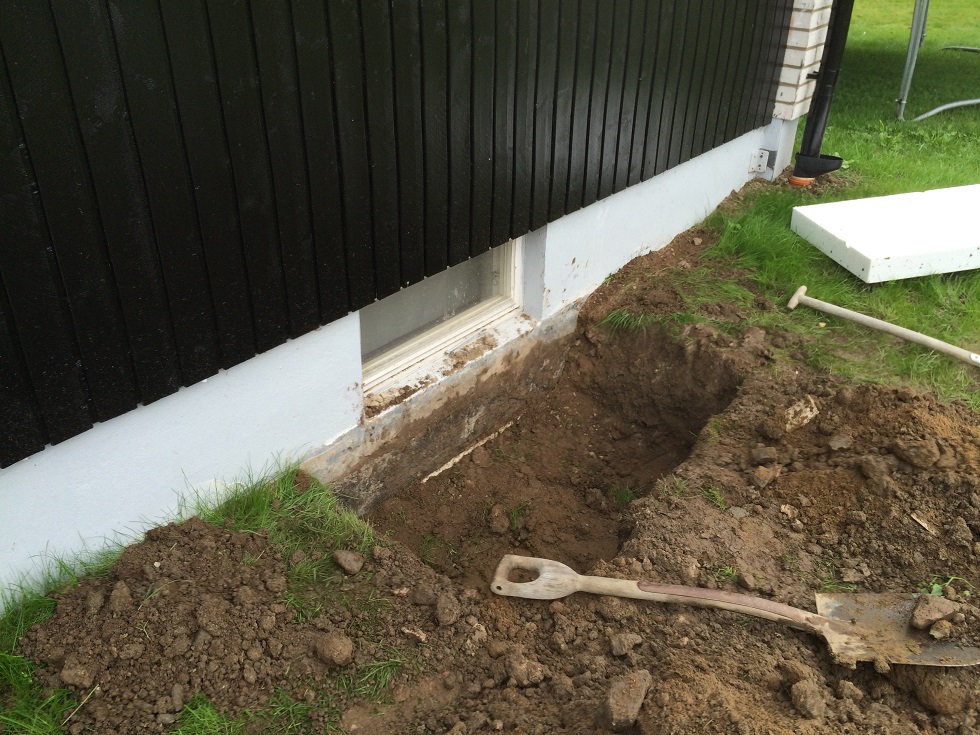
Alright, the project is underway, here I have dug out all the clay soil until I hit only sand.
Here I have filled in 1dm of gravel and then added a 100mm thick insulation, I will probably add another one around 5CM just to raise the height a bit.
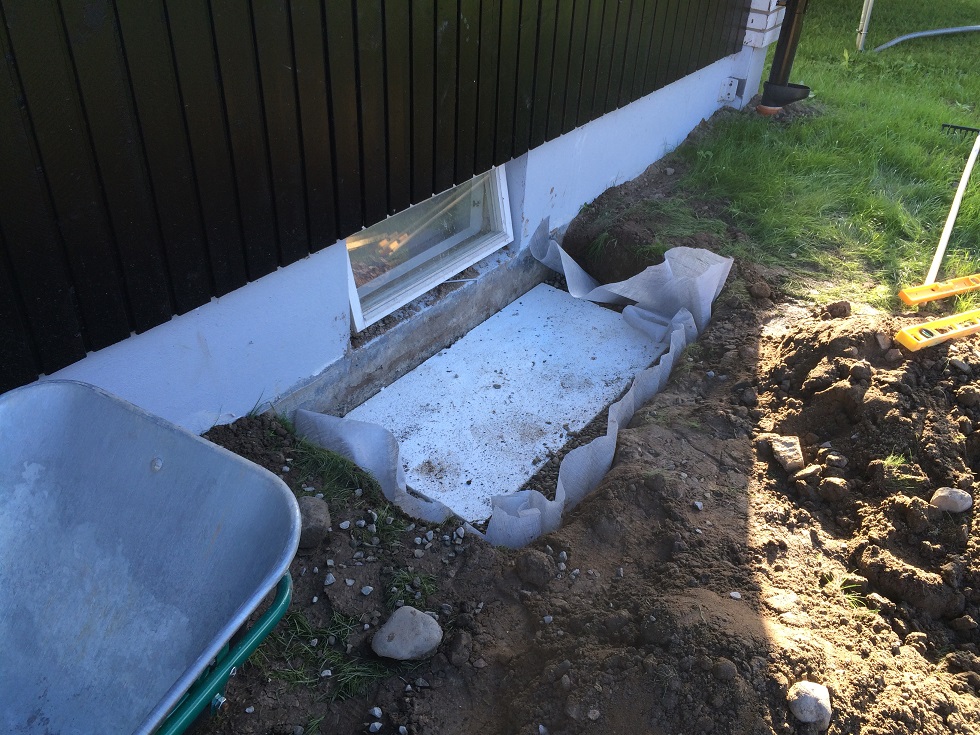
Here I have filled in 1dm of gravel and then added a 100mm thick insulation, I will probably add another one around 5CM just to raise the height a bit.
S
SueCia
Electronics enthusiast
· Dalarna
· 5 534 posts
SueCia
Electronics enthusiast
- Dalarna
- 5,534 posts
Will carve out in the cellular plastic for the well and sewage pipe, so it's in progress! Haven't found anything good yet, hoped for a trench drain from Byggmax, but it was a 10-day delivery time :S