
24,729 views ·
40 replies
25k views
40 replies
Raising the ground over basement window, building a "light well"
S
SueCia
Electronics enthusiast
· Dalarna
· 5 535 posts
SueCia
Electronics enthusiast
- Dalarna
- 5,535 posts
The roof drainage flows out into the ditch, which, as mentioned, is too high, but I can't imagine there being any extreme amounts of water, so I'm considering if one could use a pipe around 200mm in diameter and drill with the Skurups drill to make a small "well" specifically for that water. During a heavy rain of, say, 30mm, and the well by the window is perhaps 0.5 m2, which should yield 15 liters of water, that's not a lot.
The small "well" would then be placed somewhere where I have a lot of sand too.
The small "well" would then be placed somewhere where I have a lot of sand too.
Last edited:

S
SueCia
Electronics enthusiast
· Dalarna
· 5 535 posts
SueCia
Electronics enthusiast
- Dalarna
- 5,535 posts
The roof drainage works well, but the pipes are too high for the pipes from the window gable to connect with it since that pipe will be lower than the roof drainage.mexitegel said:
I don't know how you were thinking, but I was thinking of drilling one of those skurupshål about 2 meters away from the house somewhere where I have sandy soil, then making a well intended only for the window gable.
S
SueCia
Electronics enthusiast
· Dalarna
· 5 535 posts
SueCia
Electronics enthusiast
- Dalarna
- 5,535 posts
I went out to buy a spygatt for this now, of course, there were none at either byggmax, coop bygg, or beijer.
The only spygatt I found was a plastic one with a 50mm outlet.
Is it possible to use a plastic spygatt and 50mm white plastic pipes outside in the ground?
The only spygatt I found was a plastic one with a 50mm outlet.
Is it possible to use a plastic spygatt and 50mm white plastic pipes outside in the ground?
Is it a spygatt for indoor use? It is to be cast in, but the risk is that it will crack and freeze. White pipes are not as strong as the gray or orange ones, and I'm not sure how they handle frost and movement in the ground.SueCia said:
If it’s the "only" option over the weekend and you’re in a hurry to get this done, it might be worth a try. The worst-case scenario is that you have to dig out the spygatt and pipe and replace them in a few years, or it works and then it’s OK.
Sometimes you have to go for "good enough" - it will be much better than the current solution and you can proceed with raising the ground level as planned.
Your idea of diverting the water to its own little "well" for infiltration seems perfectly fine to me. Drill a hole, put in some fabric, fill with gravel/crushed stone, cover with fabric, and fill it again. It should be able to handle the amount of water you’re dealing with.
I was wondering... is there a room behind the window that you are in often/for long periods? It looks like it's top-hung and opens outward in the picture. Then it won't be possible to crawl out through it if there's a fire or something when you've built a kasun.
I have a neighbor whose son has his bedroom behind a basement window (which was a bit larger than yours) and it opened outward, so when they made a kasun like you are doing now, they changed the window to one that opened inward. Just to be able to evacuate that way if needed.
Just a thought that crossed my mind...
I have a neighbor whose son has his bedroom behind a basement window (which was a bit larger than yours) and it opened outward, so when they made a kasun like you are doing now, they changed the window to one that opened inward. Just to be able to evacuate that way if needed.
Just a thought that crossed my mind...
Hmm ... but there are ready-made light wells to buy ....
http://www.ebay.de/itm/MEA-MULTINOR...EFE-40-/191608626089?var=&hash=item2c9cc39ba9
https://www.bausep.de/aco-therm-lichtschacht-kompl-rost-masche-30-30-begehbar.html
or should it be something special with it?
http://www.ebay.de/itm/MEA-MULTINOR...EFE-40-/191608626089?var=&hash=item2c9cc39ba9
https://www.bausep.de/aco-therm-lichtschacht-kompl-rost-masche-30-30-begehbar.html
or should it be something special with it?
Last edited:
S
SueCia
Electronics enthusiast
· Dalarna
· 5 535 posts
SueCia
Electronics enthusiast
- Dalarna
- 5,535 posts
S
SueCia
Electronics enthusiast
· Dalarna
· 5 535 posts
SueCia
Electronics enthusiast
- Dalarna
- 5,535 posts
There is another basement window that is just as large but is located on the other side of the room, that's the window you'd try to get out through if needed, there's also a way out through the basement up through the garage too, so I'm not deteriorating evacuation possibilities anywayTestarn said:I was thinking about something... is there a room behind the window that you are often/for a long time in? In the picture, it looks like it's top-hung and opens outward. Then it won't be possible to crawl out through it if there's a fire or something when you've built a kasun.
I have a neighbor whose son has his bedroom behind a basement window (which was a bit larger than yours) and it opened outward, so when they made a kasun like you are now, they changed the window to one that opened inward. Just to be able to evacuate that way if necessary.
Just a thought that crossed my mind...

S
SueCia
Electronics enthusiast
· Dalarna
· 5 535 posts
SueCia
Electronics enthusiast
- Dalarna
- 5,535 posts
S
SueCia
Electronics enthusiast
· Dalarna
· 5 535 posts
SueCia
Electronics enthusiast
- Dalarna
- 5,535 posts
The drip edge:
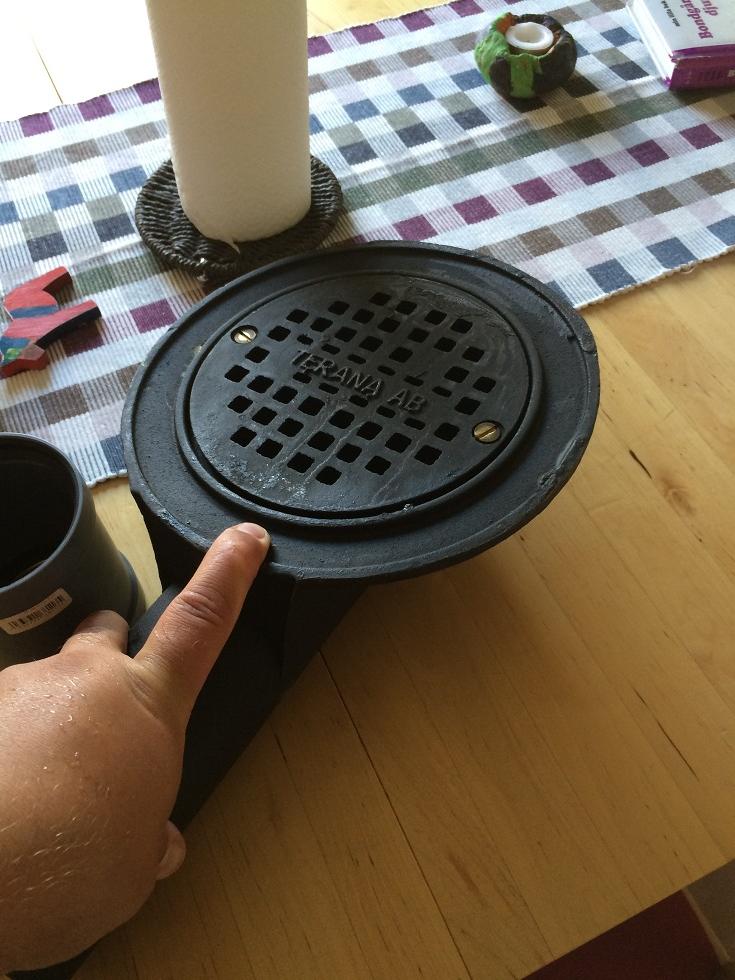
The indentation around the well where I'm holding my finger, should concrete be poured over that groove too?
Preparations for pouring:
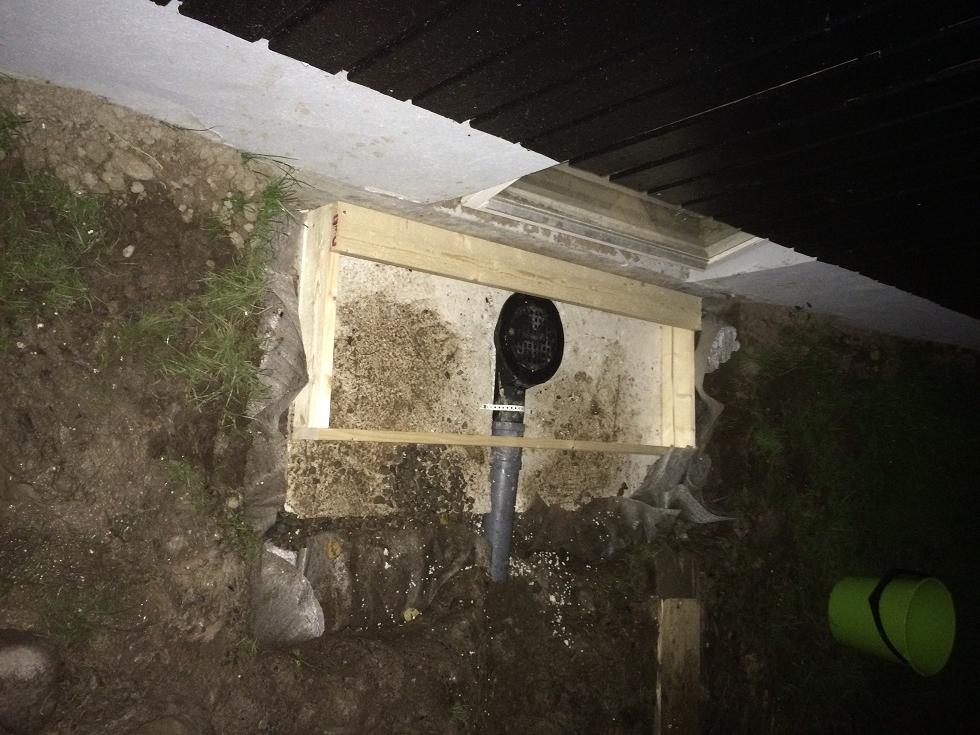
Do you see anything wrong here? Otherwise, I'll reinforce tomorrow and pour.
The indentation around the well where I'm holding my finger, should concrete be poured over that groove too?
Preparations for pouring:
Do you see anything wrong here? Otherwise, I'll reinforce tomorrow and pour.
S
SueCia
Electronics enthusiast
· Dalarna
· 5 535 posts
SueCia
Electronics enthusiast
- Dalarna
- 5,535 posts
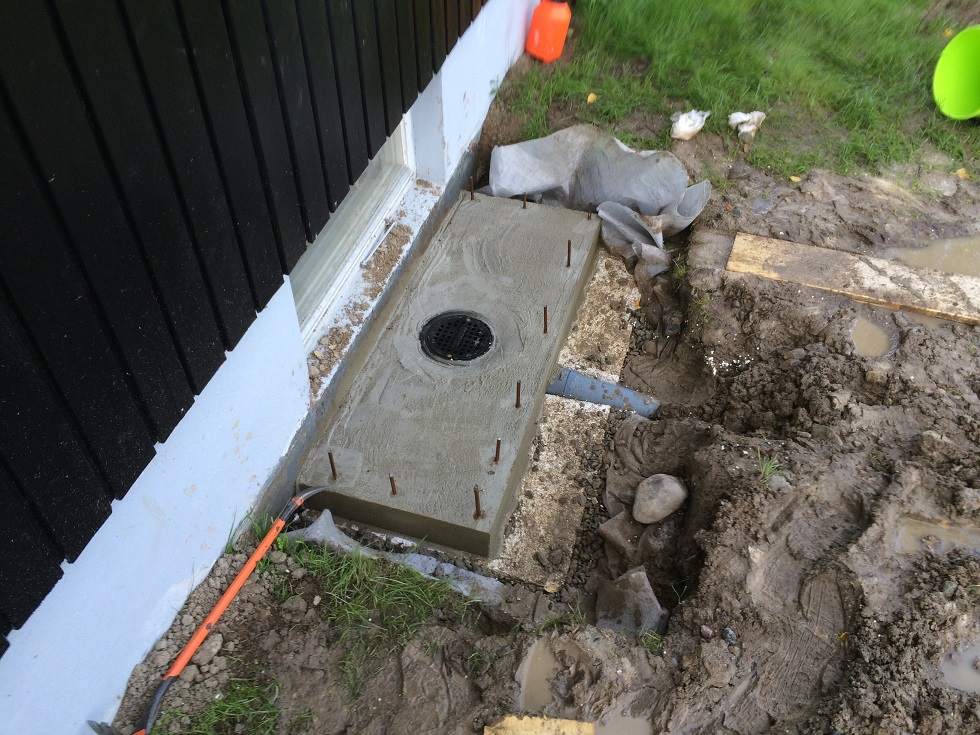
Now the slab is cast, I don't need to hear that it looks amateurish
The surface mostly slopes towards the drain, at least. What I'm considering now is how to build the outer of the walls I will cast against, the inner is easy, 3 OSB boards with some supports, no problems. Then when I build the outer one, I thought of placing the OSB board all the way down to the foam insulation and then tight against the concrete, but how do I ensure the distance is correct all the way without being able to place any through spacers?
You're not planning to cast a very high wall, right? Then it's probably easiest to place studs on the outsides of both form halves (inner/outer) that you connect with a plank piece on top. Just remember to make the studs high enough to have room to access under the plank pieces. At the bottom, backfill with soil/gravel so the outer form doesn't collapse.
Alternatively, you can drill through both forms and thread a steel wire through, wrap it over a nail, and thread it back, securing with a nail on the other side as well. Then twist the steel wire so it's tight.
Alternatively, you can drill through both forms and thread a steel wire through, wrap it over a nail, and thread it back, securing with a nail on the other side as well. Then twist the steel wire so it's tight.