We moved into a 1970s house in 2015, just before (April) a short-term measurement (about 4 days) was conducted in the living room on the entrance floor, indicating 17 ± 1 Bq/m3. The inspector we hired believed it was so low that we shouldn't worry about it.
We knew short-term measurements weren’t 100% reliable, but the inspector was clear that there was nothing to worry about here.
Measurement
Now 7 years later, we decided to do a new measurement, this time a long-term measurement (15/10 - 19/12) with a total of 3 detectors. 2 rooms indicated 120 ± 20 Bq/m3 and one room exceeded the limit with 240 ± 30 Bq/m3, giving a calculated average of 150 Bq/m3, i.e. acceptable(!?).
The reason for the new measurement was a step in investigating deteriorating health.
Construction
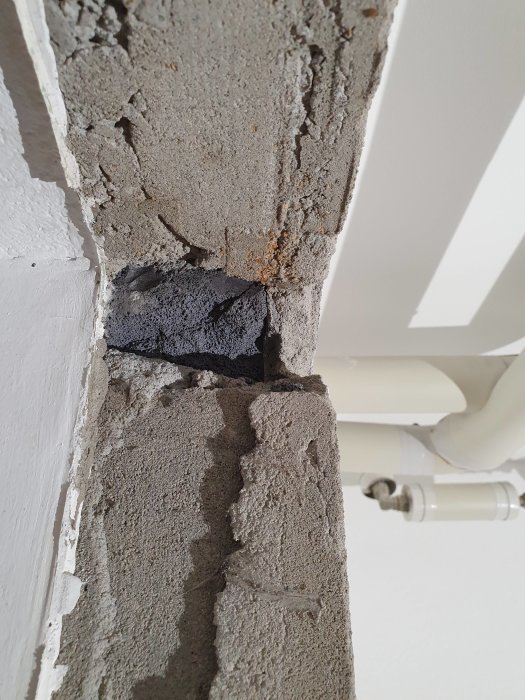
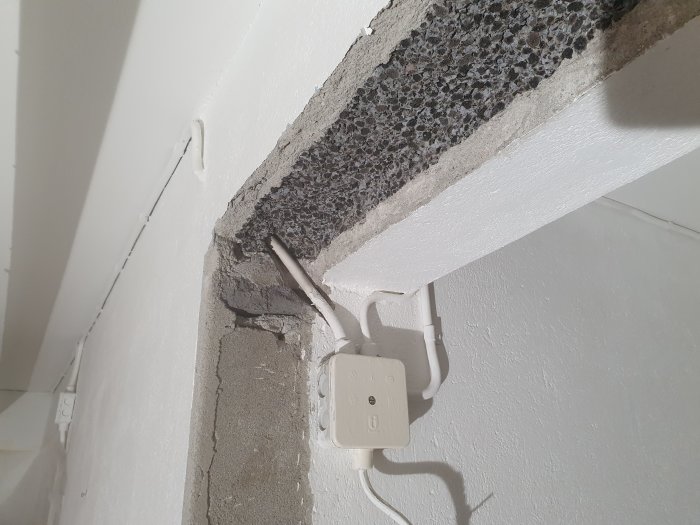
The house has a finished basement with a ceiling height of 210 cm built with lightweight concrete/hollow blocks. Although we've drilled a bit in the basement walls, we haven't noted any blue dust, but we did encounter a bit of what I believe is blåbetong (blue concrete) when changing doors:
How extensive this is we do not know, but the guess is that it is modest.
The entrance floor is fundamentally a wood construction with wooden joists, on which a brick facade has been fixed.
A mechanical exhaust fan was installed in the house when we moved in. It extracts air from 2 outlets on the entrance floor and 3 in the basement. During the measurement, this system was set to level 1/5, primarily to save energy but also not to press down any possible radon levels. Air is drawn in through wall vents and window vents which are situated here and there.
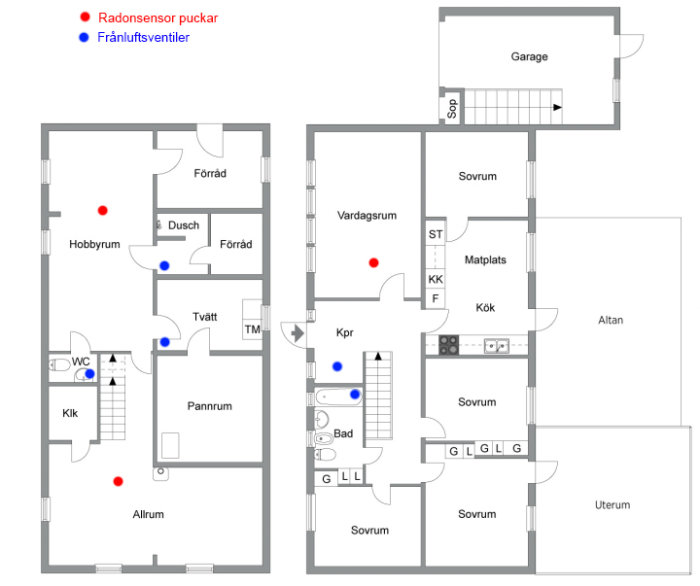
Here you can see an overview of where the radon detectors were hung and where the exhaust vents are located.
Where does it come from?
Even though we've renovated the house, I can't see that any of it would affect the radon situation. Possibly the removal of a large plastic mat in the hobby room could release radon, but the level is still below the limit here.
According to the municipality, our area is designated not as high-risk (blue) but as yellow - there might be clay here containing high levels of radon.
What now?
So what do we do now? How serious are these levels? Should previous owners have known about them? What should be the next step?
Not particularly serious if no one smokes, but it might be appropriate to increase the ventilation to level 2. Do a new measurement next winter to see how it affects things.
IIronside said:
The reason for the new measurement was a step in investigating deteriorating health condition.
Radon can affect health some decades later, not after 7 years.
IIronside said:
Even though we've drilled a bit into the walls in the basement, we haven't noticed any blue dust, but we did come across what I think is blue concrete when replacing doors:
It looks like it could be. But not all blue concrete contains radon.
IIronside said:
Here you can see an overview of where the radon measurement devices were hung and where the exhaust vents are located.
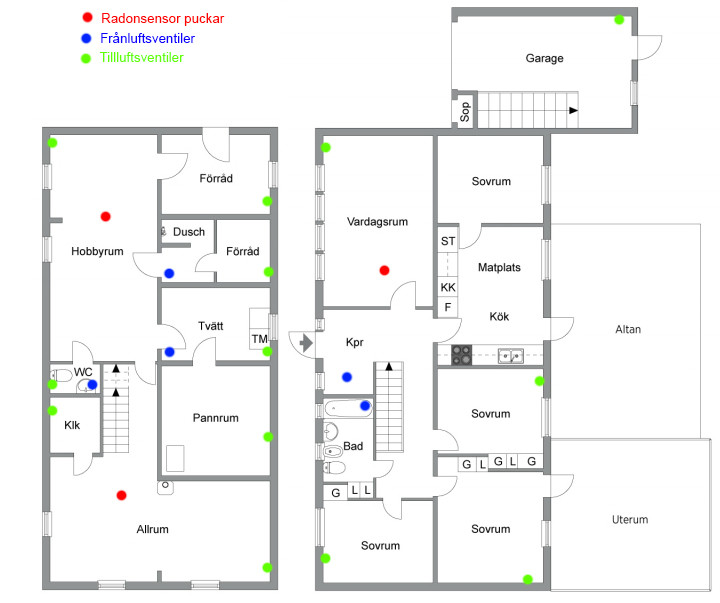
It's good if you mark the supply vents as well.
Is the exhaust set correctly with 15 l/s in bathrooms, etc.?
IIronside said:
Possibly the removal of a large plastic mat in the hobby room could release radon but the value is still below the limit here.
A plastic mat is not radon-tight, so it doesn't have an impact.
Not particularly serious if no one smokes, but it might be appropriate to increase the ventilation to level 2. Do another measurement next winter to see how it affects something.
No smokers, but 2 children who are often in the area that is elevated. This is a completely renovated living room\recreation room. Ventilated (non-active) parquet flooring has been laid, and the walls have been sanded and painted with silicate along with a few other bits and pieces.
BirgitS said:
Radon can affect health a few decades later, not after 7 years.
Ah, good to know!
BirgitS said:
It looks like it might be. But not all blue concrete contains radon.
I didn’t know that, no idea if this is blue concrete or if it even contains any radon. I haven’t encountered it anywhere else except here by all the doors in the basement. All the other work has led me to believe it’s gray lightweight concrete with holes in it, but of course, I could be wrong.
BirgitS said:
It’s good if you also mark the air inlets.
Couldn't update my previous post but here they are:
BirgitS said:
Is the exhaust air correctly set with 15 l/s in the bathroom, etc.?
Unfortunately, I don’t know anything about the ventilation system besides that there is a quite large box in the attic which I have cleaned a couple of times and several thick pipes running throughout the house. Perhaps it's time to bring in a ventilation company to check this.
BirgitS said:
A plastic mat is not radon-proof, so it doesn’t affect it.
Aha! Then I really only see one thing we’ve done that might have affected the radon flow. All the doors have been replaced in the basement, and they are all sealed, which has shown quite poor air quality in the hobby room. Until we find a solution, we leave the door to the laundry room and shower in the basement open. The door between the hobby room and living room wasn’t there before; it’s possible that it also stops the flow a bit.
What speed was the exhaust fan previously set to? If you've changed it, restore it to the previous speed to achieve a better indoor climate.
Don't know what the previous owner had it on but I seem to recall around 3 or 4. We usually adjust it a bit according to the seasons, which means when it gets cold, we turn it down, and when it gets warm, we turn it up. Tried setting it up to 3 briefly today, and there's a noticeable difference in the house; it gets significantly colder, so the fan is certainly running.
Sounds like I should get a ventilation expert in to get some advice on my specific system.
Sounds like ground radon, but you have an average below the threshold value, so my advice is to do nothing at all.
If the vinyl flooring you removed was on the basement floor, it could be part of the reason why the levels have increased. That, combined with colder weather and lower air pressure in the building.
I would check to ensure that no minor mold infestation has occurred when you changed the airflow and sealed in the basement. It can quite quickly affect health. Radon typically affects over a longer period of time and the limit values I've heard are very low.
Couldn't update my previous post but here they are:
In storage, boiler room, and walk-in closet you should not have supply air. Now there's a risk that the shower fan in the basement only gets its air from the adjacent storage instead of from the hobby room.
In the laundry room and basement WC there should only be exhaust air, now those fans won't ventilate any other room.
The bedroom with entrance from the kitchen seems to lack supply air.
IIronside said:
All doors in the basement have been replaced and they are all sealed, which has proven to give rather poor air quality in the hobby room.
A mechanical exhaust air system requires that air can pass through the doors on its way from the supply air vents in rooms where you spend a lot of time to the rooms with exhaust fans.
IIronside said:
Perhaps it's time to bring in a ventilation company to check this.
Which room had the high reading? The hobby room?
Why didn't you measure in any of the bedrooms, as recommended in the instructions?
That's a very good question, we reread the instructions but there was a lot of back and forth with other things so when we eventually decided on a location, this recommendation was overlooked. However, the detector was placed in the rec room fairly close to the opening to the upper floor, and the doors are almost always open to all but one bedroom there. It's said that radon is heavier than air, so it should eventually make its way down to the basement unless the wind currents draw it elsewhere.
We have asked the company that analyzed the samples where exactly they think we should place the next set of detectors. The problem is that it will be quite a lot of detectors if we're to measure all rooms, but maybe it's worth it. The company's suggestion was that we undertake some form of action before measuring again; maybe it will be sufficient that we've now set the exhaust fan two levels higher.
The idea is to measure in the rooms where you are the most, which is usually the bedrooms, as they have the greatest impact on what you breathe in. The bedrooms should have fresh air supply from outside so that you mainly do not breathe in air coming from the basement.
Normally, each floor should be ventilated separately.
IIronside said:
The company's suggestion was that we take some form of action before measuring again, maybe it's enough that we now have set up the exhaust fan 2 steps.
You should also ensure proper ventilation of the rooms so that the exhaust fans truly take care of ventilating the rooms where people spend a lot of time.
The idea is to measure in the rooms where you spend the most time, which is usually the bedrooms, as these rooms most affect what you breathe in. The bedrooms should have fresh air from outside so that you mainly do not breathe in air that comes from the basement.
Normally, each floor should be ventilated separately.
You should also have a proper ventilation of the rooms so that the exhaust fans really ensure to ventilate the rooms where you spend a lot of time..
Absolutely, when we placed the doses it felt like we chose spots where we spent a lot of time. But our house isn't huge and you do spend many hours, especially in the bedrooms. When we talked to the company that analyzed our pucks, they said at least one on each floor and in the rooms where we spend the most time, so that's what we went with.
It sounds like we need to do a new measurement with significantly more pucks. To get a full understanding of the radon levels in the house, we'll need one puck for each bedroom plus the rooms we've already measured. In total, it would cost us 3000 kr unless we can get a little discount through the municipality.
We have set the exhaust fan to 3/5 and it is quite noticeable in the house, even in the bedroom (office) at the far end that lacks a separate air intake (occurs through window vent). Will check the heating system to see if we can increase the heat a bit so we can maintain 21 degrees.
Have sent inquiries to a couple of ventilation companies for a review and analysis of the house's ventilation.
As mentioned earlier, most of the doors in the basement have been soundproofed, which means they are also sealed. This should mean there is no draft in the living room, but now when the exhaust fan is set to 3/5, there is quite a good draft from the supply vents here, probably the draft is coming from the exhaust vent in Krp on the entrance floor.
Possible measures in the basement:
Hobby room: Slightly open the vent, open the door to WC, shower, and laundry room.
WC: Close the vent
Laundry room: Close the vent almost completely. Close the door to the boiler room.
Living room: Open the door to the hobby room and hope that the exhaust vents are sufficient to move air in the living room as well.
Possible measures on the entrance floor:
Possibly install vents in the bedroom and kitchen that lack them, but there is quite a good draft in the window vents, so unsure if it's needed.
One of the bedrooms must have a closed door due to a pet allergy; the air is clearly worse here, maybe it's time to install an air vent (preferably sound-insulating) above the door.
By deteriorated health condition, do you mean that someone has developed lung cancer?
Because that's what Radon (or the decay of Radon) can increase the risk of.
If there are allergy issues in the family, I would probably look for other sources like mold.
Vi vill skicka notiser för ämnen du bevakar och händelser som berör dig.




BirgitS said:

Anna_H said: