Found the technical description from our house (built in 1952), have some questions:
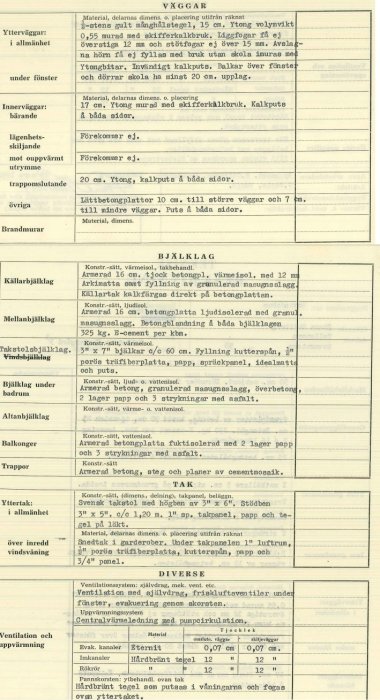
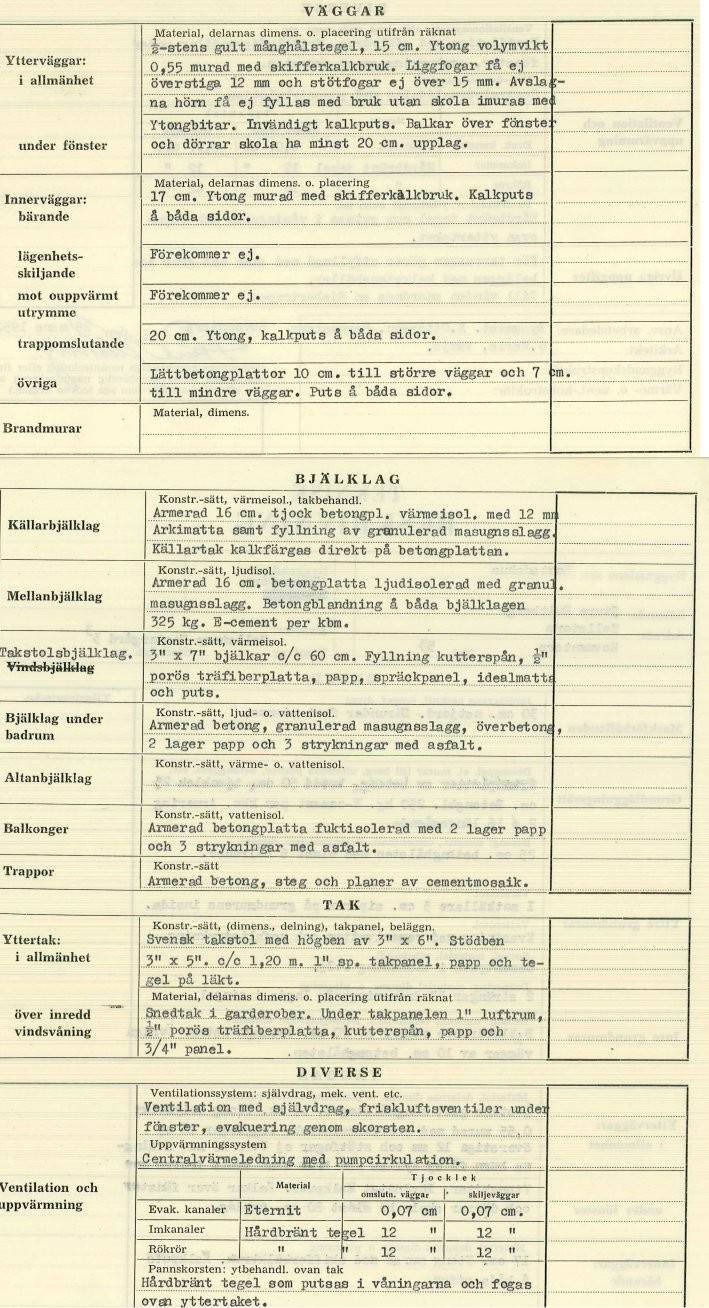
If I read correctly, the outer walls consist only of ytong = blåbetong? That is, no insulation at all? Does this concrete have any insulating ability of value?
That should mean then that there are no problems with adding insulation from the inside? Should one also install a vapor barrier or can I skip that?
The radon measurement showed 210 bq, which we guess comes from blåbetongen. Therefore, we have considered installing FTX. Don't think the house is very airtight. The idea is to seal the window vents and change the sealing strips, but we have no plans to replace the windows or anything else. Is it a good idea with FTX anyway, or better with just an F-system? (ground heat)
Is it cold inside? Are the walls cold? FTX is always preferable if you're going to invest, invest in the best for health and living environment. What is your annual consumption (electricity) and living area?
Is it cold inside? Are the walls cold? FTX is always preferable if you are going to invest, so invest in the best for health and living environment. What is your annual consumption (electricity) and living area?
The geothermal heating works well, but the walls feel cold. Tearing down the entire facade is not an option, so I'm considering adding a 100mm insulation on the inside in the rooms that are going to be renovated anyway. It should work since there is nothing organic in the wall, right? I also have an air gap between the concrete and the brick.
I plan to add additional insulation to the attic.
The house is 180 m2 + basement, don't have a figure for annual consumption.
I don't think it makes a noticeably significant difference with an extra 5-10cm. The wind will have more of an effect. I'm unsure if it's risky with an extra 10cm, depending on if there is a vapor barrier solution in the wall.
Lightweight concrete has approximately the same thermal properties as wood. 15 cm lightweight concrete, as in this case, corresponds to a 6-inch thick log or plank wall. Its insulation capability is one-third that of mineral wool, corresponding here to 5 cm of mineral wool. The wall's weight, on the other hand, is an asset; it creates a heat-equalizing ability that partially compensates for poor insulation. Improved ventilation of the FTX model is certainly the best solution. Plastic foil on the inside can contribute to greater airtightness; otherwise, it is avoided in homogeneous walls of this type. It is also said that radon-resistant wallpaper is available.
Click here to reply
Vi vill skicka notiser för ämnen du bevakar och händelser som berör dig.