


I have built indoor walls with leca, and they are primed with Finjas Grundningsbruk A. This surface is not smooth enough for tiling, so I need something that is STRAIGHT.
What is the usual approach? The wall is reasonably straight for being built...
I'm considering skim-coating with KC Puts B or C (0-1mm) and then smoothing out with a larger board, but I'm wondering about what's customary. Of course, one could have skipped the priming mortar, but it's there now and doesn't make things worse.
Gypsum plaster seems easy to work with and would probably work, but it doesn't feel quite right for basement walls even if they should be dry (only adjacent to the exterior wall and heart wall is there a theoretical chance of moisture).
What is the usual approach? The wall is reasonably straight for being built...
I'm considering skim-coating with KC Puts B or C (0-1mm) and then smoothing out with a larger board, but I'm wondering about what's customary. Of course, one could have skipped the priming mortar, but it's there now and doesn't make things worse.
Gypsum plaster seems easy to work with and would probably work, but it doesn't feel quite right for basement walls even if they should be dry (only adjacent to the exterior wall and heart wall is there a theoretical chance of moisture).

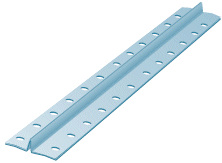
The construction company that helped me with that task used both variants (KC B/C and gypsum plaster). First, vertical aluminum rods for the purpose were attached (I don't know what they're called) with a bit of mortar directly onto the Leca, and then KC plaster was applied with the rods remaining in the plastered wall as support for the plastering board. Remaining irregularities were fixed with gypsum plaster.
Why would gypsum plaster be a problem on damp walls?
Why would gypsum plaster be a problem on damp walls?



I would go with gypsum plaster unless it's an undrained exterior wall... I've applied gypsum plaster on all our walls and it sticks like rock. In some places, I've installed new electrical conduits and I can say that getting through the gypsum plaster is significantly harder than the existing regular plaster that remains in some areas...
Gypsum plaster and gypsum board are completely different materials... Gypsum filler, however, is the same as in gypsum board.MathiasS said:
The problem with gypsum plaster is not that it dissolves but that it can detach from concrete if the concrete gets damp, but it would have to get pretty wet behind it for that to happen. So, as I said, on non-drained basement walls below ground, no, no gypsum plaster, but otherwise, it should work fine.
I have no personal experience with plaster, but the advice from sources like Finja and Weber is quite clear on that point. In my basement, it might work, but the question is whether you want to take the chance, especially if you're going to tile on it.....
But, is it really the case that in basements where tiling is intended, it's customary to apply a thick plaster before tiling?
But, is it really the case that in basements where tiling is intended, it's customary to apply a thick plaster before tiling?
Where can you read Finja's opinion on gypsum plaster in basements?
I asked Finja once, and they thought it was okay as long as there was no running/free water because gypsum plaster can absorb and release moisture. But that was some years ago, so the advice may have changed (things can change quickly in construction)?
I asked Finja once, and they thought it was okay as long as there was no running/free water because gypsum plaster can absorb and release moisture. But that was some years ago, so the advice may have changed (things can change quickly in construction)?
I think Anders is right that there is a difference between gypsum and gypsum. For example, Casco has a product called Gipsfiller which was recommended to me at a hardware store. However, Casco themselves suggested that husfix, wet room filler, or regular fix was the right way to go to apply a skim coat to the wall.
If I did this from the start, on a bare leca wall, I would probably skip the primer and just apply fix directly with a wide filler as prep for the tiling.
I made the mistake of skim coating the wall with regular sand filler, which is completely wrong (and I remembered this when I was finished), so yesterday I sanded off 2kg of sand filler that spread nicely throughout the WHOLE house (yes, the whole house).
10 minutes of skim coating, 30 minutes of sanding, 3 hours of vacuuming and wiping down.
Now I have primed and will apply a skim coat with regular fix. The walls that will be painted will be sand filled.
If I did this from the start, on a bare leca wall, I would probably skip the primer and just apply fix directly with a wide filler as prep for the tiling.
I made the mistake of skim coating the wall with regular sand filler, which is completely wrong (and I remembered this when I was finished), so yesterday I sanded off 2kg of sand filler that spread nicely throughout the WHOLE house (yes, the whole house).
10 minutes of skim coating, 30 minutes of sanding, 3 hours of vacuuming and wiping down.
Now I have primed and will apply a skim coat with regular fix. The walls that will be painted will be sand filled.

When I tiled the boiler room, I covered up rather large unevenness on the Leca wall with a good mix of tile adhesive and larger notches on the trowel.
I slowly worked my way past an edge and it's not noticeable today.
Nothing has fallen off yet hehe, but I primed thoroughly beforehand.
This might not be the most appropriate method, but it worked for me
I slowly worked my way past an edge and it's not noticeable today.
Nothing has fallen off yet hehe, but I primed thoroughly beforehand.
This might not be the most appropriate method, but it worked for me
Click here to reply