

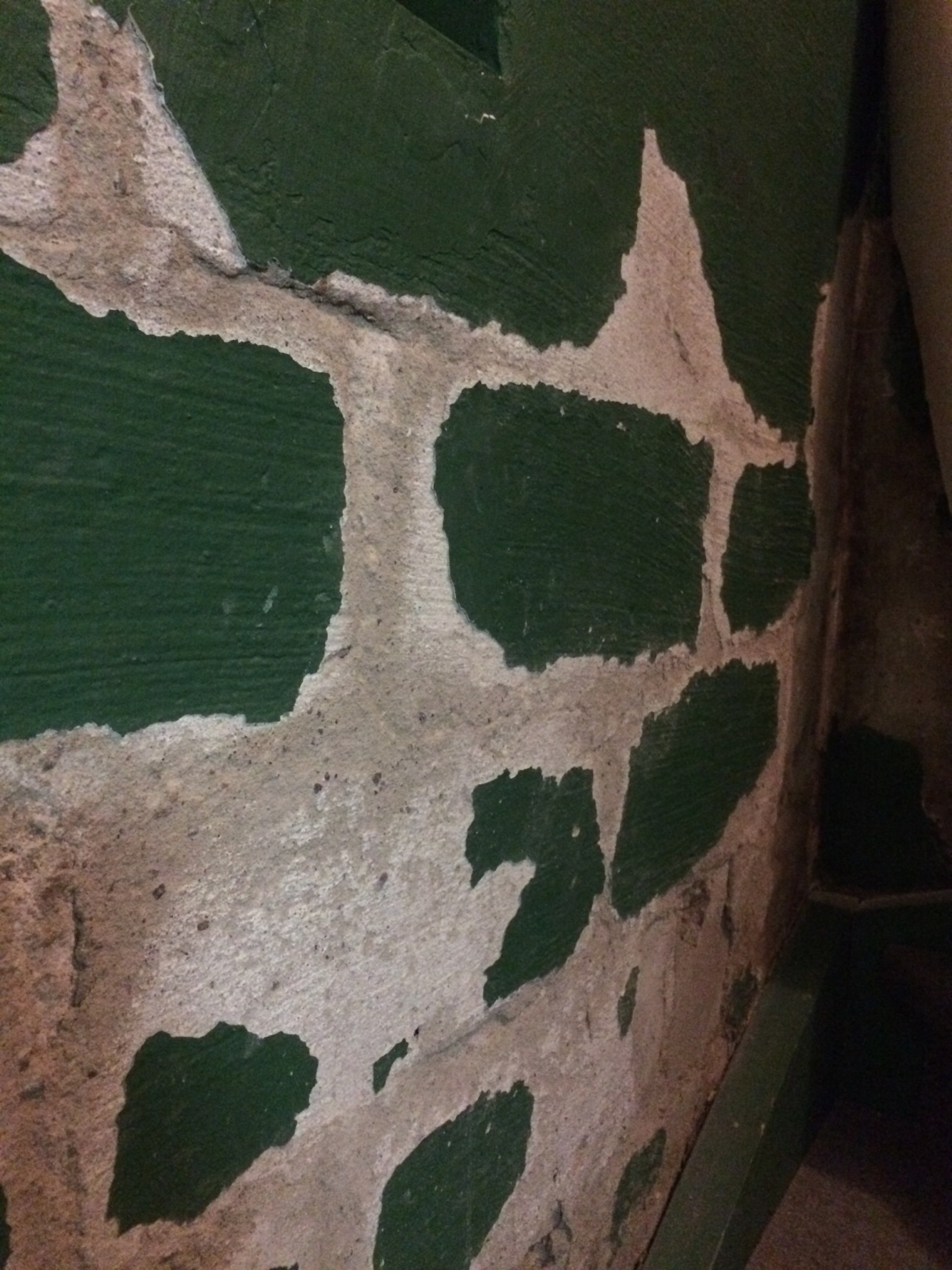
That the foundation of houses from this time draws up ground moisture at the bottom is hard to avoid...
However, you have gaps in the joints quite high up, so I think it needs to be addressed on the outside first with drainage and water diversion before you address the inside.
However, you have gaps in the joints quite high up, so I think it needs to be addressed on the outside first with drainage and water diversion before you address the inside.

That looks a bit like the wall we have in our house. Split-level from 1977. The wall is partially underground and drained with Platon externally, no insulation. I started by scraping the wall so I got a "clean" wall without paint and then plastered it with gypsum plaster and painted with silicate paint. It worked well for a while, but after a few months I started noticing small cracks that grew larger and eventually the plaster began to fall off. It was completely wet behind the gypsum plaster. I started investigating where all the water could be coming from and sealed a couple of cracks in the external plaster and applied new waterproofing on the balcony above to ensure water couldn't seep "the back way" into the wall.
I let it dry for a couple of months and then replastered with plaster mortar and left the wall unpainted to see what would happen. After a month, I could start to see a color change in the plaster roughly in the middle of the wall, but the plaster remained. After a few more months, cracks began to appear and some plaster felt loose... I knocked down all the loose parts and have now installed steel studs with panels and an exterior facade fan that's running all the time, so I've built a homemade Nivell wall, you could say...
I could never figure out where the water was coming in, everything looks fine externally and the strange thing is it always started in the middle of the wall. There are also no water or sewage pipes in the wall...
Since we converted the room into a bedroom, the "Nivell" solution felt safer because the wall previously made the room feel slightly damp...
I can add that the wall I have is made of aerated concrete, Ytong, and I followed all the rules of the art when I plastered...
I let it dry for a couple of months and then replastered with plaster mortar and left the wall unpainted to see what would happen. After a month, I could start to see a color change in the plaster roughly in the middle of the wall, but the plaster remained. After a few more months, cracks began to appear and some plaster felt loose... I knocked down all the loose parts and have now installed steel studs with panels and an exterior facade fan that's running all the time, so I've built a homemade Nivell wall, you could say...
I could never figure out where the water was coming in, everything looks fine externally and the strange thing is it always started in the middle of the wall. There are also no water or sewage pipes in the wall...
Since we converted the room into a bedroom, the "Nivell" solution felt safer because the wall previously made the room feel slightly damp...
I can add that the wall I have is made of aerated concrete, Ytong, and I followed all the rules of the art when I plastered...
I used C because the wall itself is so porous... Then it fell down for me anyway, so I can't say if B bruk would have been better...
I guess that most would recommend B-bruk...
However, the most important thing is that the wall can continue to "breathe", so use a high-quality silicate paint when you paint!
I guess that most would recommend B-bruk...
However, the most important thing is that the wall can continue to "breathe", so use a high-quality silicate paint when you paint!
Stop and hold on! You should never plaster with a stronger mortar than the base you are plastering on. If the house is from -51, most likely it has lime plaster on the walls, and then lime plaster should be used. If you're going to plaster with something stronger (B or C mortar), you must first remove all existing plaster down to the concrete block.
Gypsum plaster is completely wrong in basements.
Gypsum plaster is completely wrong in basements.
Click here to reply