This lands somewhat in between the forum section for electricity and construction, but I'll put it here.
I'm going to renovate (for aesthetic reasons, not necessity) the house and a lot of wiring will be redone. Currently, there are quite a few surface-mounted wires in the basement (old house), and I'm now considering whether I should be able to run them in the floor joists instead. I'm going to tear up the entire floor on the floor above the basement, so I have full access, making it feel like the simplest/smartest solution.
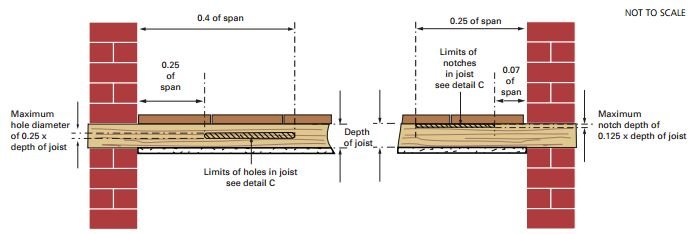
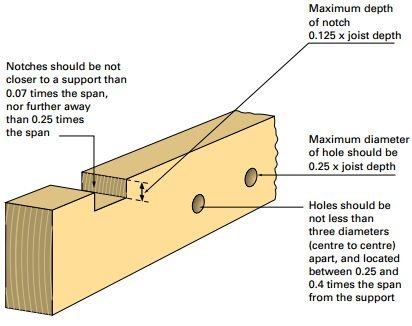
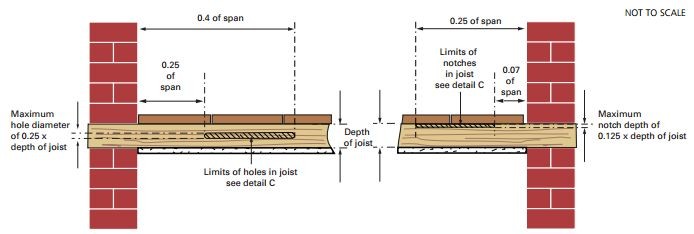
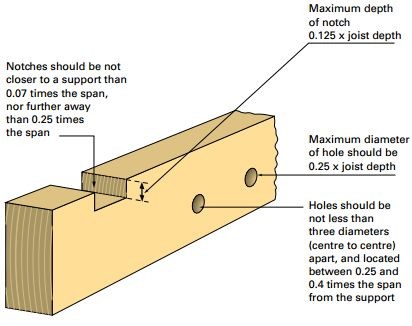
This means I will run a lot across the joists. What are the rules for making holes and running pipes through the joists? Is it more or less free as long as you stick to some maximum diameter for the pipes and run them in the center of the joists, or are there minimum distances between pipes and other things too?
Is it perhaps a dumb idea from the start to do so?
Without having seen the joists yet, I assume it's cc600 and about 200x50 dimensions. Old house, as mentioned, so it could be a bit of anything.
Generally, you should avoid making holes too close to the top and bottom edges of the beams. You should also avoid making holes where the beams are subjected to the greatest loads. Normally, this is in the middle of the length, although not always. However, a single hole with a 16 mm diameter is quite negligible if the beam is 200 mm high. In an old house (built before around 1950), floor beams are often subjected to greater loads than in a more modern one. Carefully plan the conduit placement first so you limit the number of holes.
or is there also a minimum distance between pipes and other things?
Forgot to answer this question. The answer is yes, but it's extremely rarely relevant in residential buildings. To start calculating congestion, you would need to load a couple of these pipes to the maximum for a long time, and if you follow the above recommendation of 3x diameter between the holes, you're on the right track.