
4,209 views ·
80 replies
4k views
80 replies
Pipes behind old radiator, putty/asbestos?
If your apartment is in Helsingborg and a former worker at Eternit AB lived in your specific apartment and worked from home sanding eternit plates (it happened!), then theoretically it could be asbestos in the dust, otherwise it's likely just regular ingrained dirt.S Slottsfrun said:
I don't know if I dare... I'd rather not be there messing around when I don't know what it is.Düsseldorff said:
But, otherwise, good suggestion!
The material again... like a thin soft "powder", no roughness at all.

Homeowner
· Småländska höglandet
· 5 854 posts
No, but quite often worry is unfounded.S Slottsfrun said:
The asbestos I have handled during my professional life can be counted. In tons. Confirmed asbestos, not suspected. And I'm not worried, I use protective equipment instead.
Why would one put asbestos on a heating pipe in a heated room?S Slottsfrun said:
Any experienced "röris" here? 😊
I've previously posted about these old pipes behind the radiator, but now I wonder if there's a "röris" with experience in old techniques here?
My question is as follows:
Did people in the past use to insulate horizontal pipes behind the radiator with sealant/asbestos so the heat wouldn't go into the wall but rather to the radiator itself?
Meaning, to avoid unnecessary heat loss. That's what AI says anyway. 😊
In older apartments, I have found horizontal pipes behind the radiator with "something" on them. Most people here think it's old dust, but I don't think it looks like that. It's just a lot of speculation back and forth, so I'm wondering if anyone here knows if this "technique" was used.
I'm essentially wondering if it could be old sealant/asbestos.
Yes, testing is the only sure way, I know.
But, I still want to ask if anyone has experience with this here.
Thanks in advance!
I've previously posted about these old pipes behind the radiator, but now I wonder if there's a "röris" with experience in old techniques here?
My question is as follows:
Did people in the past use to insulate horizontal pipes behind the radiator with sealant/asbestos so the heat wouldn't go into the wall but rather to the radiator itself?
Meaning, to avoid unnecessary heat loss. That's what AI says anyway. 😊
In older apartments, I have found horizontal pipes behind the radiator with "something" on them. Most people here think it's old dust, but I don't think it looks like that. It's just a lot of speculation back and forth, so I'm wondering if anyone here knows if this "technique" was used.
I'm essentially wondering if it could be old sealant/asbestos.
Yes, testing is the only sure way, I know.
But, I still want to ask if anyone has experience with this here.
Thanks in advance!
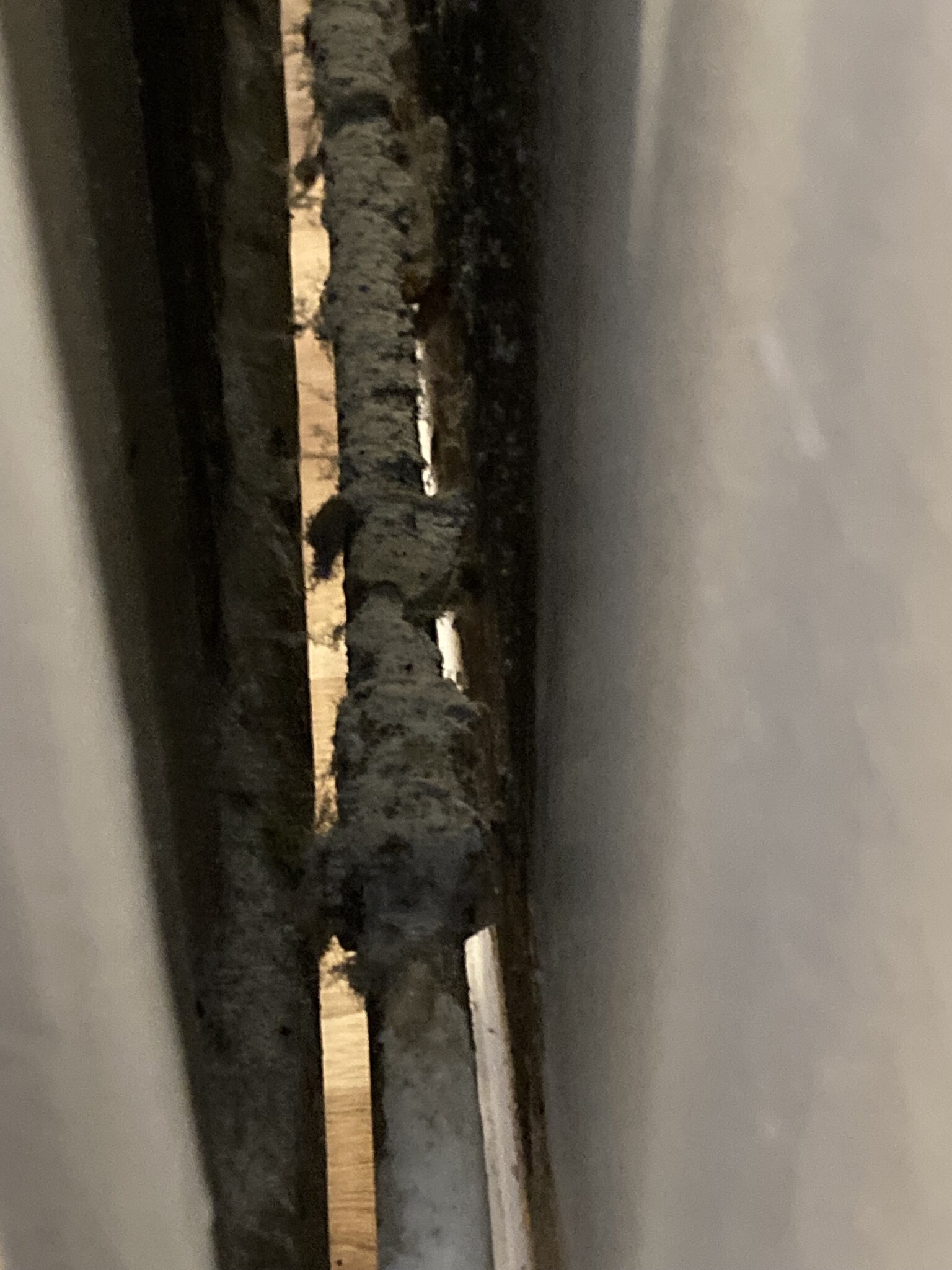
But doesn't it look like anything other than dust? Have you tried vacuuming it up?
If it were meant for thermal insulation, it looks very sporadic and inefficient (even though dust can also insulate somewhat).
If it feels like dust, and acts like dust, then it's probably old dust.
If it were meant for thermal insulation, it looks very sporadic and inefficient (even though dust can also insulate somewhat).
If it feels like dust, and acts like dust, then it's probably old dust.
Yes sporadic, but thinking that it might have come loose over the years. No idea. No, haven't tried vacuuming since it would be the worst thing to do if there were asbestos in the material.Spikbjörn said:
But for heaven's sake. Stick in a stick and poke out the debris, then you'll find out what it is, instead of writing in a forum.
When my butt itches, I scratch it back. I don't ask a bunch of strangers if I've got colon cancer.
PS. Worked as a plumber in the seventies if that's old enough😀?
When my butt itches, I scratch it back. I don't ask a bunch of strangers if I've got colon cancer.
PS. Worked as a plumber in the seventies if that's old enough😀?
It doesn't look like anything other than dust. The risk of vacuuming (even if it is asbestos) is probably negligible, you're doing it once, not every day for the rest of your life (and stop smoking, that's the dangerous factor with or without asbestos if you're not working with it).S Slottsfrun said:

Smart alek
· östergötland
· 2 832 posts
I have a bit of difficulty understanding these kinds of posts...
Why not just clean/sanitize away the problem as if it were asbestos...?
Why not just clean/sanitize away the problem as if it were asbestos...?
What's wrong with asking for knowledge from those who have worked in the field?Intet said:
If you were a plumber in the 70s, maybe you are the right person to answer my question if it used to be done that way in the past?
Regardless of your opinion that I should poke it out with a stick.
I am the right person. Just like everyone else. Dusting behind a radiator is not a health issue. It's a motivation issue.S Slottsfrun said:
If you ask such a ridiculously unnecessary question to a robot, you apparently get a ridiculously stupid answer back.
Excuse me if I seem a bit abrupt. But didn't your mother teach you anything when you were young?
I don't think the rental service will be interested in old dust behind the radiator and will hardly rush out for an emergency. In "older" houses, there was no concern about energy, insulation, and the heat loss that would occur inside the apartment anyway (probably just as uninteresting today) where it would still be heated by the radiator. Asbestos would have cost much more unnecessarily.
It's just poorly cleaned. If one is worried, one should clean with exaggerated caution; you won't be affected by such a one-time action in life.
It's just poorly cleaned. If one is worried, one should clean with exaggerated caution; you won't be affected by such a one-time action in life.