
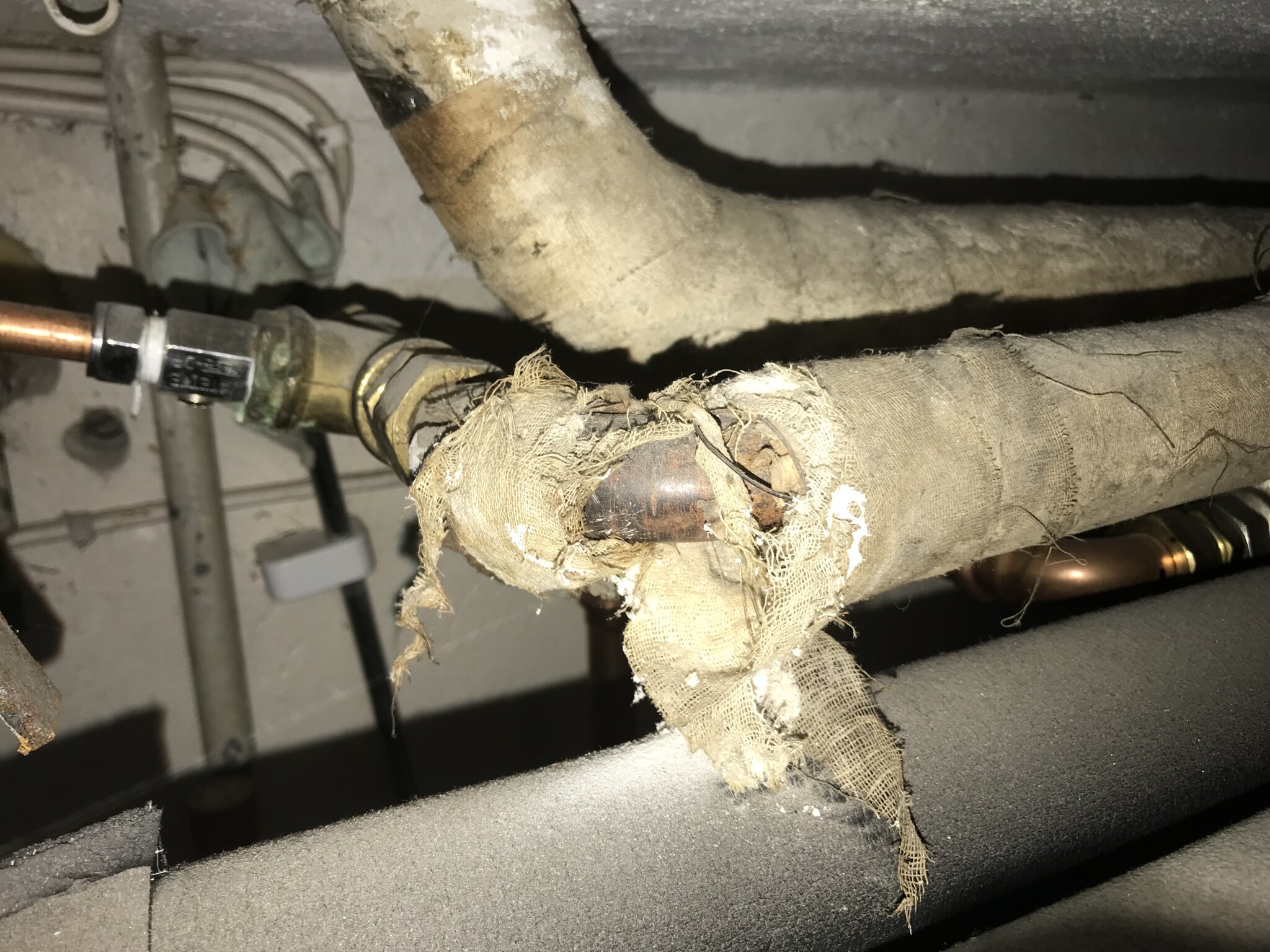
I wonder if there is anyone here on Byggahus who worked with insulating (or worked as a Sanerare) pipe bends in the early 50s. A piece of fabric from another pipe bend in the basement with less light in "pieces" has been sent for analysis and shows Amosite. What I am wondering is if all the white powder lying on the "new" black is asbestos-containing adhesive paste and how they went about insulating these pipes?
Below is a picture from my basement.
Below is a picture from my basement.
Building conservationist
· 105 posts
Looks extremely similar to mine. Gauze, paper, wire, fiberglass on the straight sections and gauze, gurmassa (asbestos), wire, a bit of fiberglass in the bends.T Timjen said:I wonder if there is anyone here on Byggahus who worked with insulating (or has worked as a Sanerare) pipe bends in the early 50s. A piece of fabric from another pipe bend in the basement with less light in "pieces" has been sent for analysis and shows Amosite. What I am wondering is whether all the white powder on the "new" black is asbestos-containing gurmassa and how did they go about insulating these pipes?
Below is a picture from my basement.
In my case, however, the asbestos powder is light brown. Yours looks white?
Yeah exactly. I think and hope that the white powder is gypsum that has been lying over the actual gurmassa with asbestos in it, as I understood it the mass with asbestos is supposed to lie directly on the pipe. What is strange is that I let the remover take a sample on another bend that was broken and he said, "what's in the fabric is definitely asbestos," which it indeed was. It was like clumps hanging in the broken fabric and as you also say, I remember it being more on the light brown side.K Krabbeluring said:
Building conservationist
· 105 posts
Hmm, okay! So what you're saying is that the white clumps were what was tested and showed asbestos? Or was it a completely different bend?T Timjen said:Yeah, exactly. I believe and hope that the white powder is gypsum that was laid over the actual gurmass with asbestos in it, as I understand it, the mass with asbestos should lie directly on the pipe. What's strange is that I had the asbestos remover take a sample from another bend that was broken, and he said, "what's in the fabric is definitely asbestos," and it was. It was like clumps that were hanging in the broken fabric, and I, as you also say, remember that it was more towards the light brown side.
In my case, if we're just talking about the bends, it was mineral wool fastened with wire, then embedded and smoothed out with asbestos of oboy-colored mass, and finally gauze that, so to speak, sealed in the asbestos and then connected to all other regular insulation on the straight sections. Unfortunately, several bends were broken from the decay over time, probably because the stiff cardboard was simply missing there.
I removed three bends myself, just the insulation, and it was a pure hell. There were just pieces of asbestos that came loose, and it was hopeless to remove, especially since the glass wool was underneath with many rounds of wire. Thought it was just gurmass, that would have been super easy.

Member
· Korpilombolo
· 3 760 posts
If you don't have the right equipment for decontamination, you shouldn't tackle the bends. Cut on the straight sections and replace everything or encapsulate and leave it be. Mark with some warning for the next generation who may not have knowledge of what's there.
Building conservationist
· 105 posts
It was an emergency intervention after a plumber cut right into 3 bends despite clear instructions that asbestos was present. He did as he pleased anyway. I wore a mask and full-body suit and had an air purifier on for 4 days, vacuumed all surfaces. It was a bit hard to plan properly when the wood furnace that heats the house is there. Before I started, I didn’t know it would be so tricky to get rid of, simply put.
Member
· Korpilombolo
· 3 760 posts
Oh. What kind of plumber lacks self-preservation instincts?K Krabbeluring said:It was an emergency intervention after a plumber cut right into 3 bends despite clear instructions that asbestos was present. He did what he wanted anyway. I wore a mask and full-body suit and had an air purifier on for 4 days, vacuumed all surfaces. A bit difficult to plan properly perhaps when the wood stove that heats the house is located there. Before I started, I didn't know it would be so fiddly to get rid of, simply put.
Building conservationist
· 105 posts
I wonder the same. It was a one-hour job to cut a couple of unused pipes and cap them. I called up to see how it was going, to which he said, "Oh no, there was no asbestos here, it usually is white and near the pipe," "okay...?" I said, and when I got home there were clumps of insulating material on the floor, discarded pipes, and broken bends with hanging bandage. He "wasn't aware" of that type of asbestos and had thus sawed right into two bends and close to one. All the insulation was torn off. The concentration of fibers in the air must have been intense.
Unbelievable! Personally, I've been a bit anxious just because I ventilated the room after the family had been showering there for a month before I discovered the damage and cleared out some stuff that was under another damaged bend.K Krabbeluring said:I wonder about that too. It was a one-hour job to cut a couple of pipes that weren't in use and seal them. I called and checked on the progress, and he said, "no, there wasn't any asbestos here, it's usually white and close to the pipe." "Okay....?" I said, and when I got home, there were lumps of gurmassa on the floor, discarded pipes, and broken bends with dangling gauze. He "didn't know about" that type of asbestos and had thus sawed right into two bends and near another. He ripped off all the insulation. The concentration of fibers in the air was probably intense.
Was it a Swedish pipe company? I've understood that many guest workers who come unfortunately barely know what asbestos is.
It was in another damaged bend that samples were taken. That's why I'm wondering if the white powder is the asbestos itself. It seems few people actually know how these bends were insulated.K Krabbeluring said:Hmm, okay! So what you're saying is that the white lumps were what was tested, and showed asbestos? Or was it a completely different bend?
For me, if we're only talking about the bends, mineral wool was innermost fastened with steel wire, then embedded and leveled with asbestos of Ovaltine-colored paste, and finally gauze that so to speak sealed the asbestos and then connected over to all other regular insulation on the straight sections. Unfortunately, several bends were broken due to the ravages of time, probably because the stiff paper was simply missing there.
I removed three bends myself, meaning only the insulation, and it was a total nightmare. Asbestos chunks kept falling off, and it was impossible to remove because the fiberglass was underneath with many layers of steel wire. I thought it was just a gum mass; that would have been super easy.
Member
· Korpilombolo
· 3 760 posts

Click here to reply