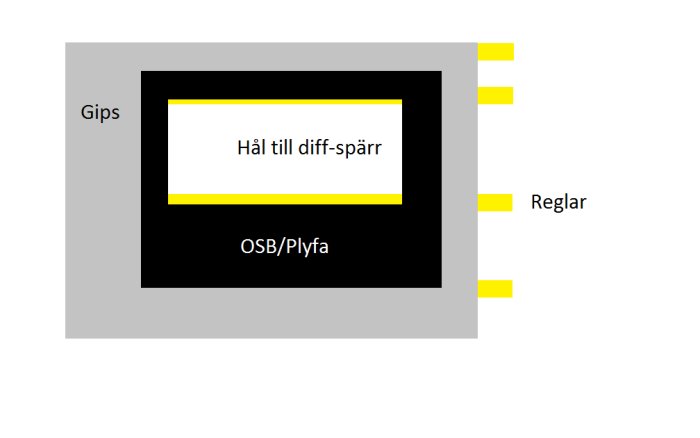
I have found myself in a redo situation but still want to make it as simple as possible for myself.
In our extension, I am supposed to install 2 vents but didn't consider that the builders placed a vapor barrier that I should not puncture unnecessarily. I have already installed the interior walls and therefore won't be able to seal around the ventilation pipe if I just cut a 100mm hole.
Would I affect the strength/construction of the wall if I created a larger square hole and then put the panel material back?
I can adapt the holes so that I have a horizontal stud under the lower joints.
The walls consist of OSB+gypsum in the bedroom and plywood+gypsum in the bathroom.
I am considering doing the same exercise on an interior wall in the bedroom to be able to move an electrical cable in the bathroom. The electrician had dropped a conduit that I then made a hole for in the wall. I thought we would place a box in the corner but the electrician has convinced me that it won't look nice enough in a new bathroom.
In this wall, I have vertical studs with a slightly greater center-to-center distance, so there will be a hole in the middle of the wall. The idea there is to place some form of blocking behind the hole that attaches to the panels from the front.
To seal against a vapor barrier, is it really worth the effort? A sealant around the pipe?
For a normal standard (outer) wall, the wall's strength is unlikely to decrease so drastically; in a wet room, if tiles are going there, I might have thought differently. Then a flexing wall is not good.
It's tempting to do so, but at the same time, those who built the rest have been very careful to ensure that all joints, etc. are tight. I can't quite reach in with sealant to the vapor barrier; there is a 50mm installation batten with insulation behind.
It sounds like I'll make a slightly larger hole, around 105mm in the wood-based boards, so I can just reach to seal as best as possible around it. It shouldn't affect any durability at all.
Does it not work to first make a slightly smaller hole and push the plastic aside? Then you can make the large hole without damaging the plastic and have a greater opportunity to seal it properly. Best regards, Magnus
Click here to reply
Vi vill skicka notiser för ämnen du bevakar och händelser som berör dig.