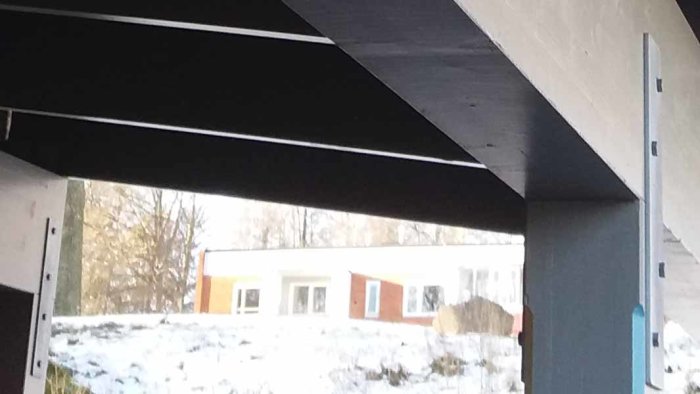
Then you haven't seen modern roof structures in glulam. It works perfectly fine to attach a plasterboard directly to glulam, but it's not necessary from a fire safety perspective. In my eyes, pure wood is attractive. Plaster is a dull material that must be painted or wallpapered. But it's a matter of taste.
I can generally agree with you, wood is nice but this beam will become too prominent in the construction... could of course paint it white... but oh well
How do I attach the post to the beam?
Googled a bit and have come to the conclusion that a nail plate of 8x30 cm on each side of the center post might work but that assumes that the beam and posts are then encased, otherwise I'm not sure how to do it?
If you turn the situation around and start by inputting the value for maximum deflection with the maximum height of a glulam beam, how large will the opening be?
If there are sliding doors that can be entirely moved to both the right and left, i.e., all the sliding doors in the same place, you wouldn't want a beam in the middle of the opening.
If you take a longer glulam beam and extend it further into the facade, wouldn't the deflection be less than if you take the shortest possible glulam beam?
After following this thread for a while, I've realized that it covers my question EXACTLY! I've gotten all my answers without asking any questions, thank you very much!
Paint the beam directly rather than going the detour via plaster. Nail plates should never be visible! In visible situations, use heavier wrought iron. See the adjacent image.
If you take a longer glulam beam and extend it further into the facade, the deflection will be less than if you take the shortest possible glulam beam?
No, with the same load per meter and the same glulam cross-section, the deflection increases with the span.
Regardless of how you organize sliding door walls, there are always points where columns are not in the way.
No, with the same load per meter and the same glulam cross-section, the deflection increases with the span.
No matter how you organize sliding door walls, there are always points where columns are not in the way.
I’ll explain myself better:
If you take a beam with a 6-meter opening that is 7.20 or 8.40 and connect it to the studs in the adjacent wall, you get different values.
Better or worse, of course, depends on the fastening.
But I think you understand better what I mean now.
No matter how you organize sliding door walls, there are always points where columns are not in the way.
Yes and no, if there are four doors and four tracks so all doors can be slid to the right or left, a column will be in the way somewhere. Even with 2 tracks, four doors will have one or two columns in the way. Given that you have 2 tracks and two columns and you always open in the middle, you're absolutely right, which is often the case
I mean the pillars don't have to "destroy" the tracks. I'm planning to place my pillar and beam 1-2 cm inward into the room. The sliding section goes so to speak outside the load-bearing beam.
I understand what @Workingclasshero means. What happens if the beam is made long enough to be considered as fixed at both ends? Well, the deflection then decreases to one fifth if all other variables remain unchanged. But the cost is quite a large waste of material. The by far best way to save material is to place a pillar in the middle. Deflection increases by a factor of 16 when the span is doubled. If the beam lies continuously over the entire span (= continuous beam) over the post, other forces also arise that counteract deflection.
I understand what @Workingclasshero means. What happens if the beam is made so long that it can be considered as fixed? Well, then the deflection decreases to one-fifth if all other variables remain unchanged. But the price is quite a large waste of material. The best way to save material by far is to place a pillar in the middle. The deflection increases by a factor of 16 with doubled span. If the beam also lies completely over the entire stretch (= continuous beam) over the post, other forces are also created that counteract deflection.
Could it still be cheaper to do that than to put in a steel beam?
Can it still be cheaper to do so than to add a steel beam?
Yes. With these examples that @Workingclasshero has provided, the steel is likely to be twice as expensive, depending a bit on the dimensions chosen for the glulam. A glulam beam that is as narrow and tall as possible is always the most cost-effective. The cost for glulam is generally proportional to its volume. The price of steel is based on weight.
My question is whether it is possible/can lay a board of 4.8 mm on the glulam beam (90mm) to reach the standard stud measurement of 95mm?
How do you otherwise proceed if you are going to continue the wall lengthwise after the glulam? The glulam doesn't have the same measurement as a standard stud.
Vi vill skicka notiser för ämnen du bevakar och händelser som berör dig.