The posts for the beam will most likely end up outside the foundation wall (inside).
This means I need to cast three foundations just inside the foundation wall.
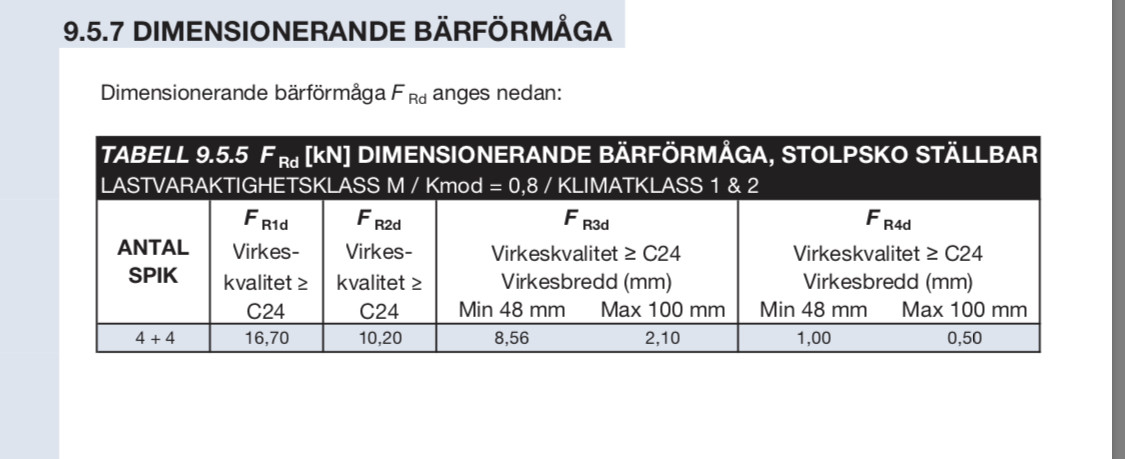
I would really like to attach the pillars with adjustable post shoes. This way, I don't have to be as precise with cutting the posts, and I can use the adjustment feature to press the beam up against the rafters.
It's easier for me to visualize such a work process than having the posts cut precisely and then "end up" level after tensioning.
Of course, I will use particularly strong post shoes.
I will see if I can find any information about stolplaster in the thread. So you can check if the stolpskor can handle these. However, not right now, as some other Christmas preparations are at the door.
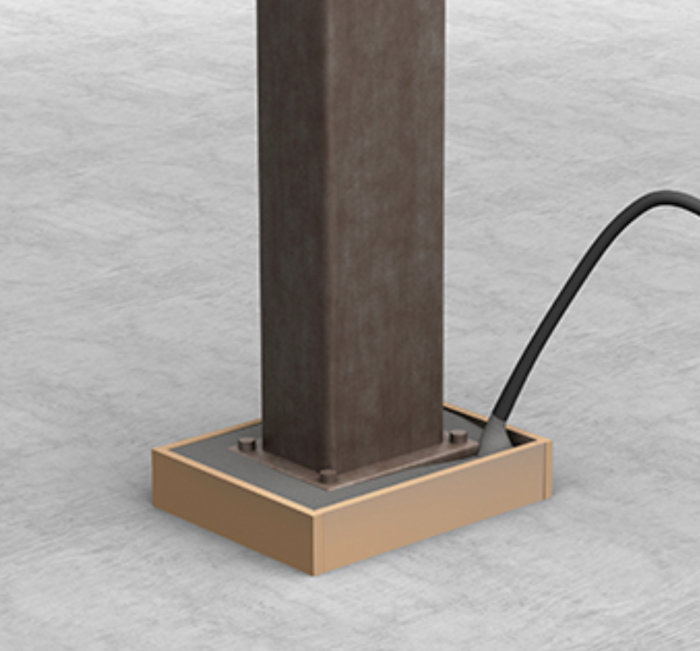
What you can do is pour concrete under the post shoe after assembly, so you don't have to worry about the capacity. I know that Byggmax has a similar, slightly "more delicate" variant than the one they linked to.
I guess that the column "hangs" in the beam in the right position, then I cast the post base. After that, I take out the wrench and adjust the beam up a few millimeters.
But do I still not have to ensure that that m20 threaded rod can handle the pressure?
It is an alternative to fastening. The undercasting concrete, such as Finja expanding concrete, is very fluid and fills the cavities well. Don't forget a moisture barrier under the end grain
Other variants of fastening;
Perfectly noted! But the slightly larger "lump" underneath I can cast with regular plain concrete. I let the rebar continue into the final casting, i.e., the one with finjas fine concrete?
Thank you Bosse, as I said, the help is invaluable.
If Justus concludes that the structure (the roof) can rest on three points with U-beam brackets (or the other model I linked to), I won't even need to underpin.
But if beam brackets prove too weak, I would underpin.
The base is exposed bedrock. The opening will be six meters with three pillars. I could skip casting concrete foundations and instead attach the beam bracket directly to the rock and then underpin. However, the pillar would need to be 30-60 cm longer because I would then be skipping the first casting.
I would not have lowered timber posts in the crawl space but instead cast them so that the post ends in the joist. Then it is more protected against moisture damage.
mm that's true. I do want the wood "inside" the subfloor boards.
How would you have carried out the beam transfer? maybe my ideas are a bit overkill, with underpinning etc.....
The "normal" way is probably to tension the beam against the rafters with a prop or similar. Measure the distance down to the concrete plinth, add 1-2 millimeters, and then just knock in the column between the beam and the concrete plinth. Of course, with a bit of moisture protection paper in between (concrete/wood).
I see that Bosse has already solved the problem. Looking at the loads, the center post is affected by about 33 kN at maximum snow load, which means that the first adjustable variant is completely insufficient. Undergirding is definitely a good solution. It is important not to forget the moisture protection under the post and also not to lower it into the foundation. The issue also has an aesthetic aspect. The irons can preferably be a bit exaggerated and look like real wrought iron. Some building brackets with many unnecessary holes become quite ugly and therefore are not suitable for visible mounting.
Vi vill skicka notiser för ämnen du bevakar och händelser som berör dig.