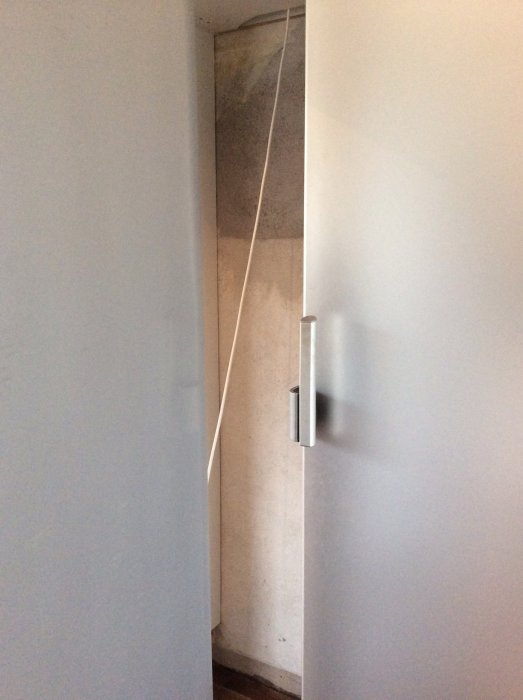
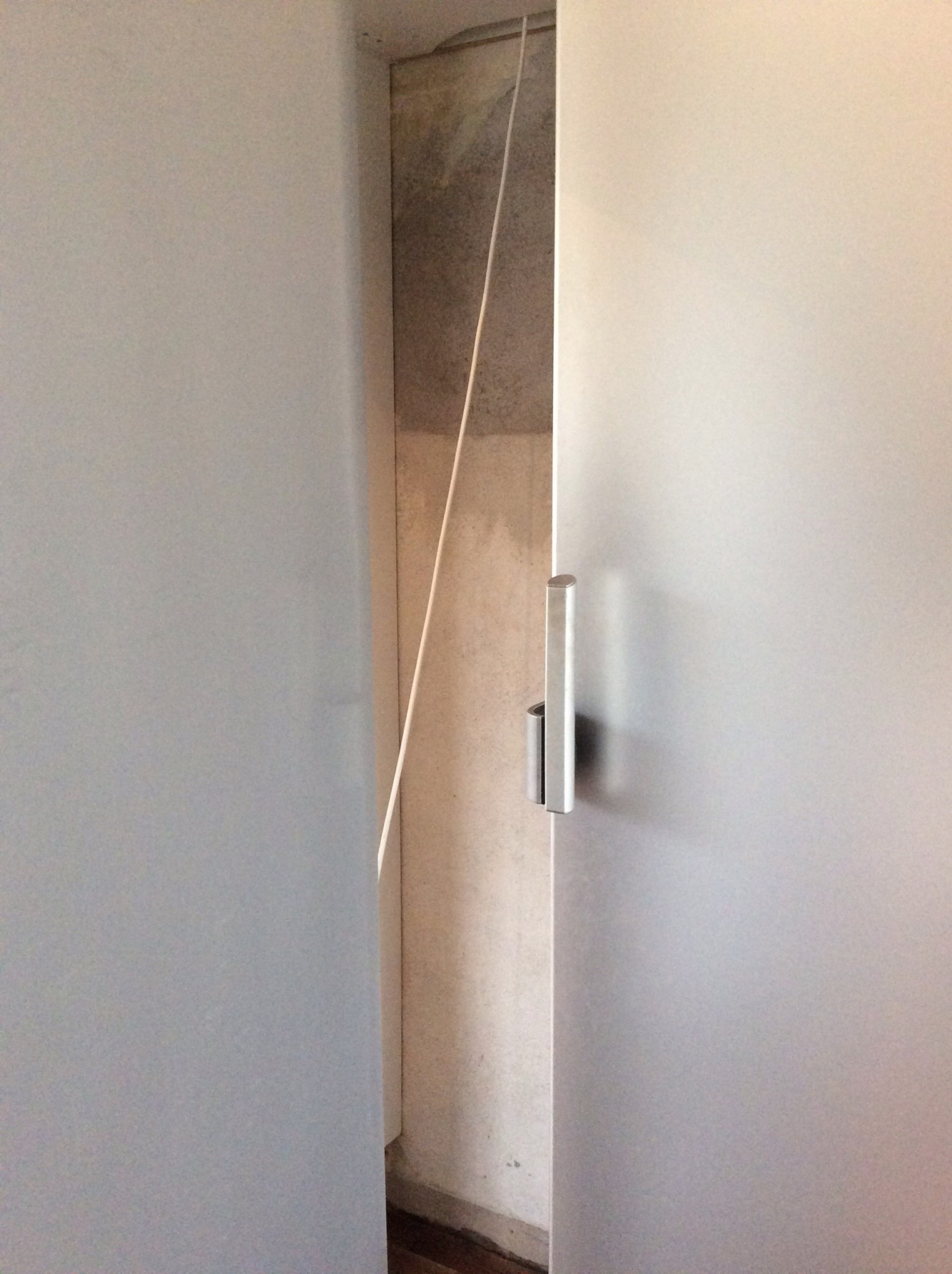
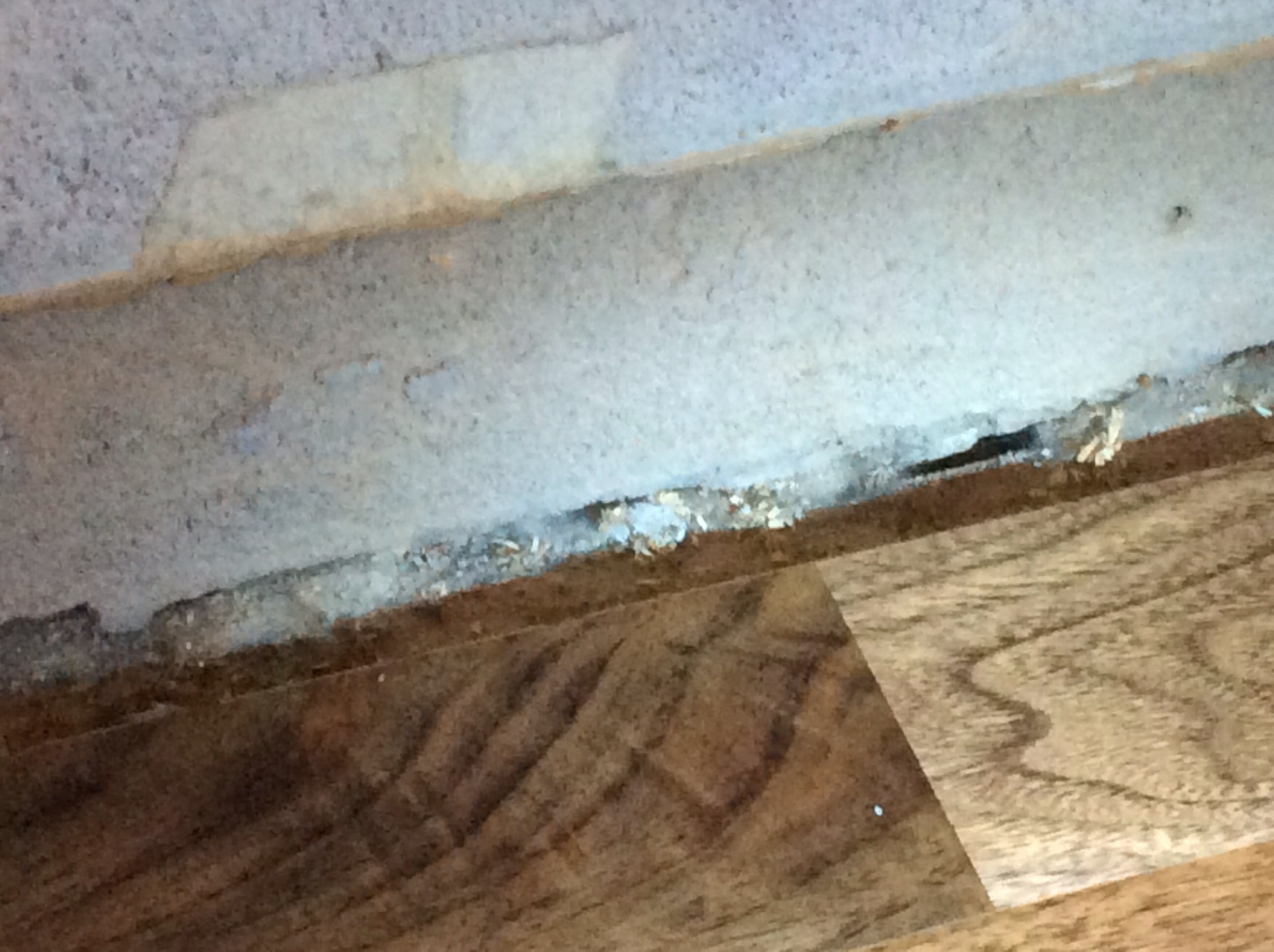
Behind the fridge/freezer and wall cabinets in the kitchen, there is an older chimney stack.
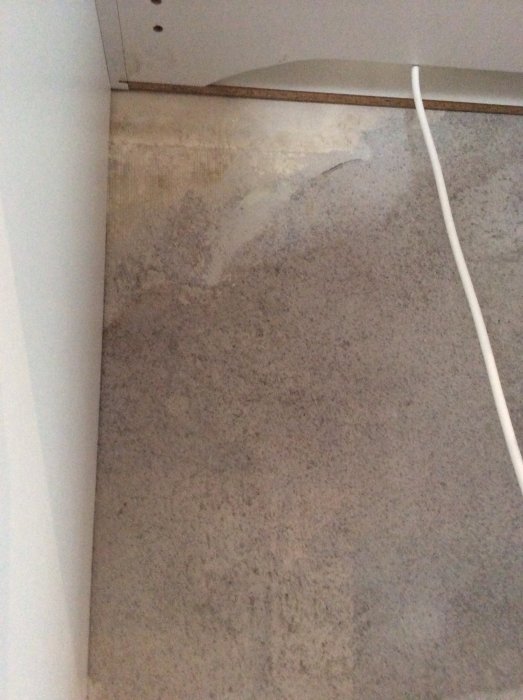
A while ago, I noticed, when I pulled out the fridge/freezer, that there was some old wallpaper on the chimney stack. The wallpaper had green mold infested. I tore off as much of the wallpaper as I could, but unfortunately, I can't reach the wallpaper that is probably on the chimney stack even behind the wall cabinets. They're not easy to disassemble. My hope is that the mold was mainly localized to the area just behind the fridge and freezer, possibly due to moisture, etc., from these.
Some thoughts:
How should I handle this?
I would like to paint the chimney stack behind the fridge/freezer with suitable paint. What type of paint?
It should be a paint that can "breathe" so that I don't trap moisture, etc.
Can I paint directly on the substrate as it looks today? Or do I have to do any particular preparation work? I want to cause as little dust formation as possible. Should I treat for mold before painting?
It feels a bit inappropriate to use strong mold agents near the fridge and freezer.
It doesn't matter much what the final result will look like, since the brick wall is hidden anyway.
I mainly want to paint to freshen up, prevent more mold infestation, and bind the mortar.
I'm thinking of a white paint that binds the mortar but can still breathe.
The paint should also withstand high temperatures since I fire in the current chimney stack, in an adjacent room.
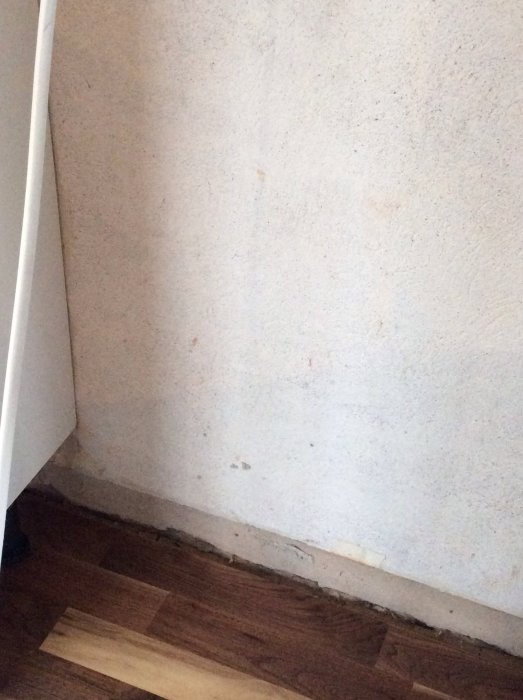
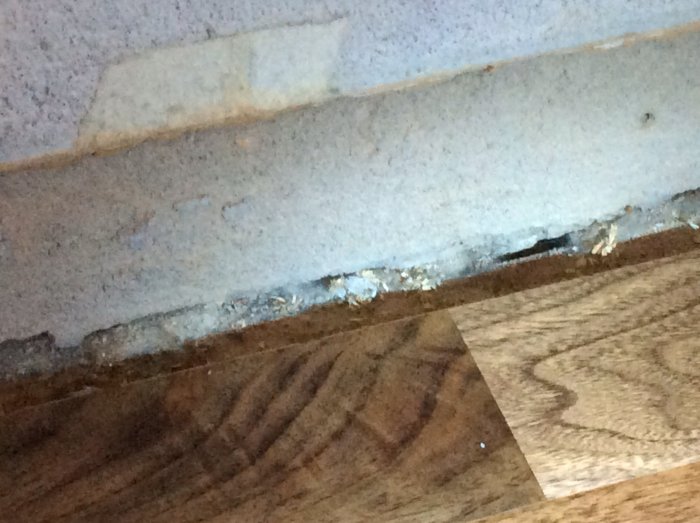
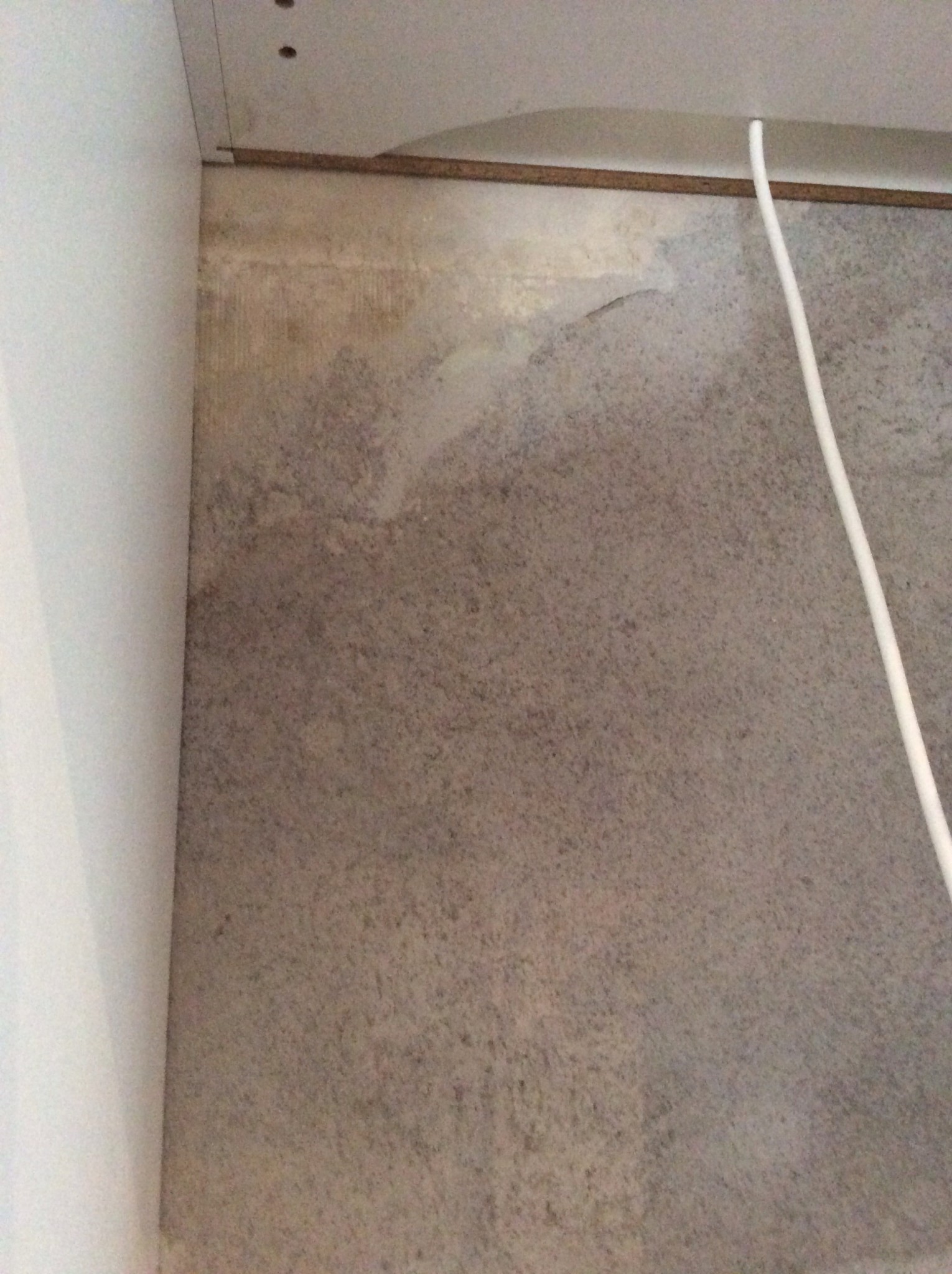
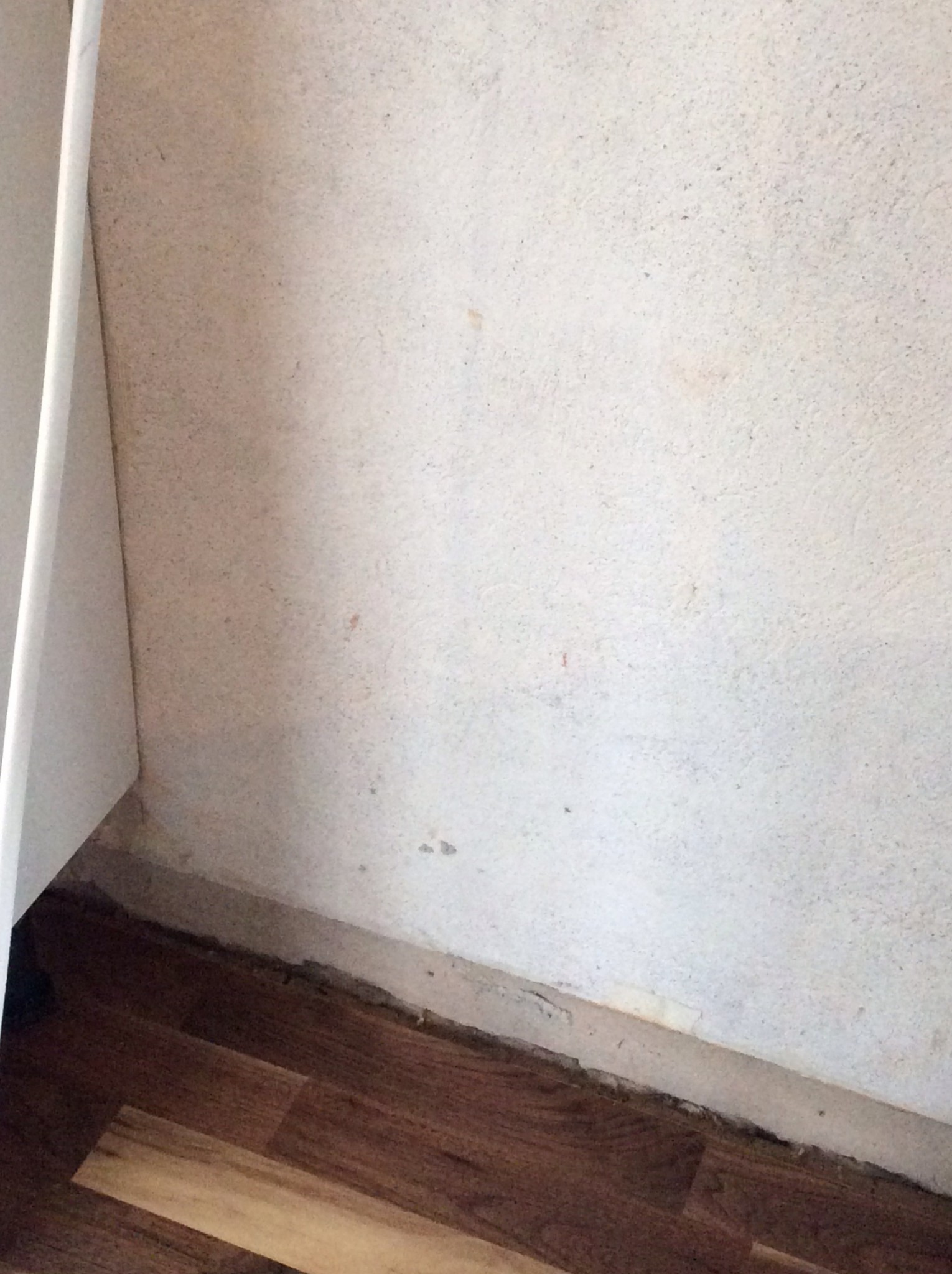
Where it is darkest in the pictures, there is newer mortar, after a mason tried to find the smoke channel when installing a stove and then patched up the wall again. At the bottom towards the floor, the older mortar seems to have yet another color. In addition, there is visible insulation that seems to be stuffed at the very bottom. A bit uncertain about the type of insulation. Would a sealant or floor molding be appropriate here?
Most of the chimney stack has a third color. I think this is where the wallpaper was placed, so there might be some glue residues here, hence the color. I think.
Is there a risk that there is asbestos in the chimney stack, in old mortar/plaster? Or can I proceed to paint without analyzing first? Hopefully, any asbestos is bound in the mortar, or what do you think?
First and foremost, try to locate why mold has appeared. Mold thrives in moisture. Moisture leak? Address this. Then you can paint with silicate paint.
I don't understand where the moisture could be coming from.
Maybe down through the chimney, running along the flue, down through the attic, upstairs, and landing at the spot downstairs. Or does that sound far-fetched?
Shouldn't I see moisture on the flue upstairs in that case?
I hope the moisture came from the fridge/freezer. Sounds simpler...
But, at the same time, I would rather think it should get warm behind these, considering the compressor, etc.
Should I take down the wall cabinets as well? To investigate?
Silikatfärg. Just paint directly or should one prime in some way?
Mold treat first? Does silicate paint breathe, and what temperatures can it withstand?
Is it water-based?
And what about asbestos in mortar/plaster? Likely or completely unlikely?
Should I analyze before painting? Or just paint?
It is impossible to give advice on where the moisture might have entered without inspecting on-site.
Silikatfärg is used because it breathes. You can paint several layers until it covers or dilute the first coat according to the instructions on the can.
Ask in the paint store about the heat resistance. The outside of a brick chimney does not get very hot, the worst that might happen is that the paint gets a little discolored.
There is no practical benefit to mixing in asbest in mortar, so it seems unlikely.
BUT if for some inexplicable reason it is so, you seal it in by painting.
Asbest fibers are only hazardous when disturbed and exposed for a prolonged period (= daily for many years), but this has already been discussed in your "asbests threads."
Yes, roland53, I have had several asbestos threads before, so by now I know quite well how/when it is harmful.
Of course, it is good to paint the surface to bind potential fibers, but unfortunately, I won't be able to reach the entire surface since part of it is behind installed kitchen cabinets.
The question is, if there is asbestos in the mortar, how much, or if anything at all is released if I leave the brick wall just as it is? What do you think?
As mentioned, the moisture, I hope it comes from the fridge and freezer and nowhere else. Is there anything negative about painting if there is mold damage left? Should I treat for mold first, before painting? Or is it fine since silicate paint breathes?
I assume the chimney stack is not in use today. Do you have a chimney cap over the chimney? If not, rain can freely run down the chimney and perhaps the entire chimney stack is moderately damp. Maybe the moisture gathers behind the refrigerator while it can evaporate elsewhere, and then there will be no mold there.
There is a possibility that it is an old water damage that someone didn't bother with after fixing the leak. Water can come on the back of a refrigerator, but then it ends up on the floor. I can't think of how water could reach the wall up by the ceiling from the refrigerator. I would assume that the water came in through the chimney. There is also the possibility that someone repeatedly spilled water on the upper floor, which then seeped through. Regardless, you should find out how the water got there and ensure it can no longer do so. Until a potential water leak is fixed, painting is a wasted effort.
As others have mentioned, first determine if the chimney is damp now or if the mold is old. Keep in mind that a lot can happen in an old house over the years without it necessarily being an "active" problem now.
A little warning about silicate paint if the chimney is truly old. Silicate paint creates a surface that is too hard for a chimney built and plastered with lime or clay mortar as was done in the past. A more flexible paint is recommended in that case.
What do you think about the color AMBIANCE, Silk matte wall paint from Nordsjö? It was recommended by the paint store today. Apparently, it's a matte wall paint for indoor painting on plaster, concrete, aerated concrete, gypsum boards, etc.
Click here to reply
Vi vill skicka notiser för ämnen du bevakar och händelser som berör dig.