
I recently moved into an apartment complex that was built in 2016. Early on, I discovered that I could hear the neighbor below quite well, especially if they were loud. The sounds seemed to come around the exterior walls, and pretty soon I suspected that the radiators, or rather where the pipes go down into the floor and then to the neighbor below.
Today, I happened to hear someone talking at the kitchen table in the apartment below and decided to investigate further. Sure enough, it was extremely easy to hear from the place where the pipes come up. To be clear, it simply seems that there is no insulation at all in the channel where the pipes run.
I know nothing about construction techniques and such, but doesn't it sound reasonable to place some insulating material along the pipe and seal it to prevent sound from coming up from the neighbor (and vice versa)? Did they simply forget something essential when they built the house? It should be easy for the landlord to send someone over to properly seal it, right? Or is it supposed to be like this? It feels a bit odd that your conversations aren't private and can be heard effortlessly if it's quiet?
Uploading a picture of one of the places, even though I guess most people know what they look like.
Today, I happened to hear someone talking at the kitchen table in the apartment below and decided to investigate further. Sure enough, it was extremely easy to hear from the place where the pipes come up. To be clear, it simply seems that there is no insulation at all in the channel where the pipes run.
I know nothing about construction techniques and such, but doesn't it sound reasonable to place some insulating material along the pipe and seal it to prevent sound from coming up from the neighbor (and vice versa)? Did they simply forget something essential when they built the house? It should be easy for the landlord to send someone over to properly seal it, right? Or is it supposed to be like this? It feels a bit odd that your conversations aren't private and can be heard effortlessly if it's quiet?
Uploading a picture of one of the places, even though I guess most people know what they look like.
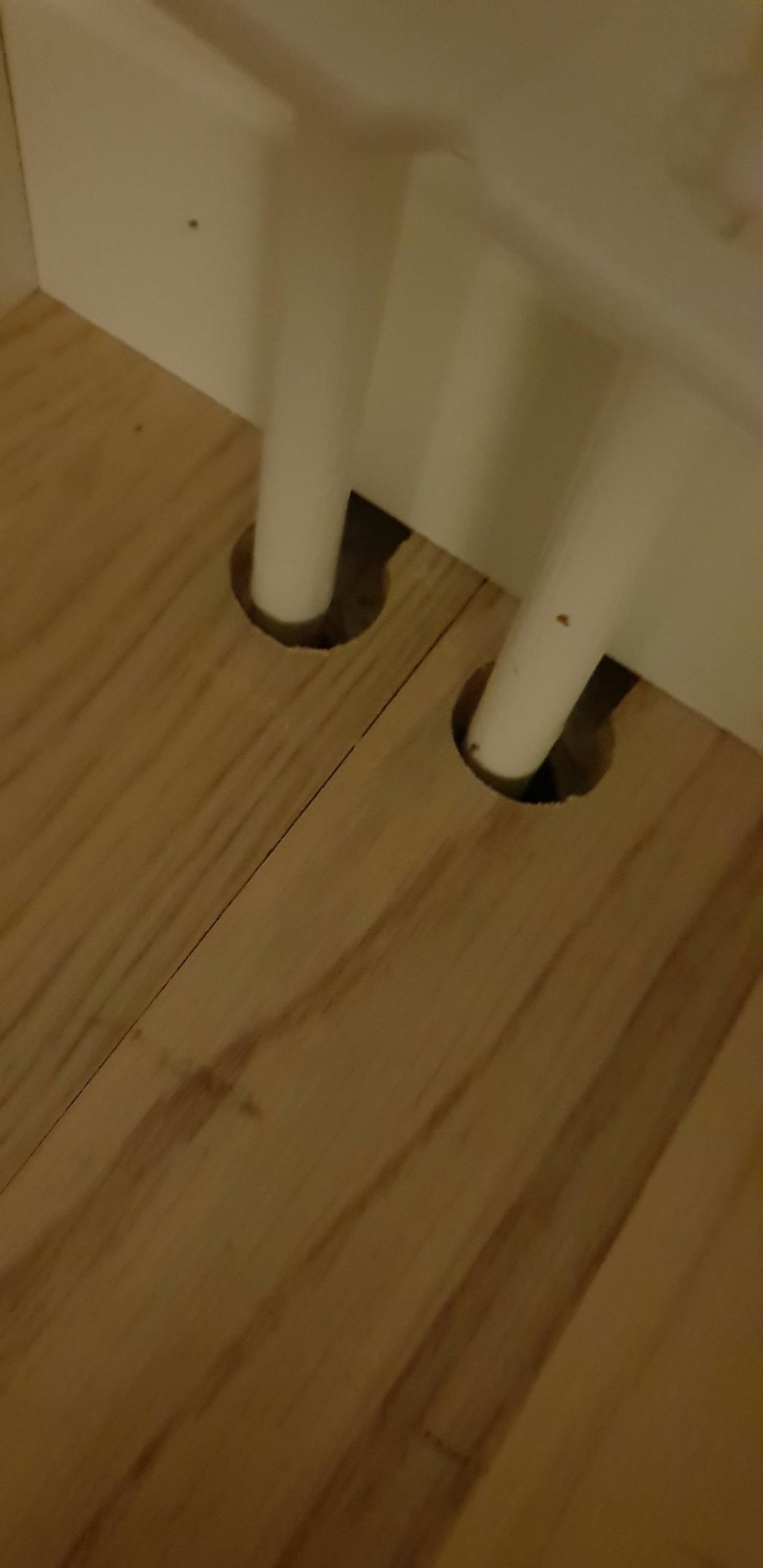
Have never heard of this problem before. What you're showing in the picture is what has been cut out in the parquet board, it should of course be covered with, for example, pipe collars. But if noise is coming up that way, it should also be leaking between the floor structure and the pipes. I assume the floor structure is made of prefabricated concrete? Can you see if you can shine a light down and maybe take a picture that also shows that, i.e., what it looks like under the parquet down into the hole?
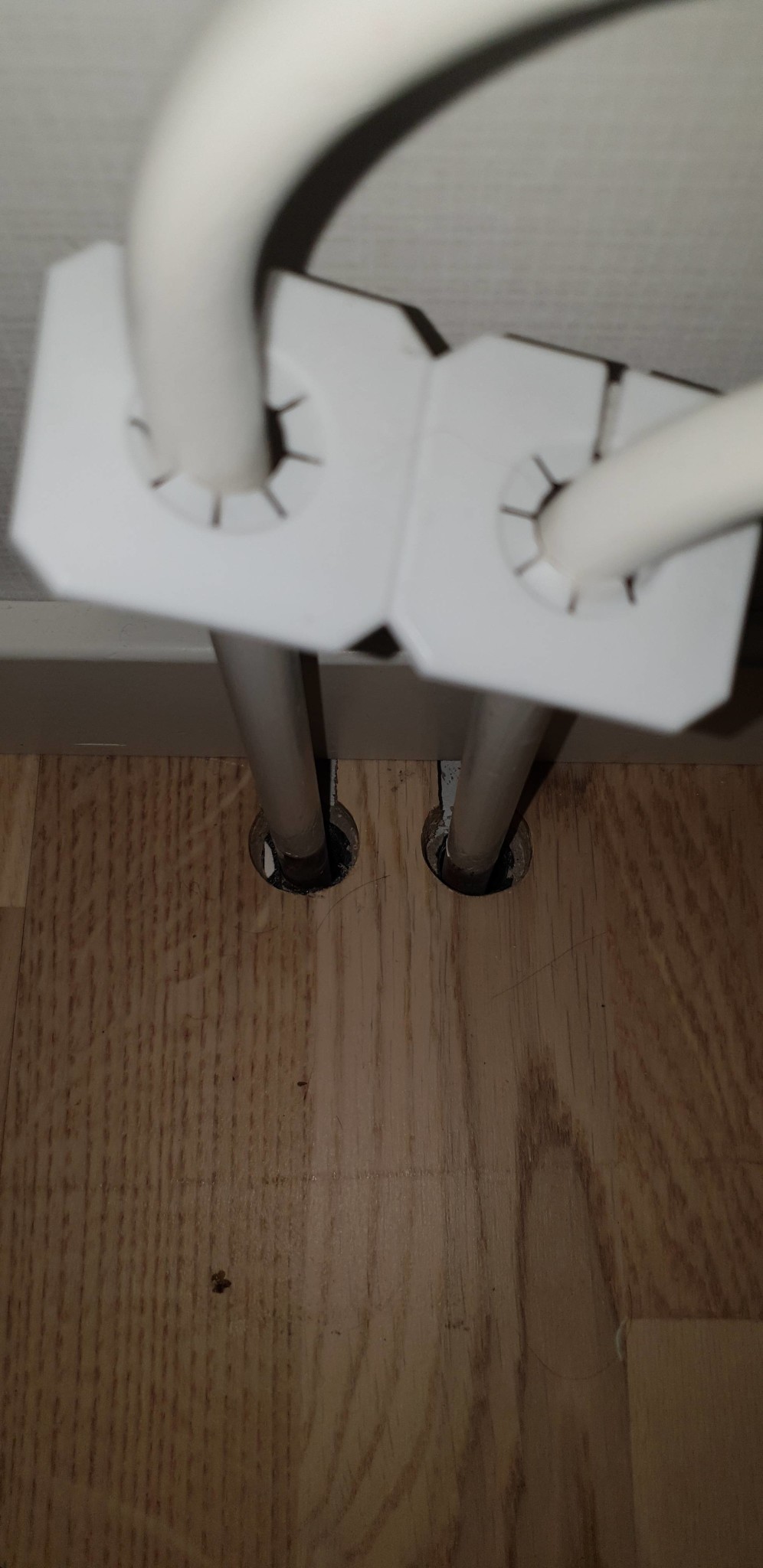
There is some kind of cover plate over it, attaching a picture.J Johan456 said:Have never heard of this issue before. What you show in the picture is what has been cut out in the parquet board, it should naturally be concealed with, for example, pipe collars. But if sound comes up that way, it should also be non-tight between the floor structure and the pipes. I assume the floor structure is made of prefabricated concrete? Can you see if you can shine a light down and maybe take a picture that shows that as well, like how it looks under the parquet into the hole?
I've tried to shine a light down but can't manage to see or get a really good picture. Attaching the pictures I took.
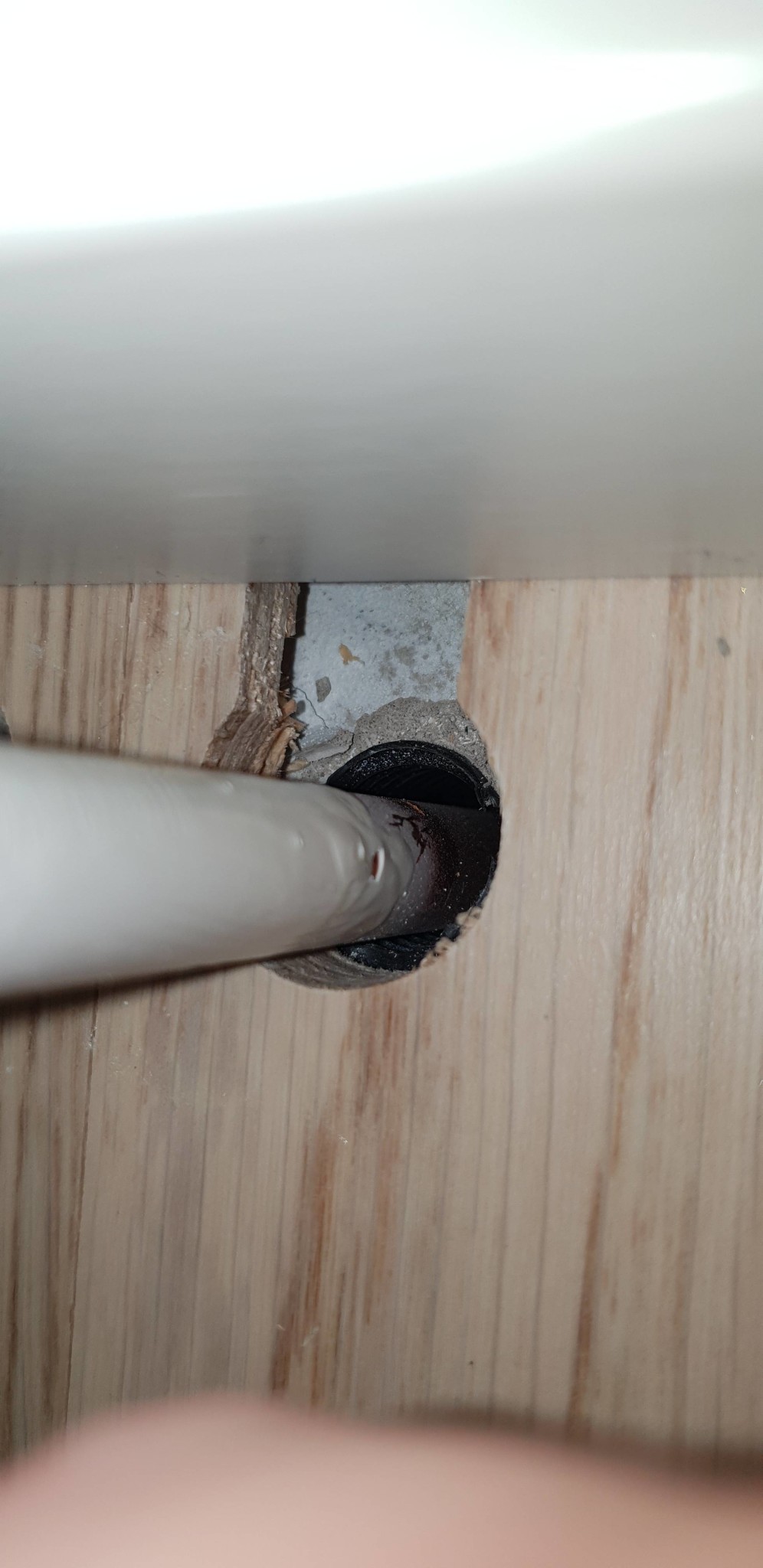
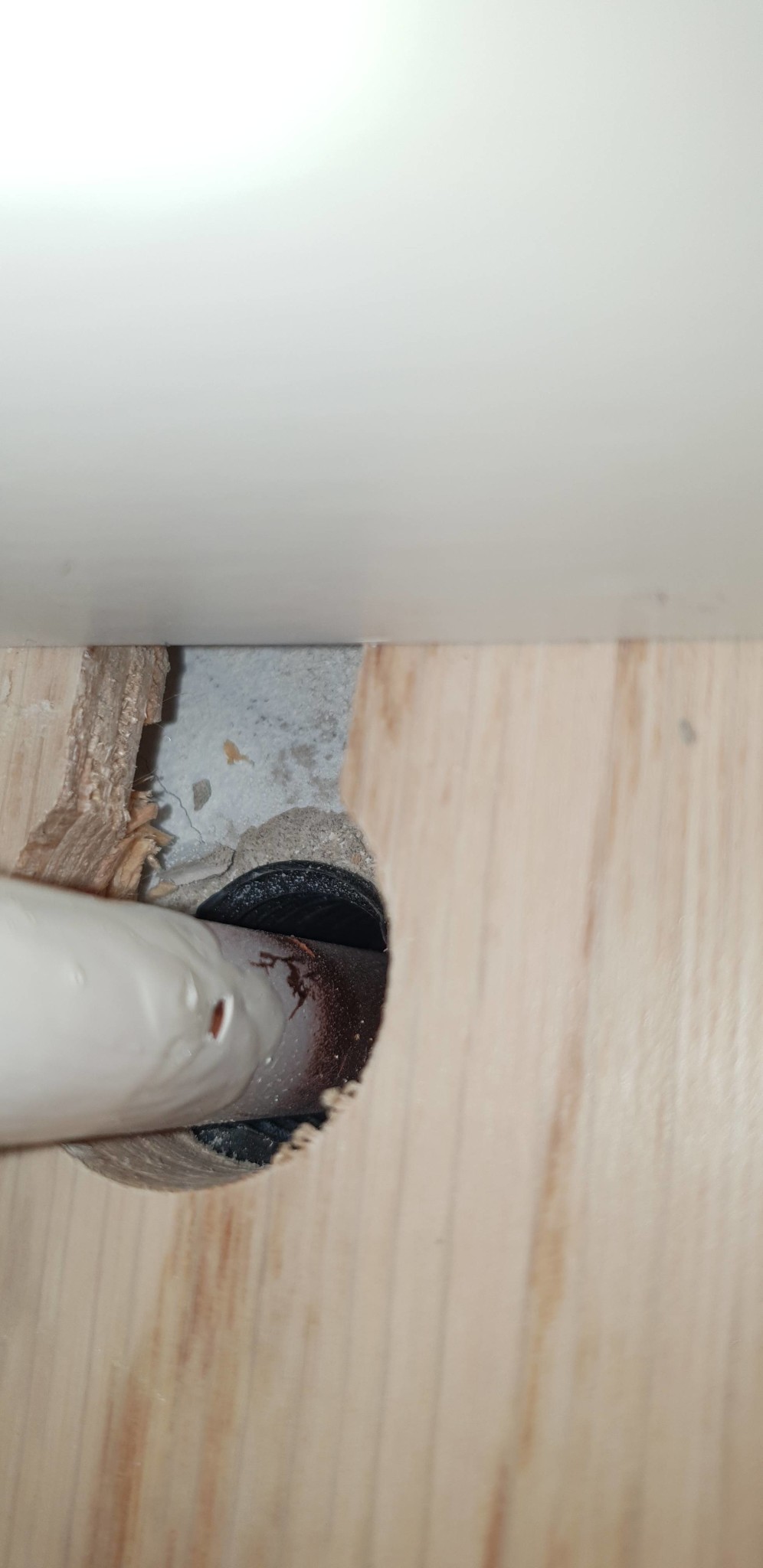
It looks like the radiator pipes are in pipes that were embedded during the casting of the slab. It seems to be missing insulation! Try inserting something long and pointed, e.g. a cooking probe. I think you should report it to the landlord; it should be considered "construction defect." I'm not an expert, but there should be noise requirements for new constructions.
Unfortunately, I don't have anything narrow enough; I'll see if I find something. My guess is that there is a similar pipe sleeve (if that's what they're called) in the apartment below. If I stick something all the way down, it will surely reach the neighbor.J Johan456 said:It looks like the radiator pipes are embedded in the slab during casting. It seems to lack insulation! Try to insert a long sharp object, like a cooking skewer. I think you should report it to the landlord; it could be considered "construction negligence". I'm not an expert, but there are certainly sound requirements for new constructions.
Once, I smelled cooking odors in my apartment, and I thought it came from the ventilation, but it's the modern type and takes air from elsewhere. I believe the cooking smell might have come up through the holes there.
I have reported this to the landlord, and they should still have a warranty on the work. I've read up a bit, and there are requirements regarding sound insulation, both for airborne noise (like voices) and impact noise. I hear some banging from below, like something being dropped on the floor. I don't know if the holes contribute to this.
Then there's also fire safety to be considered, and if it's completely open downwards, that can't possibly be met.
Thanks for the quick responses.
https://www.boverket.se/globalasset...t/2008/bullerskydd_i_bostader_och_lokaler.pdf
Page 108:
6.2 Risk Factors – General
The most common execution errors leading to shortcomings against set sound requirements are:
• air leakage through holes, gaps, and cracks
• unintended rigid connections between building parts that
should be separated, so-called structure-borne sound bridges
• unintended weak connections between building parts that
should cooperate rigidly can lead to unexpected flanking transmission
Air Leakage: Structures with high airborne sound insulation are sensitive to air leakage in holes, gaps, and cracks. This is because high sound levels in a room create fluctuations in air pressure, which pushes air through the openings and creates pressure fluctuations also in the adjacent receiver room. Even small gaps significantly degrade sound insulation, requiring great precision in seals and connection details. Manufacturers and planners should specify sealing measures and mark on construction documents where execution is critical for sound insulation.
Page 108:
6.2 Risk Factors – General
The most common execution errors leading to shortcomings against set sound requirements are:
• air leakage through holes, gaps, and cracks
• unintended rigid connections between building parts that
should be separated, so-called structure-borne sound bridges
• unintended weak connections between building parts that
should cooperate rigidly can lead to unexpected flanking transmission
Air Leakage: Structures with high airborne sound insulation are sensitive to air leakage in holes, gaps, and cracks. This is because high sound levels in a room create fluctuations in air pressure, which pushes air through the openings and creates pressure fluctuations also in the adjacent receiver room. Even small gaps significantly degrade sound insulation, requiring great precision in seals and connection details. Manufacturers and planners should specify sealing measures and mark on construction documents where execution is critical for sound insulation.
Another aspect is fire, which is much worse. In case of a fire in the apartment below you, your apartment should withstand fire for 60 minutes. If it is not sealed at all, it will not withstand, and you will get dangerous smoke gases in your home. This is very serious; fire sealing is very important. Emphasize this to your landlord; it should make him react. If it is indeed "open down," so to speak. But it should be extremely uncommon in new constructions.
Yes, well, I personally find it very hard to believe that it is completely open downwards. But considering that I can hear every word the neighbor says in a normal conversational tone through the pipes, I have a hard time seeing that what might "insulate" can withstand fire and smoke for 60 minutes.J Johan456 said:Another aspect is fire, which is much worse. In the event of a fire in the apartment below you, your apartment should withstand fire for 60 minutes. If it's not sealed at all, it won't do that, and you'll get dangerous smoke gases in your home. This is very serious, fire sealing is very important. Emphasize this to your landlord, it should get him to react. If it indeed is, so to speak, "open down." But it should be exceedingly rare in new construction.
Super great with your links and tips, especially the fire safety. The landlord can't talk his way out of that. And then good info, even if it is advisory, regarding airborne sound. Didn't know it was so sensitive with small air spaces, that they could make such a big difference.
Hello, this is a common error that I have seen many, many times when conducting sound measurements before the final inspection. The reason for not casting the pipes in place is mostly due to production reasons and also because you might get creaking noises in the pipes due to thermal expansion in the winter.
If you live in a multi-family building with about 250-260 mm of concrete in the floor structure (designed according to sound class B), you still meet BBR requirements even if this is not sealed. But BBR also states:
Buildings containing dwellings, their installations, and elevators should be designed so that noise from these and from adjacent spaces as well as noise from outside is dampened. This should occur to the extent that the intended use requires, and so that those residing in the building are not disturbed by the noise.
It is a construction error that should be addressed, and it is simply a matter of filling the holes with elastic, non-curing sealant and replacing the cover plate, and it is done, and you get rid of the sound leakage!
If you live in a multi-family building with about 250-260 mm of concrete in the floor structure (designed according to sound class B), you still meet BBR requirements even if this is not sealed. But BBR also states:
Buildings containing dwellings, their installations, and elevators should be designed so that noise from these and from adjacent spaces as well as noise from outside is dampened. This should occur to the extent that the intended use requires, and so that those residing in the building are not disturbed by the noise.
It is a construction error that should be addressed, and it is simply a matter of filling the holes with elastic, non-curing sealant and replacing the cover plate, and it is done, and you get rid of the sound leakage!
Click here to reply