
Hello!
I have a shelf that unfortunately collapsed due to overloading. Unfortunately, it also pulled the entire plug with it, resulting in a hole about the same size as a snus can, and I'm wondering how best to fix this.
Of course, I won't be using the area again to put anything up, so it's mainly about fixing it cosmetically.
Can you expect the plaster's load-bearing capacity to weaken if a new fixture is made 10-20 cm from the hole?
Thank you for your answer!
I have a shelf that unfortunately collapsed due to overloading. Unfortunately, it also pulled the entire plug with it, resulting in a hole about the same size as a snus can, and I'm wondering how best to fix this.
Of course, I won't be using the area again to put anything up, so it's mainly about fixing it cosmetically.
Can you expect the plaster's load-bearing capacity to weaken if a new fixture is made 10-20 cm from the hole?
Thank you for your answer!
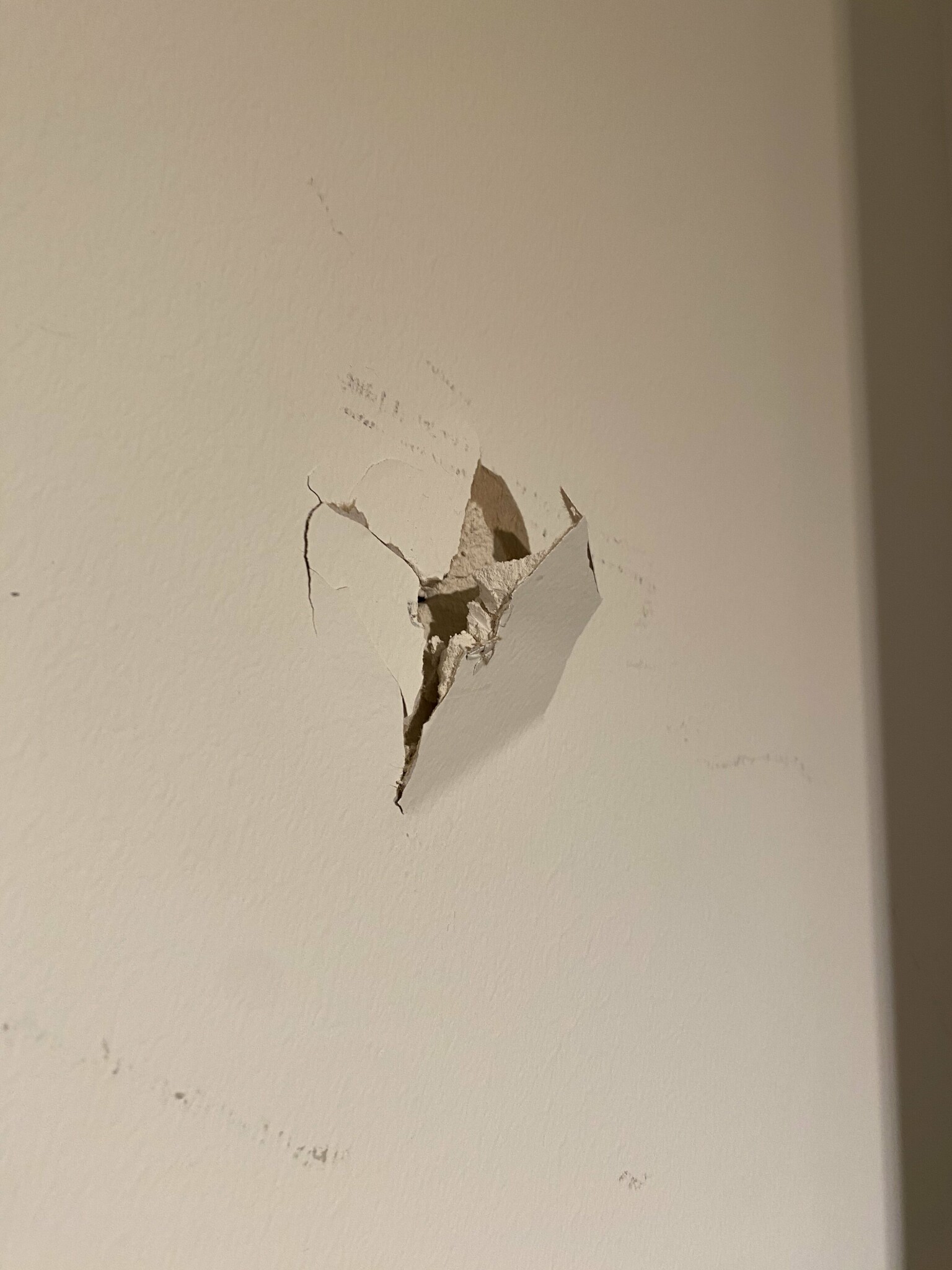
It might be foolish to set it up in exactly the same way? Look for a rule to screw it in if possible.
To fix that, you make a larger hole, square or round. Then you insert one or two pieces of wood across the hole (on the inside). Then cut a piece of drywall to the size of the hole and screw it into the wood. Spackle, paint, and move on with life.
To fix that, you make a larger hole, square or round. Then you insert one or two pieces of wood across the hole (on the inside). Then cut a piece of drywall to the size of the hole and screw it into the wood. Spackle, paint, and move on with life.
Unfortunately, there is no stud on this side, the shelf is attached to a stud on the other bracket. The plan is, of course, not to load as heavily or alternatively support it with a leg or the like on the outer edge instead.Nyfniken said:
It might be a bad idea to set it up in exactly the same way? Try to find a stud to screw into if possible.
To fix that, you make a larger hole, square or round. Then you place one or two wooden pieces across the hole (inside). Then cut a piece of drywall to the size of the hole that you screw into the board. Fill and paint and move on with life.
The repair sounds like a sensible idea. How do you attach the boards on the inside?

S Snajdarn12 said:Unfortunately, there is no rule on this side, the shelf is usually on the other bracket.
The plan is, of course, not to load as heavily, or alternatively support it with a leg or something similar on the outer edge instead.
Repairing sounds like a sensible idea. How do you attach the boards on the inside?
One method is to cut a triangular conical hole, meaning the hole is smaller on the inside. Then cut a piece of gips that is somewhat larger and sand it down so that it fits. Then simply glue it, sand, and paint. The advantage of this method is that the seam becomes minimal and it is fairly easy to sand to straight edges.
If you are going to follow the advice above, it's recommended to use a harder bröd, at least Wasa Husman, otherwise it will never hold 😎

Click here to reply