
2,995 views ·
5 replies
3k views
5 replies
Mold, should I replace the timber?

I want to start by saying that I am a total beginner in house and carpentry. I have torn out my old kitchen and, of course, one or two unwanted surprises have come up. The kitchen is as old as the house, built in 1942, so it's just about 80 years old.
Behind the sink there appears to be water damage with some mold. I guess it has leaked behind the sink over the years. It doesn't feel damp to the touch, but there is a faint yet noticeable "damp smell." The wood feels fairly healthy.
The plan is to put boards on this wall, and then the new sink will be roughly in the same place. Should I tear out and replace it? It wouldn't be an enormous extra job. Or just clean/sand it off? What do the experts say?
Behind the sink there appears to be water damage with some mold. I guess it has leaked behind the sink over the years. It doesn't feel damp to the touch, but there is a faint yet noticeable "damp smell." The wood feels fairly healthy.
The plan is to put boards on this wall, and then the new sink will be roughly in the same place. Should I tear out and replace it? It wouldn't be an enormous extra job. Or just clean/sand it off? What do the experts say?
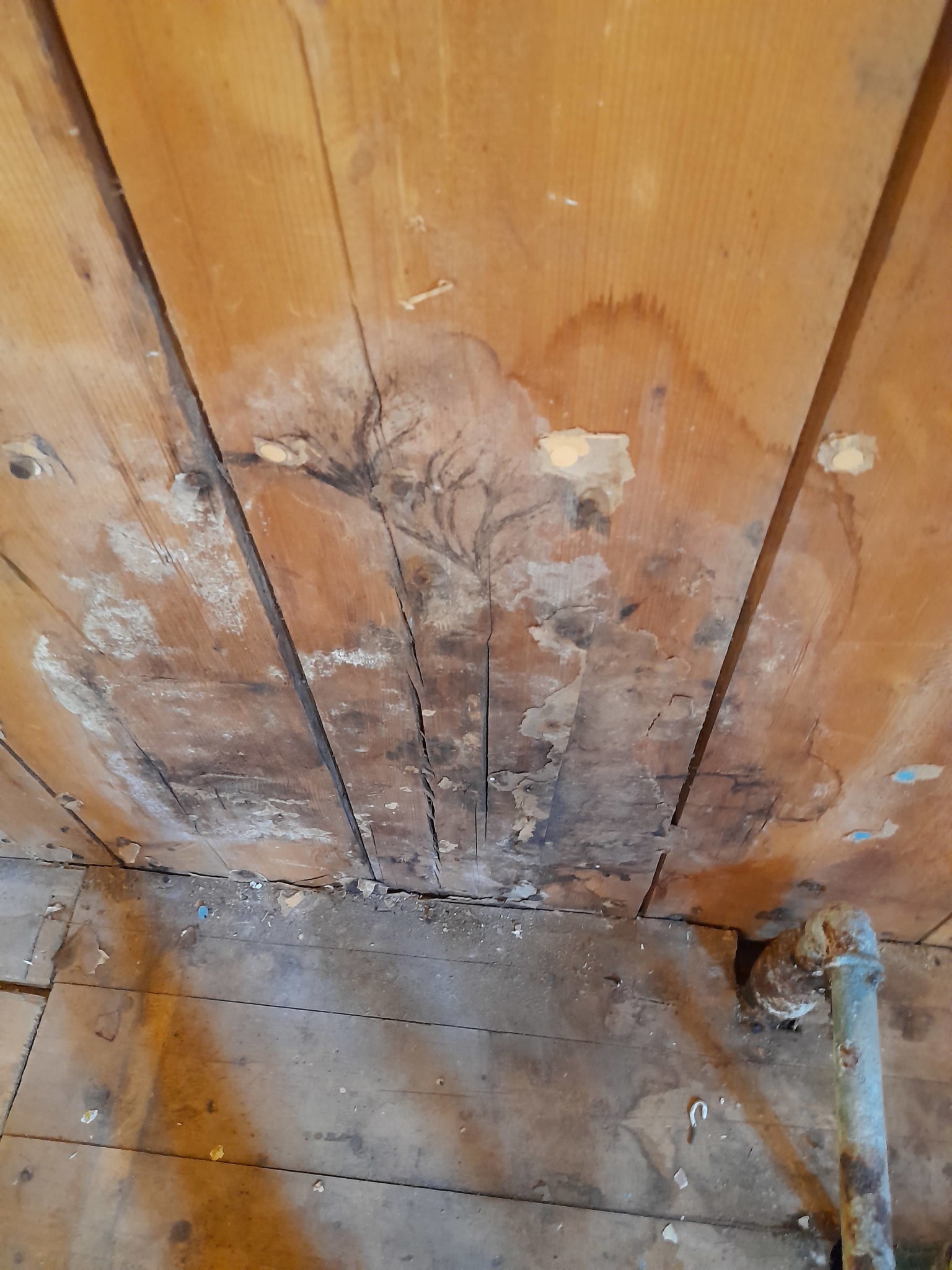

Just sand and brush on something suitable.
I don't think the wood looks particularly worn.
As long as you ensure the moisture doesn't return, it's fine.
I don't think the wood looks particularly worn.
As long as you ensure the moisture doesn't return, it's fine.

Homeowner
· Småländska höglandet
· 5 686 posts
I think that thread-like thing looks like mushroom mycelium. Take off the boards while you're at it and see what it looks like on the back!
Check the moisture content; if it's high, there is a risk of believing that something behind it is supplying moisture. If it's low, it's most likely water damage from earlier. If that's the case, I would sand it off and treat it with something like Jape to be on the safe side. Removing it will require quite a bit of work since it looks like thick planks (which is common from the time the house was built). Also, check the moisture content in the planks on the floor.
Thank you. There is no possible moisture source behind the wall, and I replaced the roof about a year ago, at that time there was no moisture in the attic. I'm almost completely convinced that it's coming from the sink, which had a very strange tilt and definitely wasn't sealed against the wall behind it.C claym said:Check what the moisture content is, if it's high there's a risk something behind it is supplying moisture. If it's low, it's most likely a past moisture damage. If so, I would sand it away and treat it with Jape, for example, to be on the safe side. Removing it will require quite a bit of work as it looks like thick planks (which is common from the time the house was built). Also check the moisture content in the floor planks.
Best answer
Then I would have, as I wrote, sanded it off and brushed on something like jape. Alternatively, ignored it completely. For mold to grow, it requires: moisture, the right temperature, and organic material. If you remove one of these, it won't grow (since you don't have an additional source of moisture, that factor is gone).
I had an almost identical situation as you: water damage behind a panel I removed. Exactly where the damage was, a sink had been. A little mold, but the planks were bone dry, so I brushed a little and am satisfied with that...
I had an almost identical situation as you: water damage behind a panel I removed. Exactly where the damage was, a sink had been. A little mold, but the planks were bone dry, so I brushed a little and am satisfied with that...
Click here to reply