
8,495 views ·
35 replies
8k views
35 replies
Load on an edge element
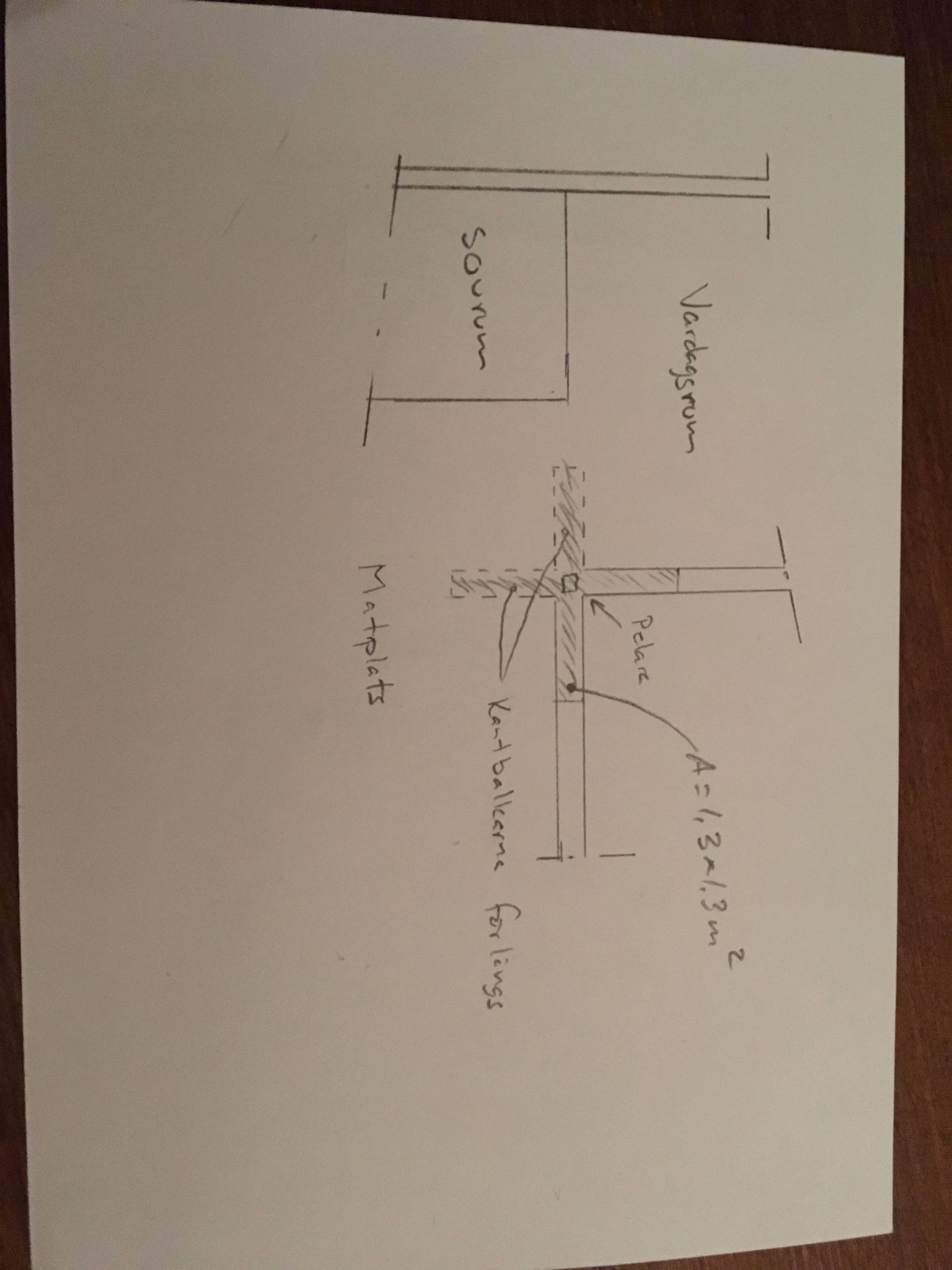
If we haven't misunderstood each other, then my upcoming sketch works. Just for the constructor to reinforce the foundation beams 

With Bosse in the team, no one loses their grip...
Without meaning this as criticism of TS (a house buyer shouldn't need to be an expert), I think one can still draw some conclusions of general interest. As I understand the house design, all major loads (including mid-floor and roof) are supported by the edge beams on the long sides. The permissible ground pressure of only 70 kPa indicates that the ground conditions are challenging. Therefore, I think the combination of house design and ground is unsuitable, which TS should have been informed about.
Regarding the house design, I also think that the angled extension with the living room is unfortunate. I also find it questionable to have concrete pillars and a concrete beam in the facade today.
Without meaning this as criticism of TS (a house buyer shouldn't need to be an expert), I think one can still draw some conclusions of general interest. As I understand the house design, all major loads (including mid-floor and roof) are supported by the edge beams on the long sides. The permissible ground pressure of only 70 kPa indicates that the ground conditions are challenging. Therefore, I think the combination of house design and ground is unsuitable, which TS should have been informed about.
Regarding the house design, I also think that the angled extension with the living room is unfortunate. I also find it questionable to have concrete pillars and a concrete beam in the facade today.
Hello
I have a shared contract and have truly divided all parts of the job.
I am considering whether I should change K for the foundation because he is being a bit obstinate. The solution he provides will cost me a lot.
I have presented Bosse's solution and he says it is not enough. I can accept that for large loads (8 tons) (e.g. at columns), one should have reinforcement or a separate slab under the slab, and then reinforce so that the load is distributed over a larger area.
What irritates me the most is that I can't come up with a solution myself that proves to him it works and whether what he says can really be true. Therefore, I have questions that someone might be able to answer so I can show it in my designer's face.
100 kpa on my plot results in a settlement of 1.6
8 tons require a separate slab under my slab
1.8 tons per M cannot be handled by a regular L element with stirrups and edge reinforcement?
I am considering using Balkelement by jackson if it would help.
Is there anyone who can take their time and provide a proper calculation? I am more than willing to pay since I am going crazy here!
Having trouble sleeping because of this.
I have a shared contract and have truly divided all parts of the job.
I am considering whether I should change K for the foundation because he is being a bit obstinate. The solution he provides will cost me a lot.
I have presented Bosse's solution and he says it is not enough. I can accept that for large loads (8 tons) (e.g. at columns), one should have reinforcement or a separate slab under the slab, and then reinforce so that the load is distributed over a larger area.
What irritates me the most is that I can't come up with a solution myself that proves to him it works and whether what he says can really be true. Therefore, I have questions that someone might be able to answer so I can show it in my designer's face.
100 kpa on my plot results in a settlement of 1.6
8 tons require a separate slab under my slab
1.8 tons per M cannot be handled by a regular L element with stirrups and edge reinforcement?
I am considering using Balkelement by jackson if it would help.
Is there anyone who can take their time and provide a proper calculation? I am more than willing to pay since I am going crazy here!
Having trouble sleeping because of this.
I would advise you not to change K at this stage. Your designer is embedded in the project and hopefully has a good overall view. If you are to change the designer, you should demand a complete load calculation to the foundation from your current K.M MackanM said:Hi
I have a shared contract and have really divided all parts of the job.
I'm sitting here considering whether to change K for the foundation because he's being a bit stubborn. The solution he's providing will cost me a lot.
I've presented Bosse's solution and he says it's not enough. I understand that for large loads (8 tons) (for example, at columns) you need reinforcement or a separate slab under the slab, and you can then reinforce so that the load is distributed over a larger area.
What frustrates me the most is that I can't come up with a solution myself to show him that it can be done and whether what he's saying is really accurate. Therefore, I have questions that someone might be able to answer so I can show it in my constructor's face.
100 kpa on my plot results in a settlement of 1.6 8 tons require a separate slab under my slab 1.8 tons per M a regular L element with ties and edge reinforcement can't handle? I could consider using Balkelement by Jackson if it would help.
Is there anyone who can take their time and provide a proper calculation? I am more than willing to pay as I am going crazy here!
Difficult to sleep because of this.
The designer is not wrong that there are "complicated" (expensive) solutions compared to a "regular" house foundation. When you have large spans and few vertically supporting elements, the loads are concentrated and large compared to a "regular" house. This, combined with less optimal ground, often requires more extensive foundations.
The problem the designer has is that the loads end up far out on the slab. Using L-elements means the edge beam is loaded eccentrically, and the stress in the ground becomes locally greater than if the load was centered on the edge beam. This moment can be managed in the slab, but it requires a slightly thicker slab than usual.
You can also cast a slab under the edge beam on which the L-element is then placed. This also requires a higher class of insulation than normal.

You can also use piling. However, a thicker slab is required, but you can use standard L-elements.
All measures involve an increased cost, so it's difficult to avoid.
We also discussed privately that using Alba beams as the designer suggested, is not a good solution in my opinion.
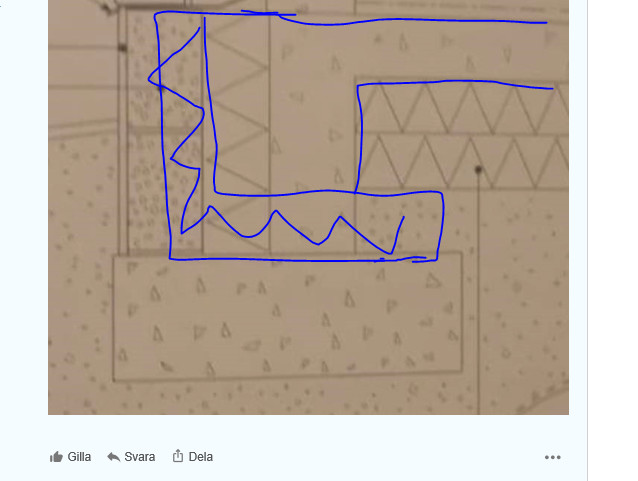
A rough example: Slab~2.5kPa, Edge beam~60kPa. (60-2.5)/100*16mm=9.2mm settlement difference between the slab and beam. It will crack nicely. I would have made a homogeneous solution of reinforced concrete so that the edge beam and slab are connected. You want everything to be connected so the loads can be distributed better and achieve a more even settlement profile.
Last edited:
A "simple" solution would be to use the longitudinal central walls on the ground floor as load-bearing core walls with appropriate reinforcement of the slab underneath them, but that might be pushing the boundaries too much? HusCompagniet's website unfortunately does not provide much help in this regard. Piling must also be interesting with such poor soil conditions.
Click here to reply