

Since the type of house we are renovating/remodeling is quite common, we hope that someone wise and experienced on this forum can help us.
The house is a typical 69+69 sqm house (basement+living floor) built in 1939 and is located in the southern suburbs of Stockholm. What we are wondering is if someone can help us identify potential load-bearing walls, either because you know similar houses or you can see it in the drawings. Both drawings differ a bit from how the house was actually built. In the basement, the pantry has been moved forward towards the stairs and there is a small tiled room behind it (like an old toilet/shower). On the upper floor, there are no closets or any wall in the outer hall (to the right of the chimney), and the wall that runs between the hall and bedroom/kitchen is in line with the wall between the dining room and living room.
Hope I didn’t complicate things too much and that someone has some good ideas!!!
The house is a typical 69+69 sqm house (basement+living floor) built in 1939 and is located in the southern suburbs of Stockholm. What we are wondering is if someone can help us identify potential load-bearing walls, either because you know similar houses or you can see it in the drawings. Both drawings differ a bit from how the house was actually built. In the basement, the pantry has been moved forward towards the stairs and there is a small tiled room behind it (like an old toilet/shower). On the upper floor, there are no closets or any wall in the outer hall (to the right of the chimney), and the wall that runs between the hall and bedroom/kitchen is in line with the wall between the dining room and living room.
Hope I didn’t complicate things too much and that someone has some good ideas!!!
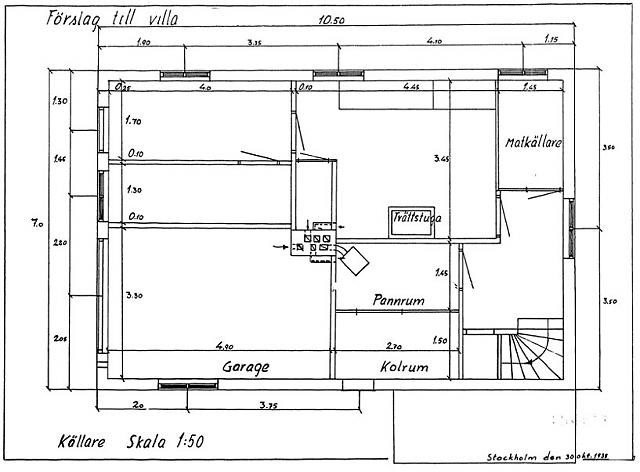
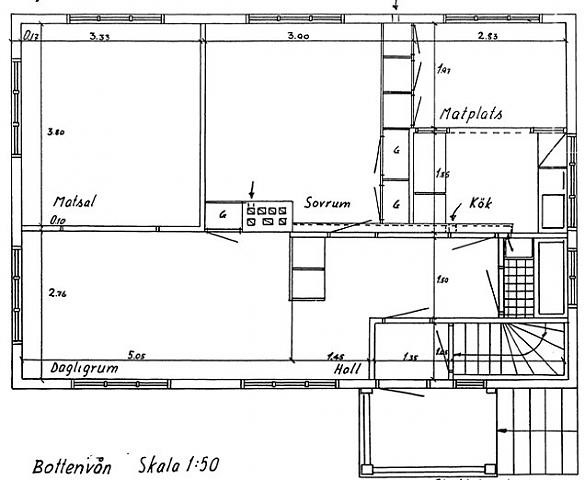

We have a similar house, but with an upper floor as well.
There, the walls that go through the middle of the house across the trusses are load-bearing. In the basement of our house, these walls are 20 cm instead of 10, which the non-load-bearing walls are. On your drawing, it doesn't look like any walls in the basement are a bit thicker. Is that the case in reality as well?
Probably, the horizontal wall in the middle of the house in the picture supports the floor to the attic.
And probably, the corresponding wall in the basement supports the wall on the ground floor.
There, the walls that go through the middle of the house across the trusses are load-bearing. In the basement of our house, these walls are 20 cm instead of 10, which the non-load-bearing walls are. On your drawing, it doesn't look like any walls in the basement are a bit thicker. Is that the case in reality as well?
Probably, the horizontal wall in the middle of the house in the picture supports the floor to the attic.
And probably, the corresponding wall in the basement supports the wall on the ground floor.
Sounds like our project is quite similar to yours overall. Great, then we have someone who's one step ahead and can be asked for advice. 
We haven't really tackled the basement with a measuring tape yet, so I don't really know how it differs from the drawing. However, I do know that my partner's grandfather (who built the house and its extension) wasn't very meticulous about building the exact same thing he got a building permit for...
Continuing with a follow-up question:
On the upper floor, we are thinking of making a room in the lower left corner, the door would then be roughly where the built-in closet is. Possibly the opening needs to be widened a bit, but we plan to block off the entire opening to the dining room. We will also close the opening to the kitchen, but possibly widen the opening to the current bedroom a little. So overall, we will definitely close off more than we are removing. Is there anything specific to consider when building the wall so that even what we add helps with support? Is there any risk that we will need to support due to the widenings we want to make, even if we close off all the other openings?
We haven't really tackled the basement with a measuring tape yet, so I don't really know how it differs from the drawing. However, I do know that my partner's grandfather (who built the house and its extension) wasn't very meticulous about building the exact same thing he got a building permit for...
Continuing with a follow-up question:
On the upper floor, we are thinking of making a room in the lower left corner, the door would then be roughly where the built-in closet is. Possibly the opening needs to be widened a bit, but we plan to block off the entire opening to the dining room. We will also close the opening to the kitchen, but possibly widen the opening to the current bedroom a little. So overall, we will definitely close off more than we are removing. Is there anything specific to consider when building the wall so that even what we add helps with support? Is there any risk that we will need to support due to the widenings we want to make, even if we close off all the other openings?
In general, new or widened openings in load-bearing walls need to be supported. (not a big job in the normal case). If you widen an opening (e.g. the closet), you destroy the existing load distribution (e.g. beam above the opening). Sealing it off doesn't matter since those openings are already supported.
Draw on the plan what you want to do so the house is suitable and functions for your needs. Then, bring in a builder to get assistance with the assessment and what needs to be done. Don't let the work of supporting a new opening ruin your floor plan.
/Mats
Draw on the plan what you want to do so the house is suitable and functions for your needs. Then, bring in a builder to get assistance with the assessment and what needs to be done. Don't let the work of supporting a new opening ruin your floor plan.
/Mats
Btw. Installing a door in the wardrobe for entrance to the bedroom might work (maybe a bit of a corridor feeling due to the chimney and wall). Widening it would be more difficult since it's squeezed between the chimney stack and the wall to the dining room.
How many changes are you planning to make? If you sketch what you want to achieve and share your thoughts, there are surely plenty of tips to get from the forum. (e.g., are you planning to add a bathroom on the upper floor? how many rooms do you want to have?)
/M
How many changes are you planning to make? If you sketch what you want to achieve and share your thoughts, there are surely plenty of tips to get from the forum. (e.g., are you planning to add a bathroom on the upper floor? how many rooms do you want to have?)
/M
Said and done.
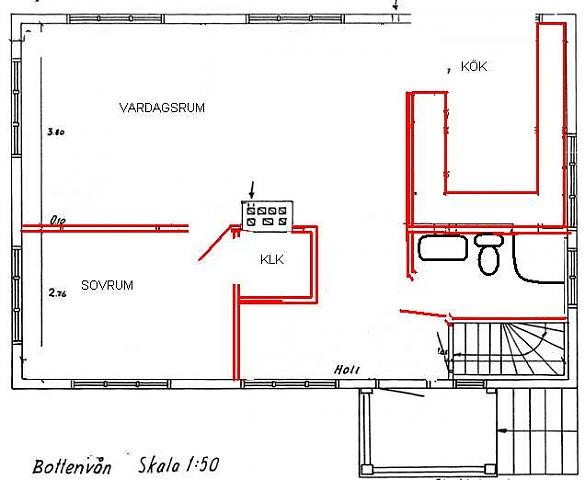
Something like this is how we think we want it. Where the outer wall in the kitchen was removed, an extension was made in '67, so in that part, we plan to try to add another bathroom and two or three rooms. But we thought of changing the old part of the building like this. A bedroom with a closet (sliding door between), a hall with hanging space (which doesn't exist today), extending the existing bathroom, and changing from a parallel kitchen to a U-shaped kitchen. Note that it's all done a bit quickly in paint, so it's hardly to scale...
What's affecting the (likely) load-bearing wall is that the existing openings beside the chimney will become a bit wider, and the rest will be sealed.
Something like this is how we think we want it. Where the outer wall in the kitchen was removed, an extension was made in '67, so in that part, we plan to try to add another bathroom and two or three rooms. But we thought of changing the old part of the building like this. A bedroom with a closet (sliding door between), a hall with hanging space (which doesn't exist today), extending the existing bathroom, and changing from a parallel kitchen to a U-shaped kitchen. Note that it's all done a bit quickly in paint, so it's hardly to scale...
What's affecting the (likely) load-bearing wall is that the existing openings beside the chimney will become a bit wider, and the rest will be sealed.
Aha,
What a transformation it will be! Looks like you've put a lot of thought into it.
The hallway will become much more airy. I wouldn't worry about the load-bearing walls at this stage. But as I said, bring in a builder just to be safe.
You can probably support the openings with beams that you recess above the arches.
(there are a couple of threads about this on the forum)
Good luck!
What a transformation it will be! Looks like you've put a lot of thought into it.
The hallway will become much more airy. I wouldn't worry about the load-bearing walls at this stage. But as I said, bring in a builder just to be safe.
You can probably support the openings with beams that you recess above the arches.
(there are a couple of threads about this on the forum)
Good luck!
Click here to reply