Hello,
After several hours as an anonymous reader, it's now my turn to ask a question
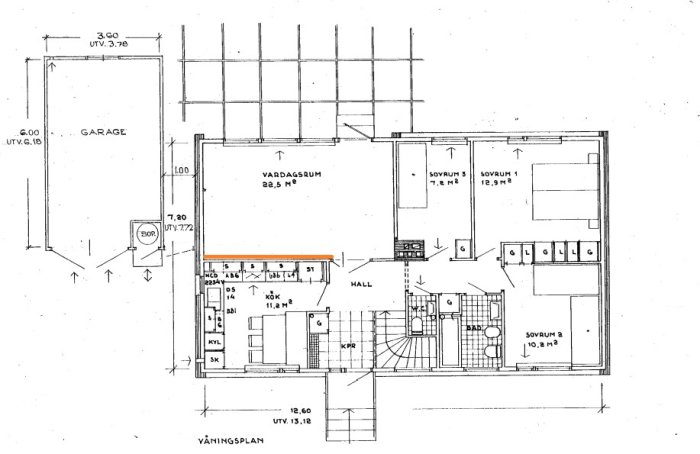
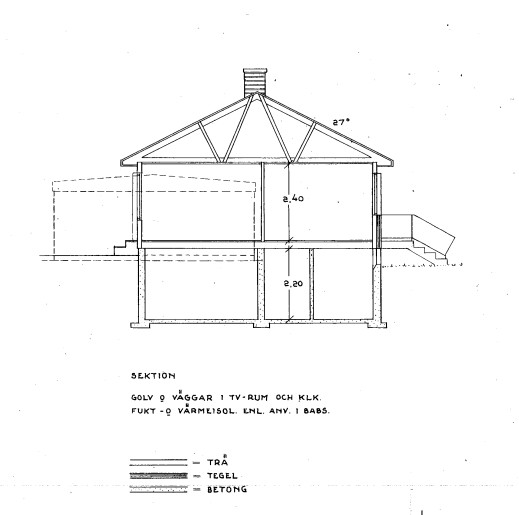
I'm in the process of replacing our old kitchen and simultaneously opening up between the kitchen and living room to achieve a more open floor plan. My problem is that I can't quite interpret the plans to determine if the wall to be removed is load-bearing or not, and if it is not load-bearing, will the ceiling sag if I remove the wall? The wall to be removed is about 4 m and the total dimension of the opening will be 5.5 m. (See image)
I would preferably like to avoid reinforcing the rafters as I don't want a visible glulam beam inside, and the ventilation duct is "in the way" for reinforcing in the attic.
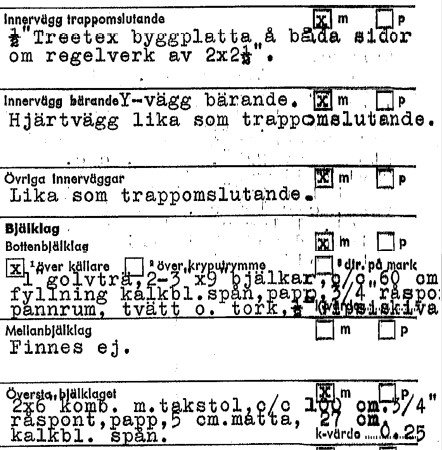
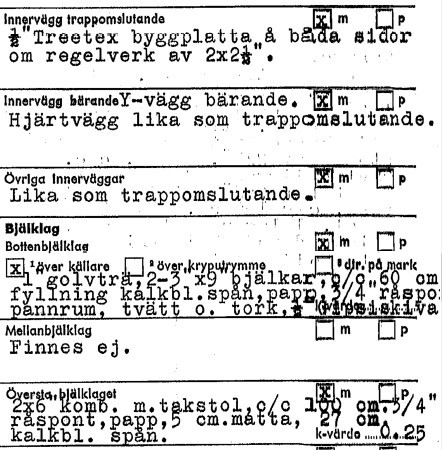
The interior wall consists of 2 x 2 1/2" studs with treetex boards on them.
The rafters are of dim. 2 x 6" and the collar tie is 2 x 5; the center distance of the rafters is 100 cm.
Grateful for all the advice I can get regarding this
Hey,
When you read it says that the outer wall, the core wall, and the stair-surrounding wall are load-bearing.
Looking at the drawing, it shows that this is true as well.
You can create smaller openings that you locally offset, but I would at least be careful about creating any larger openings in that wall without offsetting it.
Yes, it is clearly visible on the drawing and in the text that the wall is load-bearing:
Partly because the wall is included in the drawing, partly because it is clearly stated that the core wall, which the wall between the kitchen and living room is part of, is load-bearing.
If you use a steel beam, you will get neater dimensions.
Yes, it is clearly visible on the drawing and in the text that the wall is load-bearing:
The wall is included in the drawing, and it states explicitly that the heart wall, which the wall between the kitchen and living room is part of, is load-bearing.
If you use a steel beam, you'll get slimmer dimensions.
Okay, thanks for the quick response
Then there's no doubt anymore.
To get the correct dimensions for glulam or a steel beam, is the only option to contact a structural engineer?
I have contacted a constructor to calculate a glulam beam. The response was that the wall is not load-bearing. He explained that since the house is only 7.2m wide and the partition wall is built from 2x2.5" the wall is not load-bearing. He also found a technical description of the roof stating: Type material dim. 2x6" self-supporting in truss construction, 100cc.
The technical description is what reveals it all, "free-standing".
Most likely the text referring to the "hjärtvägg" is about the wall in the basement.
The roof trusses, by the way, look quite similar to mine where we have free-standing at 8.0m, 2x7" in our case.
Hello
To be able to answer your renovation questions constructively, a bit more information is needed.
The location of the house and the year it was built are two interesting pieces of information. To calculate roof loads, current snow and wind loads are needed (the town and municipality are sufficient). The year of construction indicates the remaining structural lifespan.
The year of construction also says a lot about the building technique: is the roof truss prefabricated or built on-site, is it nailed together with manual nailing plates or factory-made nailing plates? Perhaps it is nailed with overlapping lapping. Judging by the description, the latter seems to be the case.
The wall itself is partially load-bearing. This is because, after a number of years of load variations on the trusses, which have started to settle slightly, it has begun to take some load, which is natural. However, the truss is probably still self-supporting, especially with the relatively short span.
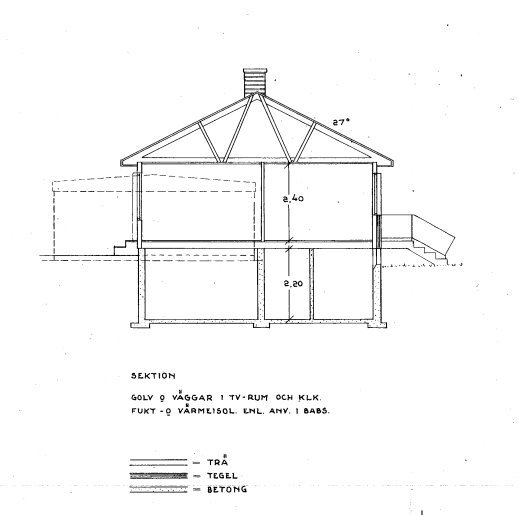
Judging by the construction description with a mixture of dimensions, both handwritten and drawn, with both centimeters, meters, inches, and others, the document was written no later than around 1965. However, after studying the content in the joists, including sawdust mixed with lime, the construction period should be placed between 1940-1950. However, the presence of the extremely time-specific word TV room right under the section indicates the construction year is 1956, could that be correct?
Hello
To be able to answer constructively on your renovation questions, a bit more information is needed.
The location of the house and the construction year are two interesting details. To calculate roof loads, the current snow and wind loads are needed (city and municipality are sufficient). The construction year indicates the remaining structural lifespan.
The construction year also says a lot about the building technique: is the roof truss prefabricated or built on site, is it nailed together with manual nail plates or factory nail plates. Perhaps it is nailed with overlaps. Judging from the description, the latter seems to apply.
The wall itself is partially load-bearing. This is because after several years of load changes on the trusses causing them to settle slightly, it has started to bear some load, naturally. However, the truss is probably still self-supporting, especially with the relatively short span.
Judging from the building description with a mix of both handwritten and drawn measurements in centimeters, meters, inches, and other units, the document was written no later than around 1965. After studying the table of contents in the joists including sawdust mixed with lime, the construction period should be placed between 1940-1950. However, the presence of the highly time-specific word TV room right under the section places the construction year to 1956, does that sound right?
Not far off The house was built in 1966, snow zone 2.0, wind load zone 24. The roof trusses are built on site without nail plates.
I also agree with your point that over the years, the wall has become more or less load-bearing, at least for the ceiling.
I've decided to support visibly with a steel beam to be on the safe side.
I'm considering what type of beam and size would be reasonable? I'd prefer to use an IPE beam as I want to integrate one of the posts into the adjoining interior wall, and an HEA beam would be a bit too wide.
Many houses built during this period have self-supporting trusses, but at the same time, many of these houses have a variant that is not self-supporting but relies on the middle resting on the interior wall that acts as a heart wall in the house. The only way to be sure is to inspect how it looks, which is easiest done by digging on the attic to the potential joints in the roof rafters. Are the roof rafters spliced in the middle and if so, how are they spliced...
Or you play it safe and assume that you need to reinforce the wall. Once you have given all the facts to a structural engineer, he will be able to help you with whether the truss is indeed self-supporting or not.
As I wrote earlier, I, at least, would not assume they are self-supporting with the uncertainties that exist.
Many houses built during this period have self-supporting trusses, but at the same time, many of these houses have a variant that is not self-supporting and relies on the center resting on the interior wall running as a heart wall in the house.
The only way to be sure is to inspect how it looks; this is easiest done by digging into the possible joints in the roof beams in the attic.
Are the roof beams spliced in the middle, and if so, how are they spliced...
Or you take the safe route and assume that you need to reinforce the wall. When you have provided all the facts to a structural engineer, they will be able to help you determine if the truss is indeed self-supporting or not.
As I wrote earlier, I personally would not assume they are self-supporting given the uncertainties that exist.
/Peter
The trusses are spliced in the middle, there is a beam on each side of the splice that is approximately 1m, which is tightly nailed.
Yes, it is better to be on the safe side. The ventilation duct can absolutely be moved. I think I will, however, place it visibly. I would preferably like to have a steel beam to reduce the dimension. Any ideas on the size of an IPE beam?
Since they are spliced in the way they are, I believe without having calculated it that they are free-bearing, but I think considering the age of the house that the wall, as previously mentioned, is partially load-bearing since everything has "sagged a bit."