
Trying to determine if I have a load-bearing wall in the middle of the house or not. I'm considering removing about 1.5 meters of it to get a more open floor plan.
What might indicate that it's not load-bearing so far:
* The wall is not thicker than other walls, neither on the drawing nor in reality.
* The roof trusses are of the truss type (self-supporting?). http://www.timmele.com/pics/takstolar/fackverk_takstol.jpg
The question is if there are more ways to figure this out or if someone needs to be brought in to calculate it? The house was built in '65.
What might indicate that it's not load-bearing so far:
* The wall is not thicker than other walls, neither on the drawing nor in reality.
* The roof trusses are of the truss type (self-supporting?). http://www.timmele.com/pics/takstolar/fackverk_takstol.jpg
The question is if there are more ways to figure this out or if someone needs to be brought in to calculate it? The house was built in '65.

The safest bet, of course, is to bring in one of those ingen-gör. But there might be someone here who knows. Can you describe a bit more where the wall is located? Pictures are great!
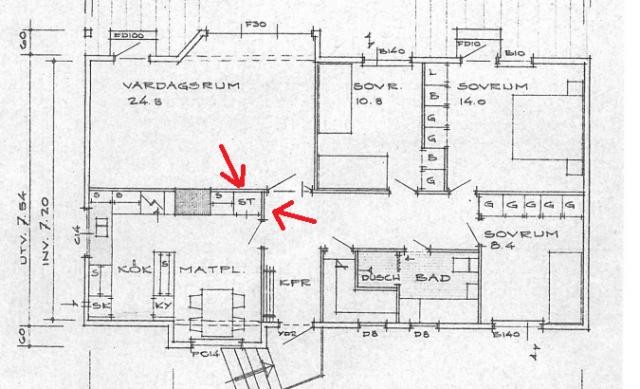
Is it two floors or just an attic, it looks like a staircase is drawn in.


It looks like it, but it actually doesn't seem uncommon to have self-supporting trusses. However, maybe not in the 60s? A beam with a pillar on each side then, I guess? Or could the beam be attached to the chimney stack on one side perhaps?

Bearing or not, not easy to say, but if you tear down the wall, you can see if there's a beam at the top end of the wall or if the stud spacing is tighter than other walls. If that's the case, I would place the beam in the attic and strap the roof trusses to it, so you don't have to have the beam visible on the inside = nicer in my opinion.
That seems really convenient if you can place the beam up in the attic. I have read about it before but perceived it as a workaround. Is it an accepted way to create an opening?enSAM said:Load-bearing or not, it's not easy to say, but if you tear down the wall, you'll see if there's a beam at the top end of the wall or if the stud spacing is tighter than other walls. If that's the case, I'd put the beam in the attic and hang the rafters off it, so you don't have the beam visible inside = neater, in my opinion.
Click here to reply