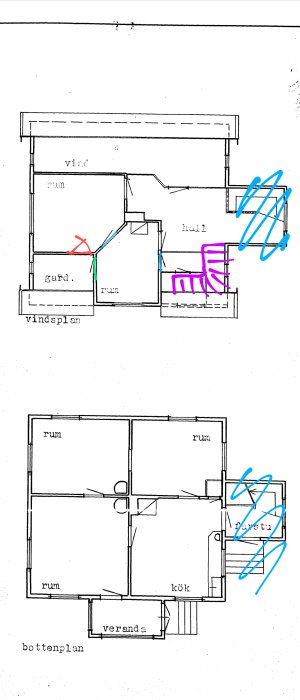
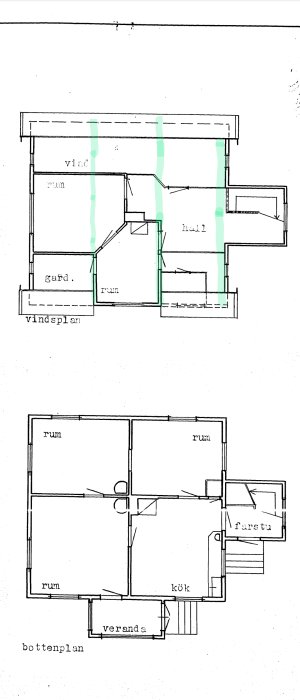
I would like to install a door between the bedroom and the walk-in closet upstairs, so that we can go that way instead of via the balcony room.
I.e., create a door where the red marking is and close up at the green one. The blue one is already closed up, and the stairwell to the right has been demolished with the stairs now indoors instead. The layout and room division aren't quite accurate. However, I can't find a newer digital drawing...
The wall in question is 260 cm.
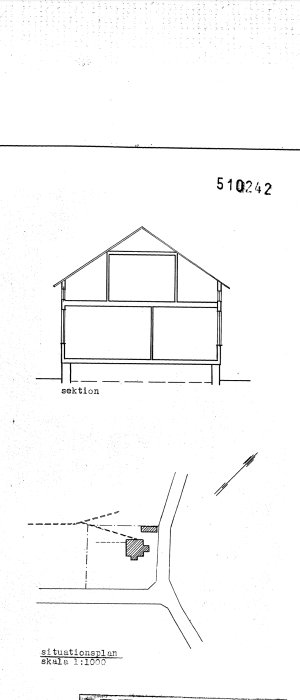
There is no wall directly below, but you can see the wall in the cross-section.
An internal wall only exists in that third of the house, not further to the right.
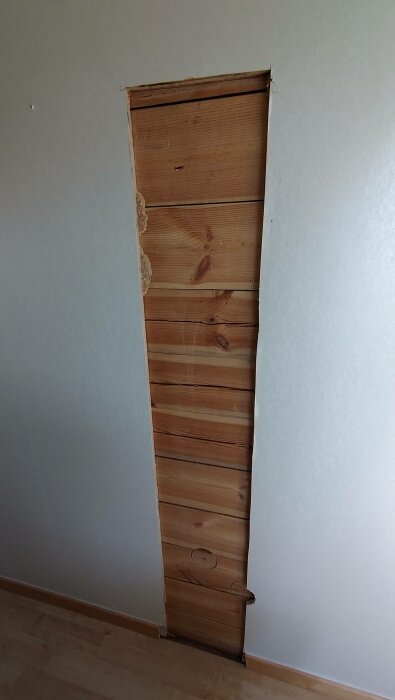
Behind the particle board, as far as I can see, there is solid wood, as deep as I've drilled... a log wall...?
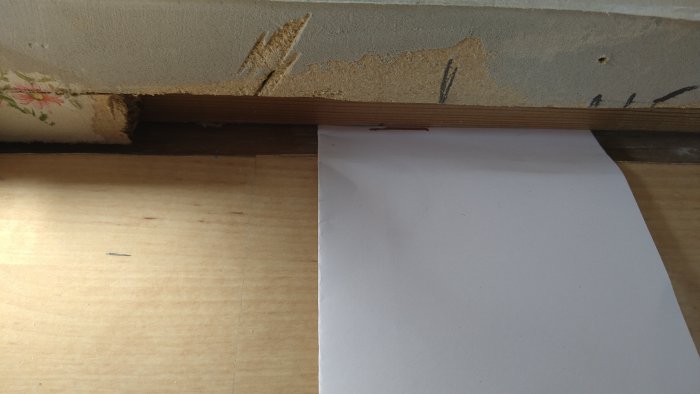
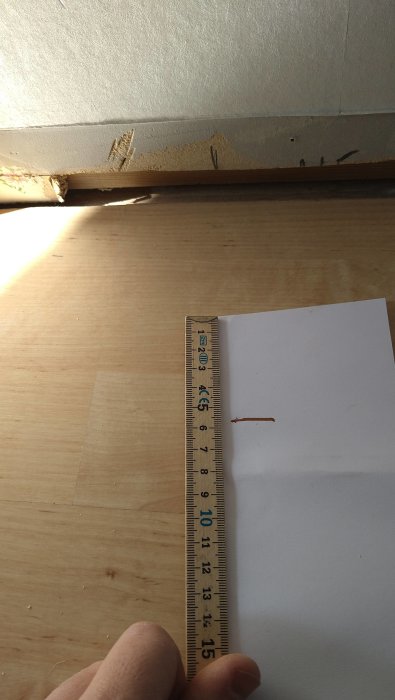
If I remove the skirting board, I can slide a piece of paper under the lowest beam, at least about 6 cm. Whether that's the particle board I'm hitting, or something else, I don't know.
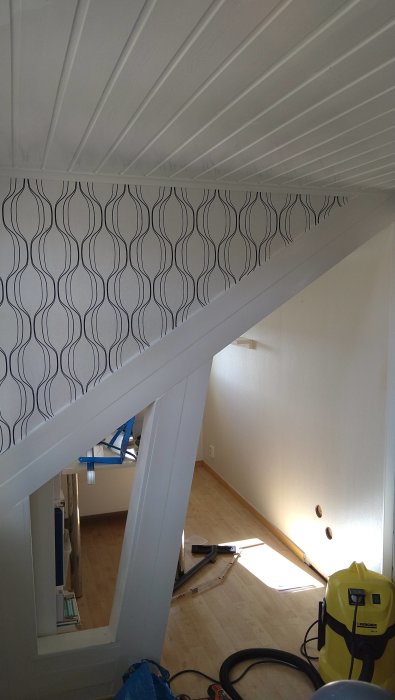
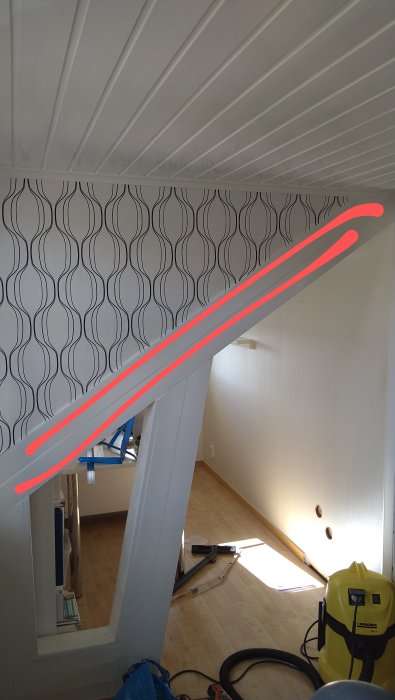
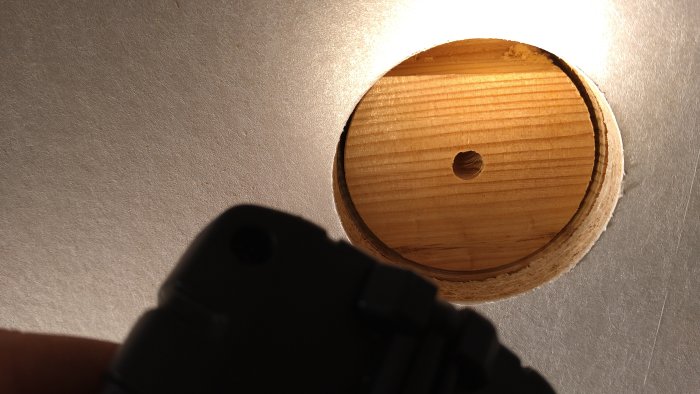
Here you can see the hole I want to close up and the wall where I want the door:
I wasn't planning on cutting the large slanted beams
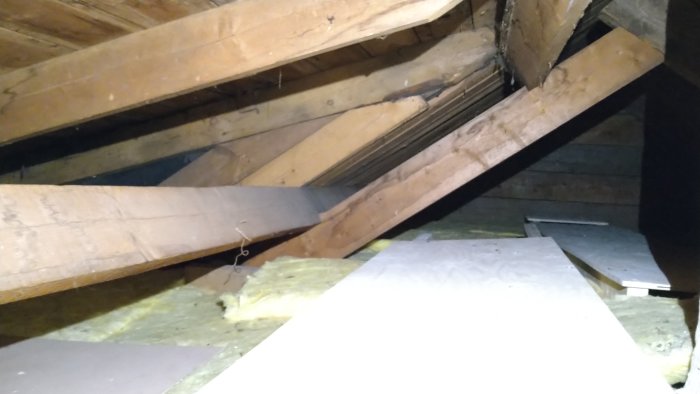
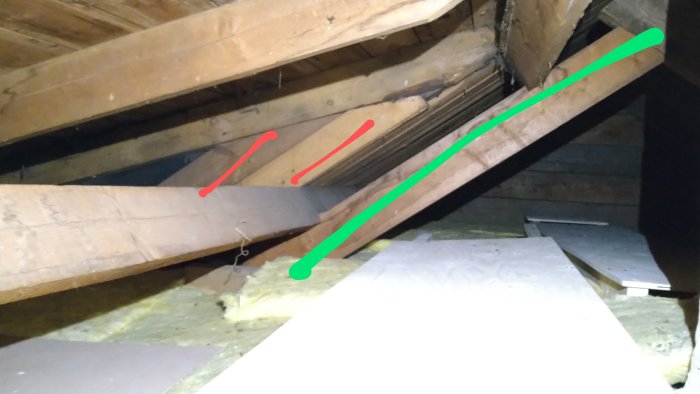
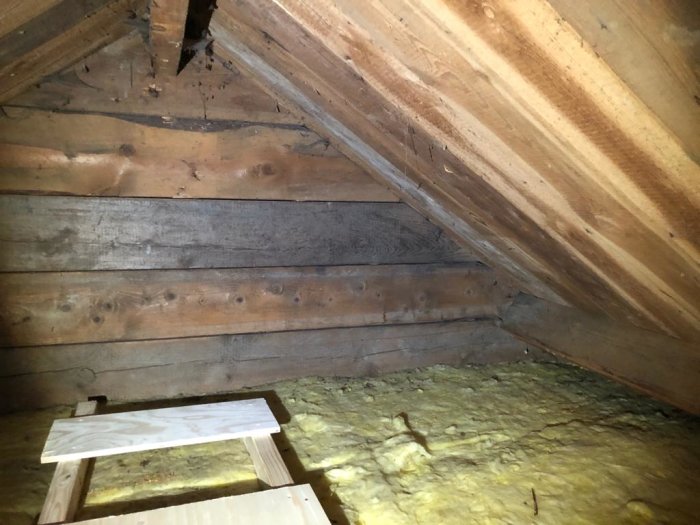
For fun, a picture of the attic above the balcony room and towards the space above the wall. Nothing directly from the roof rests on the wall, but perhaps the floor joists across (from top to bottom on the drawing).
Thoughts on this are appreciated! Is this wall likely load-bearing?
The trusses go down into the knee wall (closet, attic) and you cannot remove them. But you can probably make a doorway between two trusses. Provided that it is not a timber wall but a plank wall.
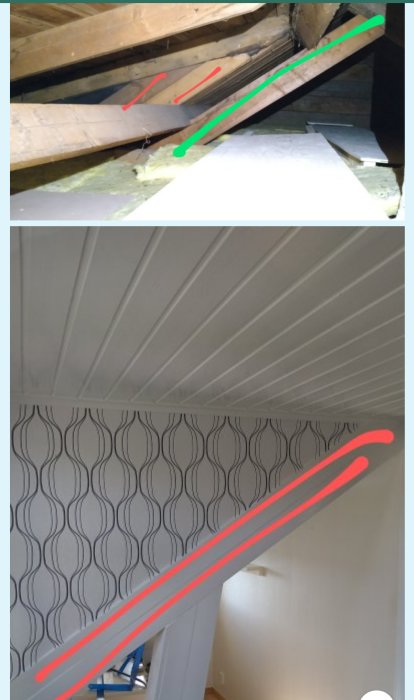
The green one can hardly end in mid-air, it should either connect with the red one or go down to the floor. Tricky construction in any case, so it might be best for a structural engineer to check it on-site.
You're right, it can't really do that, I had seen incorrectly. It's the green beam on the rafter in the attic that continues down to the red indoors. It's encased behind two planed boards which made me mistake them for the two red ones in the attic.
I have also concluded that there are only (?) three rafters in the roof construction:
They cross, and on top of these lie beams at the ridge (one on each side of the chimney). Along the entire roof, additional beams run, and on these lie the roof boards (30x175mm), standing. Then comes the roofing felt.
At the gable that lacks a rafter, the beams are instead embedded directly in the wall, which I guess is made of fairly thick timber.
The possible load-bearing function of the wall that I want to put a door in exists only in about 1/3 of the house. How does the rest manage?
It has stood for a hundred years, so I'm not too worried that it's completely wrong.
Since you thought it looked a bit unusual, I'm now also curious about the construction method of the roof and wonder if it has a name..?
New holes have been cut and it turns out there seems to be tongue-and-groove planks, about 14 cm high behind the chipboard, presumably about 6 cm thick.
There are gaps between the planks, which I think indicates that they are not loaded. Agree? Otherwise, the load would be solely on the tongue if the groove is so shallow that the planks can't be fully pressed together -- but that would be a strange way to make tongue-and-groove, I think.
If I leave the top plank and have the door below, it will indeed be a bit low, but you will still have to duck through the door.
What do you think? Can I do anything further on my own to investigate?
Where is the house located? I guess Medelpad or Ångermanland. If it's an old log house, the heart wall is usually logged all the way up to the ridge next to the chimney wall. On that lies the ridge, as well as those other logs halfway down, and on those the roof is then laid. Sometimes, however, the walls of the castle wing are logged and then load-bearing, but this can be seen in the attic. That doesn't seem to be the case with you. Do you know if the room in the middle of the upper floor facing the long side is original, or if it was made later? That is, the room where you want to close the opening.
The house is located in the Gothenburg region, and the room you are referring to is a balcony room with a flatter roof than the rest of the house, and full standing height throughout the room. Above the "veranda" on the plan, there is a balcony.
I don't really know when it was added or if it's original; I'll see if I find any old pictures. It's not a recent addition in any case.
I think it looks like you have a ridge roof, meaning a number of longitudinal beams on which boards have been laid. What I'm wondering about is the support. As mentioned, the beams usually rest on a central load-bearing wall, but where you have the balcony room there is no such wall. I guess that room was added later. You can also see in your pictures that the roof structure seems to be made of more modern timber. So, hopefully, some other form of support has been created for the beams, and that's probably what you need to figure out before you start tearing down the wall.
Click here to reply
Vi vill skicka notiser för ämnen du bevakar och händelser som berör dig.