
42,530 views ·
360 replies
43k views
360 replies
Load-bearing capacity of aluminum L-beam
With the right sized pipe (preferably several) and the right pre-bending, you can easily skip that self-supporting roof sheet..
But my initial thought is that you're considering using material dimensions that are far too weak for the span you have over the pool..
The question I really feel I'm missing an answer to, in order to give advice on how to proceed, is how much CAN the structure sag in the middle?
Otherwise, it's of utmost importance to know more exactly what the finished structure will weigh, because then there's no problem specifying how much you need to pre-bend the long pipes in the structure..
I have myself worked with manufacturing machines of similar lengths (but higher load) and am currently designing a machine with a similar unsupported length..
But my initial thought is that you're considering using material dimensions that are far too weak for the span you have over the pool..
The question I really feel I'm missing an answer to, in order to give advice on how to proceed, is how much CAN the structure sag in the middle?
Otherwise, it's of utmost importance to know more exactly what the finished structure will weigh, because then there's no problem specifying how much you need to pre-bend the long pipes in the structure..
I have myself worked with manufacturing machines of similar lengths (but higher load) and am currently designing a machine with a similar unsupported length..
It is certainly possible to solve with either a frame, self-supporting sheet, or a combination (as you seem to be considering). However, I agree with @Violina that you're considering dimensions that are too weak. You have a very challenging span to manage. I’ll see if I have time to calculate your suggestions later. However, I have an immediate objection regarding the sheet metal: You should absolutely not splice sheet lengths lengthwise (join two 420 cm to 840 cm length). If it is to be reasonable with sheet metal, it should be 840 cm lengths.
However, doesn't it seem difficult to calculate when you neither have a reliable weight nor an allowable deflection to relate to?E Erik Lindroos said:It is certainly possible to solve with some kind of frame, self-supporting sheet metal, or a combination (which you seem to be considering). However, I agree with @Violina that you are considering too flimsy dimensions. You have a very challenging span to handle. I'll see if I have time to calculate based on your suggestions later. However, I have an immediate objection regarding the sheet metal: You should absolutely not splice sheet lengths lengthwise (join two 420 cm to make an 840 cm length). If sheet metal is to be sensible, it should be 840 cm lengths.
Absolutely. I thought you could relate deflection to the moment of inertia and give some benchmarks to start from. For example, that the proposed frame causes x mm deflection at 1000 kg distributed load, and so on. But a final dimensioning should be based on "better" figures. Didn't @Huggedugge1 mention 14 mm deflection earlier?Violina said:
The point of self-supporting sheet metal is that its profile height provides such stiffness that it supports both its own weight and the loads it is subjected to without any other supporting structure. It replaces the entire floor framework you have under the decking.Huggedugge1 said:
Well… now you have REALLY lost me!!!
Self-supporting sheet metal is probably a good way to go, I think. I found a Plannja variant that didn't add much height. Then my idea is to lay the decking and screw it into the self-supporting sheet metal. (Haven't checked which screws etc., but that will probably be resolved.)
When it comes to the frame, I have looked at Montano.se and found KKR pipes. I was thinking of VKR or KKR square pipes. Since VKR is insanely expensive, I am more interested in KKR, which will be rust-protected and then painted black, alternatively clad with wood. I was thinking of KKR 120*60 with 5 mm thickness. 840 cm + 420 cm will be the frame. The weight of the frame will then be about 320 kg.
The self-supporting sheet metal from Plannja is 7 cm high and has a span of 480 cm. Then the covering width is 750 cm (uncertain what happens when it needs to cover 840 cm...) The weight of the entire roof sheet will then be about 100 kg depending on thickness. The decking weighs about 1000 kg, the frame 320 kg. So 1.5 tons total.
So my question is then… Is KKR 120*60 with 5 mm thickness a reasonable solution as a frame that will work? How much will the open part that goes over the pool sag when it is closed???
Or can anyone suggest something else suitable to make it work?
Can someone help me…
If it is to make any significant sense, such a sheet should run unbroken over the entire 8.4 m span. It then supports the decking on its own, and no supporting frame should be necessary.
The only dimension I see that might be reasonable is the previously mentioned TP200. It is a standard height and, as mentioned, is on the borderline in height to fit under the terrace.
Here is some data for such a sheet:
https://f.nordiskemedier.dk/2ugltroxhvfidoea.pdf
If you lay such a sheet from short side to short side and cover it with 1000 kg wood (decking and frame), I calculate the deflection with 0.7 mm sheet thickness to 19 mm. Increasing to 1.0 mm sheet reduces the deflection to 15 mm, and with the thickest sheet, 1.5 mm, it becomes 12 mm.
It is no more than 226 mm span between the beams on TP200, so only the thinnest decking is needed.
Insulation probably needs to be solved with some sprayed variant.
You might need to think through where the wheels sit on the sheet and introduce a point load.
I still think the best solution (if you don't want to make a guide that helps lift the deflected point at the end) is to focus on stiffening the load beam. Most attractive, I think, is a welded, pre-cambered profile mounted outside or replacing the existing load beam feels most attractive.
I can only agree. The idea of pre-cambered profiles is not something I've personally dealt with in practice, so it's not so prominent in my "idea bank." But for this case, where deflection is the primary issue, it sounds excellent (especially when the construction already exists).Bernieberg said:
The point of self-supporting sheet metal is that through its profile height it is so rigid that it supports both its own weight and the loads it is subjected to without any other supporting structure. It thus replaces the entire floor structure you have under the deck.
For such a sheet to have any significant purpose, it should run uninterrupted over the entire span of 8.4 m. It then supports the deck on its own and no supporting frame should be needed.
The only dimension I see as reasonable is the previously mentioned TP200. It is a standard height and, as mentioned, is on the edge height-wise to fit under the terrace.
Here is some data for such sheet metal:
[link]
If one places such a sheet from end to end and covers it with 1000 kg of wood (decking and frame), the deflection I calculate with 0.7 mm sheet thickness is 19 mm. If you increase to 1.0 mm sheet, the deflection becomes 15 mm, and with the thickest 1.5 mm sheet, it is 12 mm.
It is not more than 226 mm span between the purlins on TP200, so you only need the thinnest decking.
Insulation would probably need to be solved with some sprayed variant.
You may need to think about where the wheels sit on the sheet and introduce a point load.
I still think the best solution (if you don't want to make a guide that helps the deflected point at the end) is to focus on stiffening the beam. Most attractive to me is a welded pre-cambered profile that is mounted on top of or replaces the existing beam feels most attractive.
My total height for the terrace that the deck should go under is 23.5 cm.With properly sized pipe (preferably multiple) and the right pre-bending of it, you can easily skip that self-supporting roof sheet...
But instinctively, I would say that you want to use far too weak material dimensions for the span you have over the pool...
The question I really feel is missing an answer for to even be able to give advice on how to proceed is how much CAN the construction sag in the middle?
Otherwise, it is of utmost importance to know more precisely what the finished construction will weigh, because then it is no problem to specify how much you need to pre-bend the long pipes in the construction...
I have myself worked on manufacturing machines with similar lengths (but higher loads) and am currently designing a machine with similar unsupported length...
Then it's about how high the rail wheels are mounted. Today on the existing deck, I have 3 cm between the deck and the patio. Ideally, I would like to lower it to reduce heat loss.
I would rather skip the sheet metal, but then the weight for the existing solution increases by about 350 kg. (Joists 120*45)
Approximately 1450 kg is the total weight today.
Partly it dips in the middle of the deck. Then both long sides dip.
Partly it dips in the middle of the deck. Then both long sides dip.
I think you misunderstood me. What I understand is that it's 5 lengths of about 420 cm being joined together to cover 840 cm.E Erik Lindroos said:It can certainly be solved with either a frame, self-supporting sheet metal, or a combination (as you seem to be suggesting). However, I agree with @Violina that you are considering dimensions that are too weak. You have a very challenging span to handle. I'll see if I have time to calculate your proposals later. However, I have an immediate objection regarding the sheet metal: You should absolutely not splice sheet metal lengths along the length (joining two 420 cm to make an 840 cm length). If it's going to make sense to use sheet metal, they should be 840 cm lengths.
I would like to jump back to the question in post #69 so we can get all issues on the table. My suggestion with a reinforced main beam will not affect how much the roof sags between the long sides.
Yes, that is correctly understood.Just to avoid misunderstandings: is the problem that when the pool cover is partially open, the free long side hangs down so much that it becomes a problem when approaching fully open position and the long side of the cover needs to go up on the edge again?
When the cover is fully open or fully closed, it has support along all four sides and everything is fine?
When I close the pool cover, it goes 3.5 cm below the pool edge and doesn't come up.
It is also a visual issue that when it is fully closed, the middle hangs down about 3.5 cm. You can see this if you place a plank on its edge between the long sides in the middle.
If you want to fix the sagging in the middle, the beam running from side to side also needs to become stiffer.
Do you have any photos or sketches of what the entire framework looks like without the decking? The more info, the better chance of coming up with good and relevant suggestions.
Will check if I find any cards.
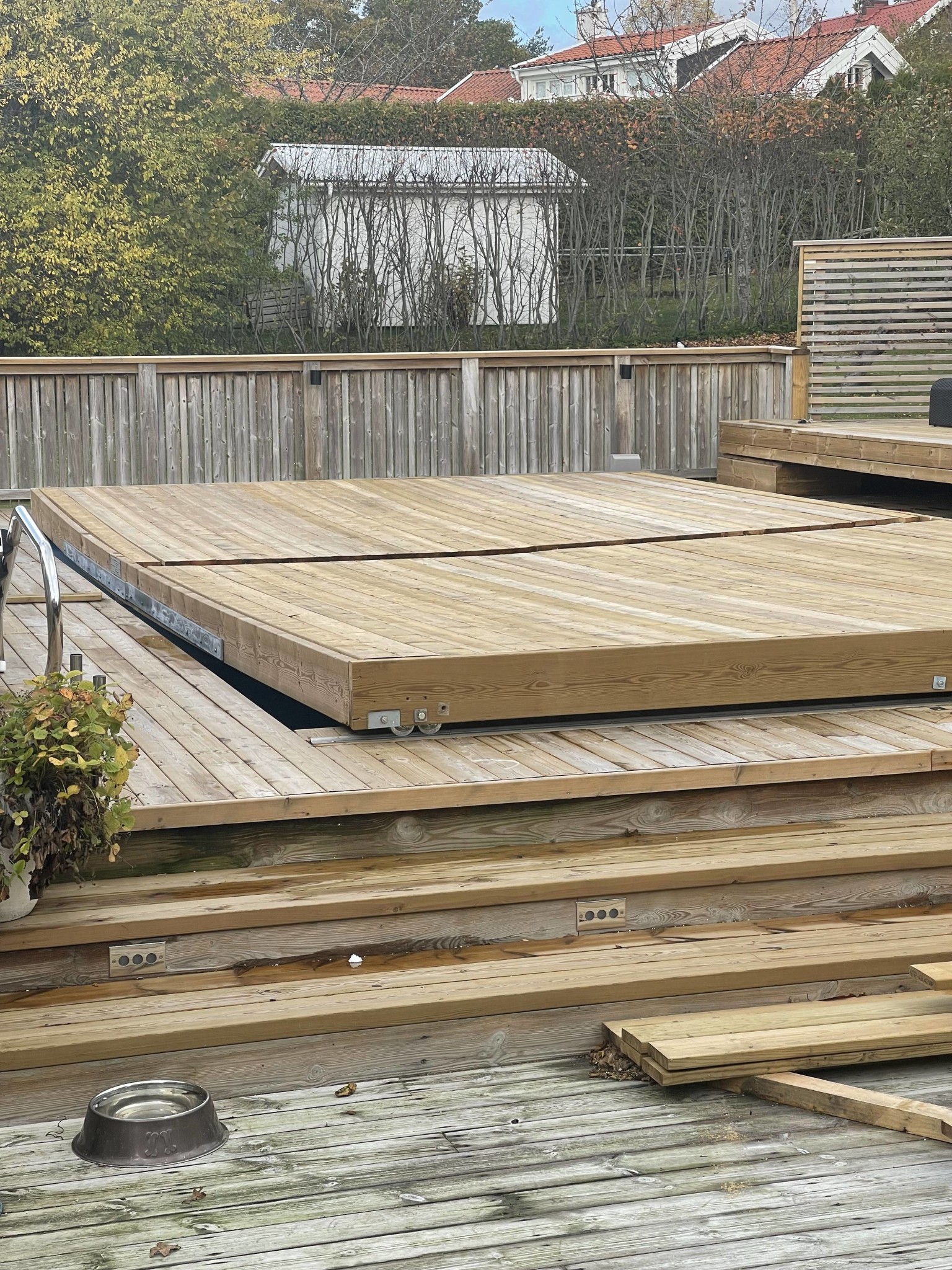
Unfortunately, I don't have a sketch. But I found a video and some photos.