As a rule, lime plaster is generally soft enough that it rarely cracks, but using mesh is definitely not a bad idea. Firstly, it makes it stronger, and secondly, it keeps the plaster in place, especially when applying slightly thicker layers.
Is it reasonable to mix 15-20 bags of plaster with a drill, or should I rent a cement mixer?
A cement mixer can be a bit overwhelming when you have a large amount to apply by yourself. However, a mixer can be very helpful as the drill can be quite hard on your hands. Take two bags at a time and use a good masonry tub. That will get you far.
A tombola can become a bit tedious as you have to polish a large amount yourself. However, a mixer can be very helpful since the drill wears on the hands quite a bit. Take two bags at a time and a good mortar tub. You'll get far with that.
Thanks, then I'll buy a mortar mixer available for 6-700 SEK at Bauhaus
Thanks, then I'll buy a mortar mixer available for 6-700 kr at Bauhaus
Avoid collomix. I know several people who have had issues with their gearboxes breaking down. I use Biltema's with double rods. It makes some noise but so far it has worked. But a cheap mixer should do the job with plaster.
Feel free to post some pictures of how the work progresses.
As slats, you can use pipes, easy to clean after use.
I've used a lot with a Hercules from Bauhaus, their cheapest model but it holds up. A tip is not to pour in all the mortar at once, but mix a thin batch and then finally add the remaining mortar, it's much easier to mix that way and saves the mixer.
Another gadget that is super convenient is a plaster sprayer, a kind of bucket/spatula with air nozzles at the bottom so you spray the mortar onto the wall, it adheres well as it's flung against the surface and it goes quickly, the downside is that you need a good compressor.
Round dowels work very well as strips to level against. They come in various diameters so you can adjust to the desired thickness. Additionally, they are easy to attach and to remove afterwards.
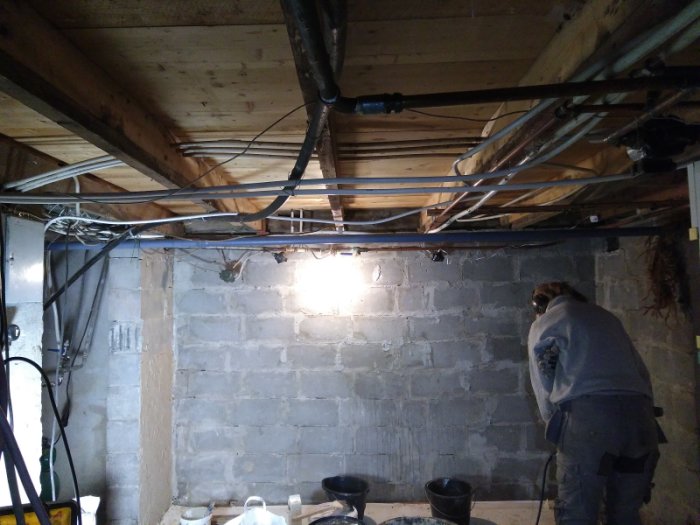
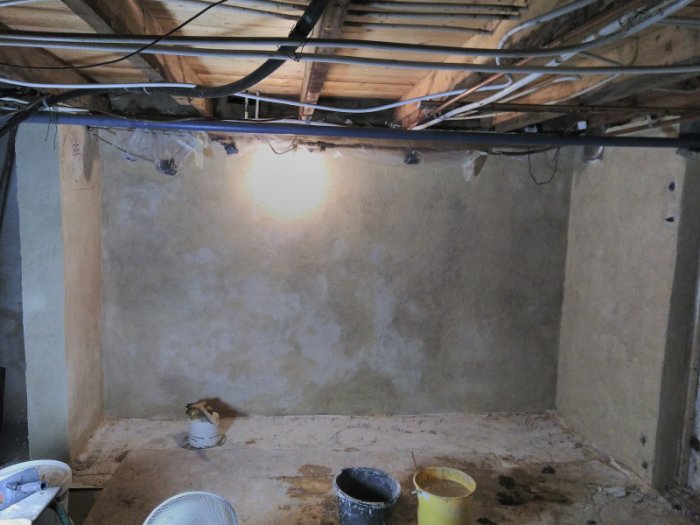
Now I have set up 13 mm thick "poles". I couldn't drive plaster hooks into the concrete, so they are fixed with plugs and screws and adjusted with a level.
I went and bought hydraulic lime mortar 0-2 mm and have plastered an inner corner tonight. It won't win any beauty prize unfortunately. The straight stretches will be much easier.
A question: It says that you should compress with a långskånska, but the one I bought seems to mostly tear up the plaster? It's made of plastic and has a texture on the underside. Are there different types of långskånskor?
It scrapes up, yes. It is important that you have more plaster than what needs to be plastered up. Then you remove the excess with a straightedge. If you want a smooth finish, you brush the surface afterward. If you want more in the other direction, a float is what you need.
It does tear. It's important that you have more plaster than what is to be plastered. Then you remove the excess with a straightedge. If you want a smooth texture, you scrub the surface later. If you want more in the other direction, a scratch float is what you need.
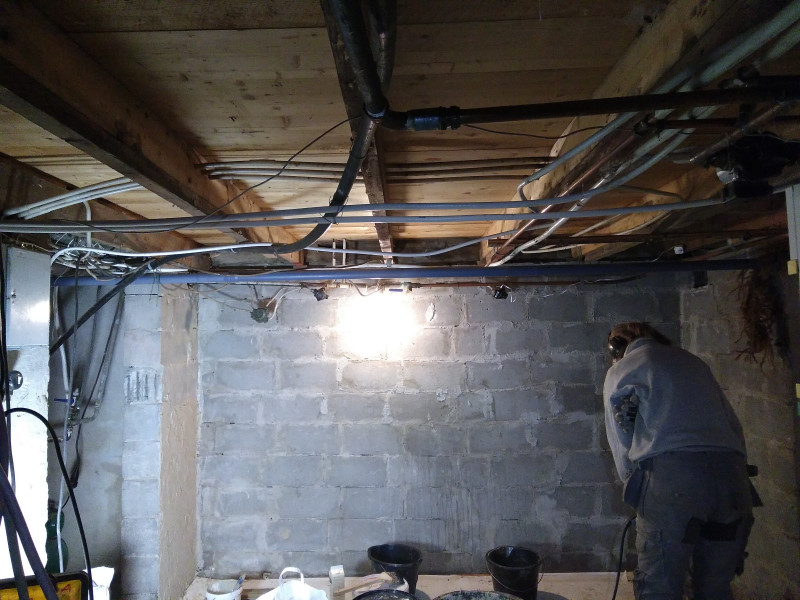
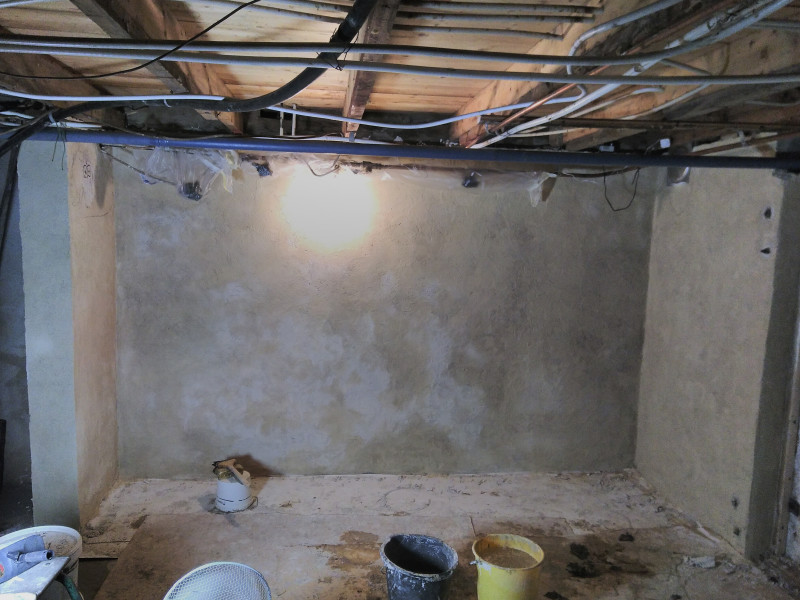
Today I started the plastering itself, but quickly realized that I cannot plaster the entire depth at once. The wall is so uneven that 13 mm is more like 40 mm in some places. And then all the plaster fell off when I used the straightedge. So now I have plastered up to the mesh and a little beyond on an entire wall, and I'll plaster the last centimeter later!
I used a steel skånska when plastering, couldn't get the right snap when throwing, so I "spread" all the plaster instead, it went great. I think the tool you call långskånska sounds more like a float that you should use afterward to get a good surface.
I painted with lime paint in my basement. Had KC-bruk. It turned out great! If you plaster with lime mortar, I absolutely think you should use lime paint too. Cheap, white, and very good at absorbing and releasing moisture. Don't forget to dampen during curing!
Vi vill skicka notiser för ämnen du bevakar och händelser som berör dig.

Silver78 said:

