Thank you very much. Do you need to vibrate leveling compound or is it enough to pour it out and leave it?
/J
Basically just pour it out and let it set... but you usually need to "assist" a bit with a wide spatula or pin roller. Personally, I like a spatula as I feel you have more control with it.
However, it requires some technique and preferably several people working at the same time; it's best if one mixes and one pours.
It's very important to follow the mixing instructions regarding the amount of water and how long you stir with the whisk. You need many buckets and a couple of tubs to mix in, as well as a proper whisk that can handle stirring. I always have water on hand in a large mortar tub and a makeshift measure with the exact amount of water needed for one bag. Then I mix two bags and two measures of water in another large mortar tub, stir, and pour it into a couple of buckets before I/we carry it in and pour it. You have to keep going the whole time because it starts to set quickly, and you can almost see the setting mass chasing you across the floor. Therefore, you must prepare the work with material, water, and tubs so that this doesn't become a bottleneck.
Yep, preparation seems to be crucial. Now the doorway is where the slope is the greatest, and I don't need to fill as much at the top of the garage, but how do I spread it over the surface? It's important to get it right so you don't have to wade around in the spread...
Yep, preparations seem to be key. Now the doorway is where the slope is greatest, and at the top of the garage, I don't need to fill in as much, but how do I dose over the surface? It needs to be right so you don't have to wade through the leveling compound...
When I use these, I level with a laser and cut them so the leveling compound just reaches the top. Then you have them as a guideline for how much you should pour out. If you're inexperienced, you can place them a little closer together on the floor.
The pins become embedded in the leveling compound and should stay in place.
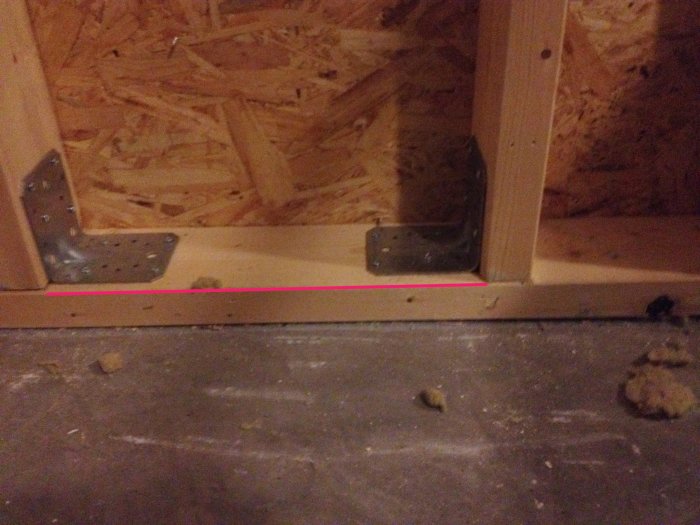
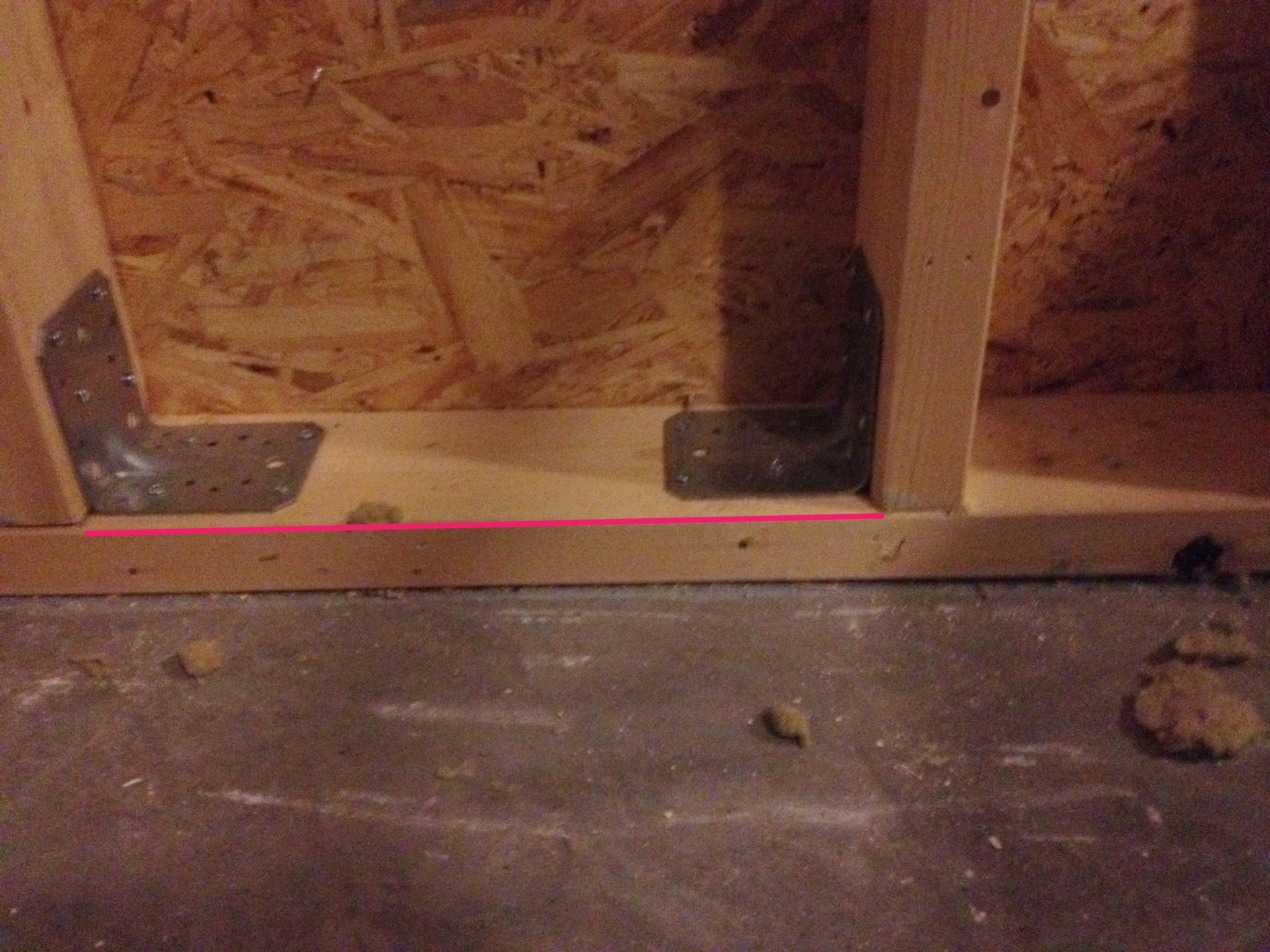
I realized something, the parquet floor is 14 mm and you can also lay that floor foam underneath to reduce creaking, so you gain a few mm. So then you calculate negatively from the threshold/0 level like 5.76 -1.4+1.0= 3.36 as the highest fall point? Then you wouldn't need as much leveling compound... is it correct to think that way? That is, that the floor's 0 level including parquet reaches up to the top of the floor joist (see image)? I've opened up the wall where the door studs are prepared. However, the floor joist seems to follow the slope of the floor... how the heck do I level the threshold then?
I don't understand the latest post, with the calculation of reduced fill. You need an even (level) surface for your floor, so it doesn't slope. Use a long level or laser to measure the difference between the highest and lowest point. That's what you need to fill in.
I once "reversed" the slope in a bathroom and wanted to save on leveling compound out of thriftiness. I then made "corridors" with closing strips over the room in the places that needed the most filling. That is, I laid two parallel strips with about 20cm corridor in between. In these, I filled leveling compound and thus got 20cm wide ridges that were level and at the correct height. Between these, I filled with concrete (cheaper) and used the "leveling compound ridges" as support for a board to scrape the concrete with. It turned out really well.
Regarding the studs you have set up, I think it might have been best to wait until after the self-leveling compound to install them, but it's a bit late now...
Perhaps you can saw off the part where the threshold will rest. Then do the self-leveling, including the space under the threshold. Once that's done, place a piece of stud back in the doorway and attach it to the rest of the framework. Could that work?
I don't understand the latest post, with the calculation of reduced filling. You need to have an even (= level) surface for your floor, so it doesn't tilt. Use a long level or laser to measure the difference between the highest and lowest points. That is what you need to level out.
I once "reversed" the slope in a bathroom and wanted to save on self-leveling compound out of frugality. I created "corridors" with edging strips across the room in the places that needed the most filling. In other words, I laid two parallel strips with about a 20cm corridor between them. In these, I filled with self-leveling compound, creating 20cm wide ridges that were level and at the right height. Between these, I filled with concrete (= cheaper) and used the "self-leveling ridges" as support for a board to scrape the concrete with. It turned out really well.
Around 3000kr, I think. It was quite a large bathroom and when the lowest point becomes the highest point, the volume immediately becomes quite large. Considering that the amount of work wasn't that big, I thought it was worth it. I wasn't very experienced with leveling compound, so there was a security factor in limiting the areas as well.
I think it might be best to consider getting help from professionals. 500 liters of self-leveling compound is quite a lot to buy in bags and to mix, apply, and get right if you're not a bit experienced.
OT comment, why on earth are you using brackets for the rule instead of toe-nailing? It must be 100 times more expensive... if you now think a few extra bucks for levelling compound is expensive?
OT comment, why on earth are you using brackets on the studs instead of toenailing? That must be 100 times more expensive... if you think a few extra kronor for leveling compound is expensive?
The picture misleads a bit. We bought a newly built townhouse and had the option to choose living space instead of a garage if we acted early. We were too late in the purchasing process and now have to rebuild ourselves. However, the framework in the wall was already prepared for a door frame and the construction company attached brackets on the studs just in the doorway to make it easier to change, I guess.
I haven't set any studs myself in the picture.
But if the floor joist follows the slope, won't that be tricky?
I think you can saw off that part of the plank against the floor where the threshold should be, then use leveling compound and after that put the plank back and attach it to the other planks.
What is your timeframe for moving in there? It is also possible to level with cement, which is cheaper than flow. But it takes longer to dry before you can lay the floor.
Click here to reply
Vi vill skicka notiser för ämnen du bevakar och händelser som berör dig.