
3,012 views ·
6 replies
3k views
6 replies
Laying floating plank floor on intermediate joist.
Hello,
We have knocked down a wall between two rooms on the upper floor of our 1950s house. Since we are going to lay a new floor in conjunction with this, I thought I would take the opportunity to address the impact noise from this room which is quite disturbing on the floor below.
I have read quite a bit on the forum about this, and there are a lot of good suggestions, but I want to do it as simply/cheaply as possible.
Today, there is a 28mm plank floor nailed directly into the joists of the subfloor, which are about 80mm*230mm, and the joists are insulated with sawdust.
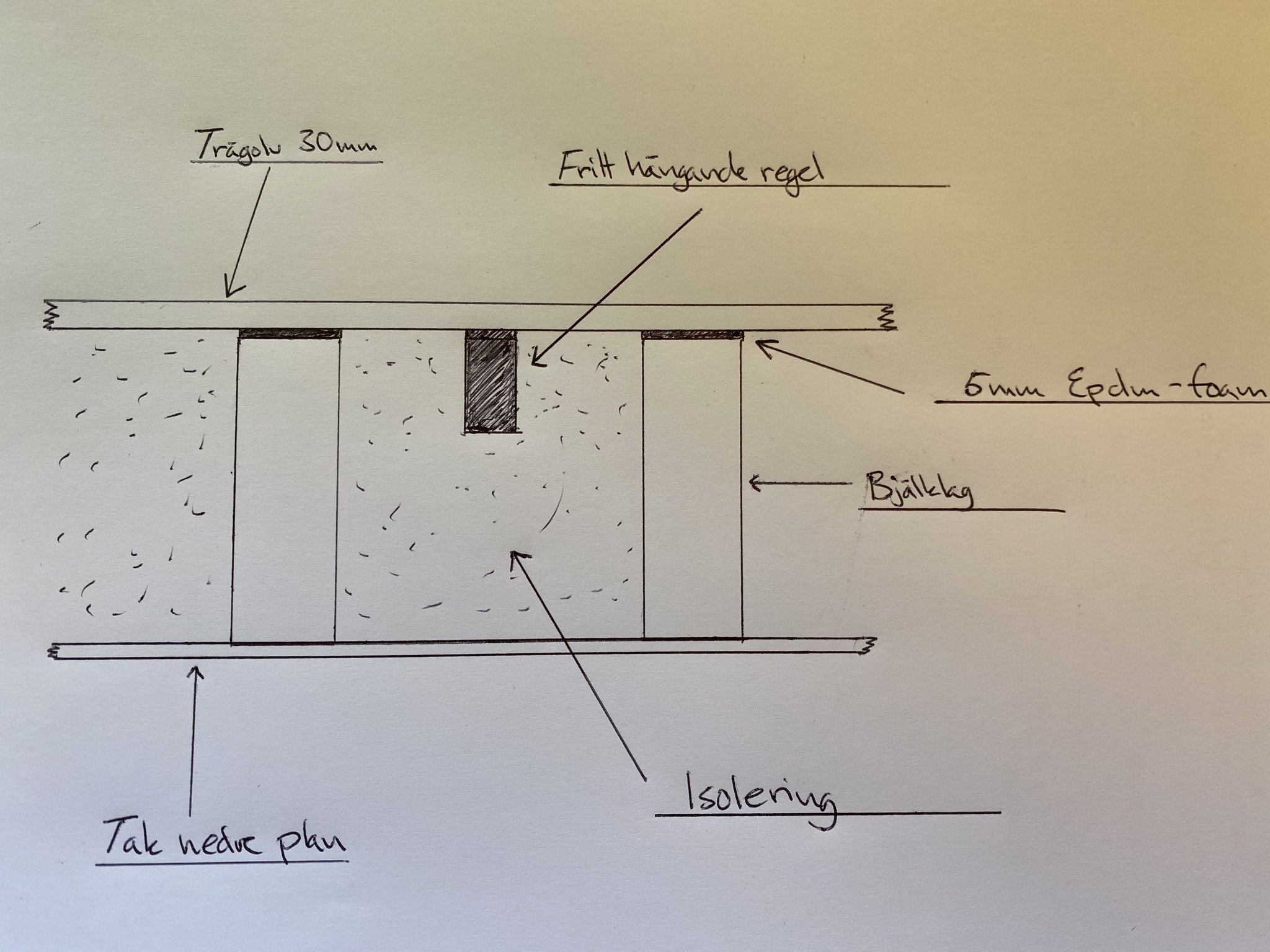
The idea is to replace the sawdust with some form of modern insulation. Then, I plan to lay a 5mm thick EPDM foam on the subfloor joists. On top of this, a 30mm thick tongue-and-groove pine floor which I will glue in the tongue and screw into freely hanging battens that are positioned between the joists of the subfloor. See diagram.
This way, the entire floor will rest on the foam but still be solidly screwed together without adding too much height.
Aside from the possibility that the floor may flex slightly, do you think this will make any difference to the impact noise on the floor below?
We have knocked down a wall between two rooms on the upper floor of our 1950s house. Since we are going to lay a new floor in conjunction with this, I thought I would take the opportunity to address the impact noise from this room which is quite disturbing on the floor below.
I have read quite a bit on the forum about this, and there are a lot of good suggestions, but I want to do it as simply/cheaply as possible.
Today, there is a 28mm plank floor nailed directly into the joists of the subfloor, which are about 80mm*230mm, and the joists are insulated with sawdust.
The idea is to replace the sawdust with some form of modern insulation. Then, I plan to lay a 5mm thick EPDM foam on the subfloor joists. On top of this, a 30mm thick tongue-and-groove pine floor which I will glue in the tongue and screw into freely hanging battens that are positioned between the joists of the subfloor. See diagram.
This way, the entire floor will rest on the foam but still be solidly screwed together without adding too much height.
Aside from the possibility that the floor may flex slightly, do you think this will make any difference to the impact noise on the floor below?

How much load can EPDM foam withstand?
There will be a quite substantial point load on the foam since it only rests on the beams. I think there is a risk that it will quite quickly get compressed and not serve any function.
Just a thought, I don't have any knowledge about EPDM.
There will be a quite substantial point load on the foam since it only rests on the beams. I think there is a risk that it will quite quickly get compressed and not serve any function.
Just a thought, I don't have any knowledge about EPDM.

It is well thought out, but it would be better to decouple the ceiling than the floor considering that it is relatively unburdened. But whether it is suitable depends, of course, on whether you are renovating the floor below as well...
So not really the first but assumed it was ~45 mm wide, but if they are closer to 100 mm wide as you say, there should be no problem.Berghiller said:

Click here to reply