
Hello
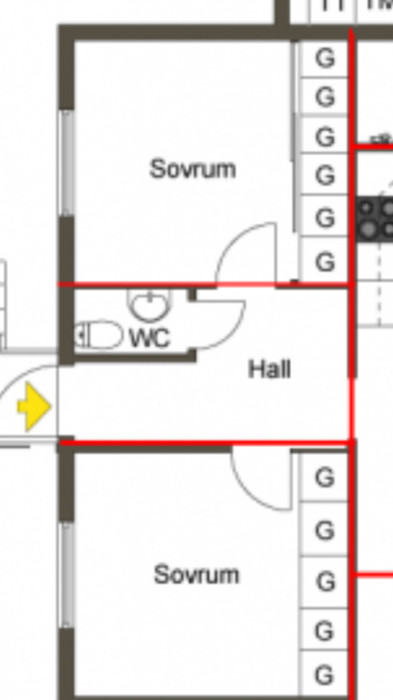
I am renovating the hallway, the floor joists run in the direction of the arrow and are about 600cc 45x250 or thereabouts. That is also the way I plan to install the furring strips and lay the underfloor heating pipes later. Is 45x70 sufficient for cradling, or do I need to dig out all the sawdust to the bottom to fit the same dimension? Maybe I can cradle at 300cc?
So this will be the order once it's done...
Floor joist with cradling, furring strips with heat plates and pipes, 10mm chipboard, and a vinyl click floor.
I am renovating the hallway, the floor joists run in the direction of the arrow and are about 600cc 45x250 or thereabouts. That is also the way I plan to install the furring strips and lay the underfloor heating pipes later. Is 45x70 sufficient for cradling, or do I need to dig out all the sawdust to the bottom to fit the same dimension? Maybe I can cradle at 300cc?
So this will be the order once it's done...
Floor joist with cradling, furring strips with heat plates and pipes, 10mm chipboard, and a vinyl click floor.
You want to do this to save height?
I see a risk of some sway between the rafters then, not much that supports point load with 10mm chipboard.
If you use 22mm floor chipboard, it should work without problems. Then you just use the sparse panel to support the GV. Otherwise, it is a much larger part of the load-bearing structure.
I see a risk of some sway between the rafters then, not much that supports point load with 10mm chipboard.
If you use 22mm floor chipboard, it should work without problems. Then you just use the sparse panel to support the GV. Otherwise, it is a much larger part of the load-bearing structure.
Yes, it's to save some height. What dimensions do I need to use for kottla and what cc to achieve a stable floor? The beams are 50x250 and are 600cc.
The glesen will be 28x95 or 28x120
10mm chipboard on top of that.
I prefer a tighter cc on the kottling rather than digging down to the bottom.
The glesen will be 28x95 or 28x120
10mm chipboard on top of that.
I prefer a tighter cc on the kottling rather than digging down to the bottom.
Place the 45*70 studs vertically with 800mm spacing so the sparse panel should support well between the rafters.
Join the chipboard on the rafter or sparse panel, and on the short side, place sparse panel under the joint and screw-glue the joint.
Join the chipboard on the rafter or sparse panel, and on the short side, place sparse panel under the joint and screw-glue the joint.
Thanks for the answer. Just to make sure I understand. Earlier you said it could flex, but not now?C corre said:
If you have thicker kortling between existing floor joists, you will create a new subfloor where the sparse panel and GV hoses are located. With enough of them, you replace the stability lost due to the change in direction of the sparse panel and lay it between the floor joists.J jooohan said:
Compare it to how the floor would look if you laid a sparse panel across the existing frame and then laid the floor on top of that.
Click here to reply