
40,577 views ·
58 replies
41k views
58 replies
Joining floor joists 50x200 with nail plates
Own forest = own sawn timber.
Gray from the sun, yes long-term project
Gray from the sun, yes long-term project

Member
· Västerbottens län
· 18 081 posts
Just as I suspected.
P
P
Apparently, there are special nail plates for splicing where I planned. It's called Gerber plate.
I found a good handbook from Gunnebo:
http://www.bkl.lth.se/fileadmin/byg...tur/Beslagshandbok_2012_Gunnebo_Fastening.pdf
As many have already written (and many don't believe).. the entire floor becomes stronger/less bouncy when using full lengths with support in the middle. However, the full length doesn't need to be a homogeneous plank. The easiest way is to buy a couple of sheets of construction plywood, cut them to get 120cm x beam height, or even 15mm plywood, glue, and use a staple gun or screw.
A lask on each side of the beam. 60cm on each side of the joint.
If you don't want to glue, then screw/nail a vertical row of nails/screws 5cm from the far edge of the lask, a row of nails/screws 5cm from the short end of the beam, and one screw/nail between these two rows, the same on both sides of the joint.
Like the number 5 on a die plus a few extra dots to the right and left, this times two on each lask (on each side of the beam joint).
If you don't want to glue, then screw/nail a vertical row of nails/screws 5cm from the far edge of the lask, a row of nails/screws 5cm from the short end of the beam, and one screw/nail between these two rows, the same on both sides of the joint.
Like the number 5 on a die plus a few extra dots to the right and left, this times two on each lask (on each side of the beam joint).
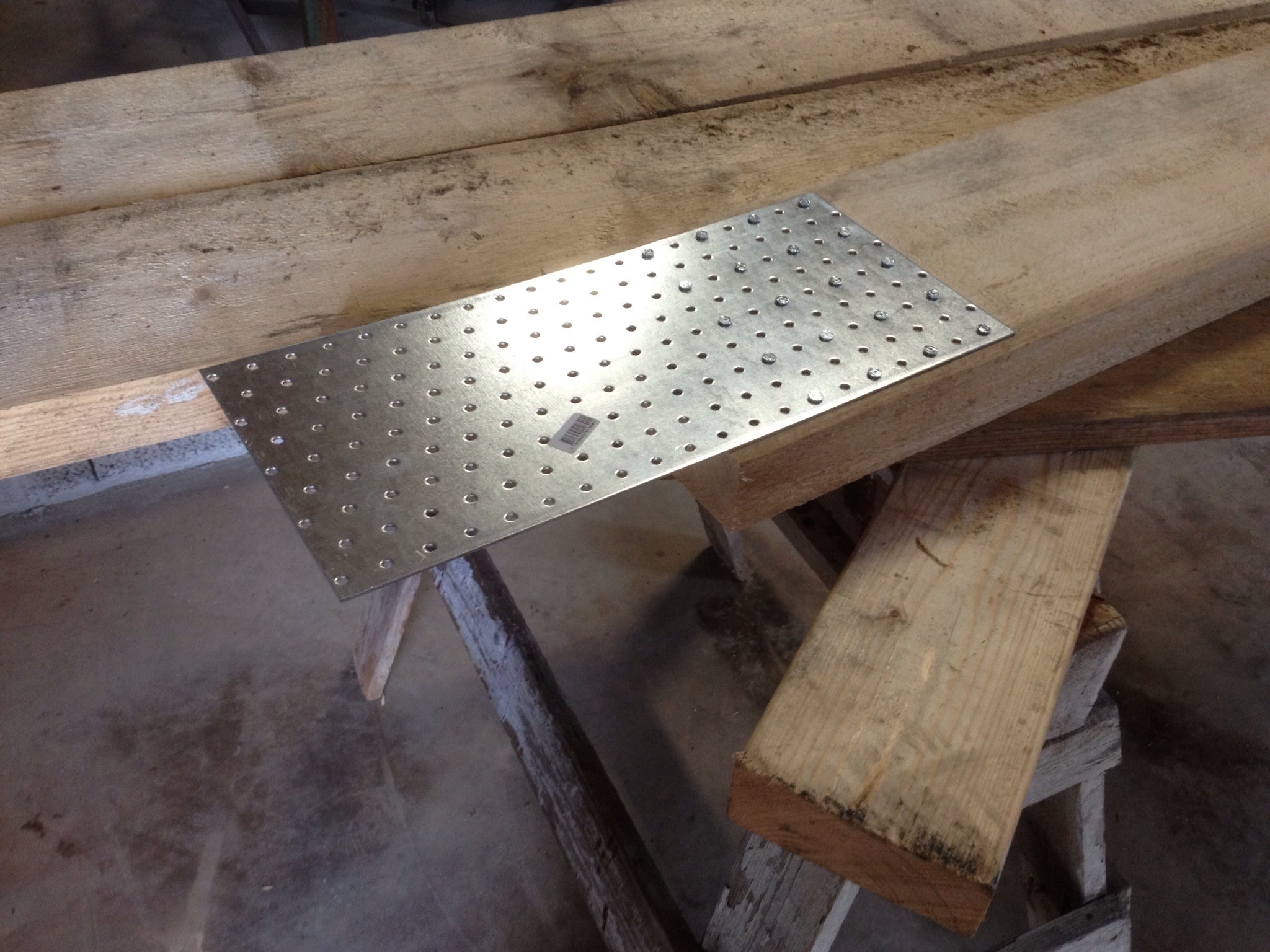
This is how it can look with the maximum allowed number of nails.
I think it will be 12-14 later.
I guess 10 will be enough.
Last edited:

I'm driving with gunnebos ;-)
That sounds good. I doubt they take chances with the quality ...
The nailing pattern in your picture looks good to me. Unfortunately, I can't provide any expert input.
But that's probably how I would have nailed if I had to "take a chance."
If it's primarily to take bending moments, there should be nails at each end, nothing or little in the middle.
But your joints probably need to handle both bending moments, tensile force, and shear in the joint.
The nailing pattern in your picture looks good to me. Unfortunately, I can't provide any expert input.
But that's probably how I would have nailed if I had to "take a chance."
If it's primarily to take bending moments, there should be nails at each end, nothing or little in the middle.
But your joints probably need to handle both bending moments, tensile force, and shear in the joint.
How do you do on the other side? The nails shouldn't end up in the same place.moonlightfarmer said:
I recall that the distance between screw/nail should be more than 10 times the thickness of the nail in the direction of the wood fibers... I have no source on that, but it's something I remember from a long time ago...
Last edited by a moderator:
I shift the entire hole pattern by one hole in the direction of the beam. Then there will only be 12 nails.
If the nails had only been 35 long, I think it would have been acceptable to run them against each other.
If the nails had only been 35 long, I think it would have been acceptable to run them against each other.
Yes, that probably would have been enough, but I think it complicates the continued construction a bit. I would prefer to have everything at cc 600 or 1200. I know it might sound silly, but I think it makes things a lot easier.
Last edited:
Yes, the 5cm shift can complicate things. Mostly if you're planning to maximize the width for the trusses with 1200mm in each section. Then it becomes a bit tricky for the joists when it doesn't align with where you want to place the floor chipboard, etc.