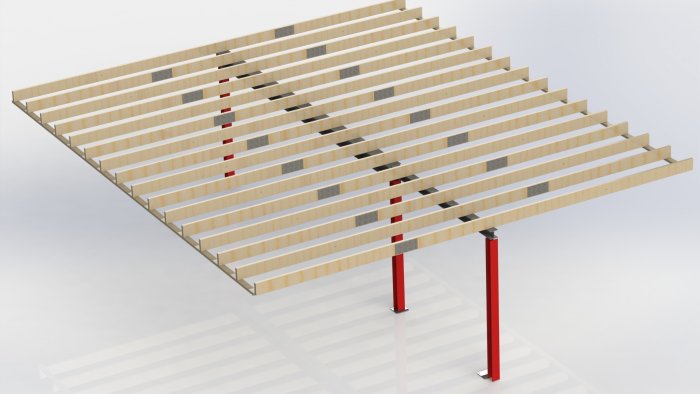
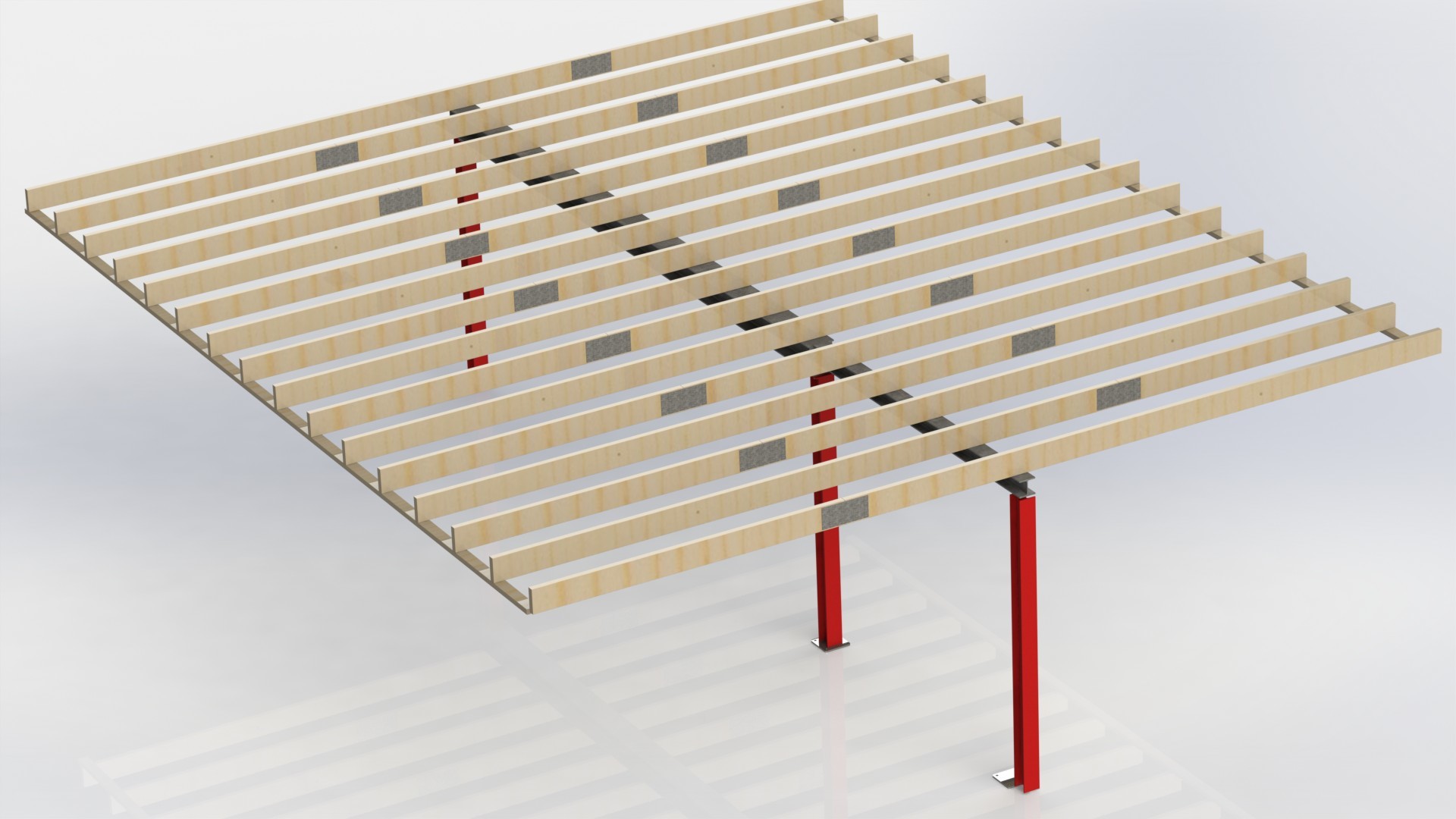
I was planning to build a floor structure consisting of 50x200 joists at 600 centers. The total length is about 7800, resting on three supports, one of which is in the middle.
On the underside, there will be a gypsum ceiling, and on the upper side, it should meet the requirements for living space if possible.
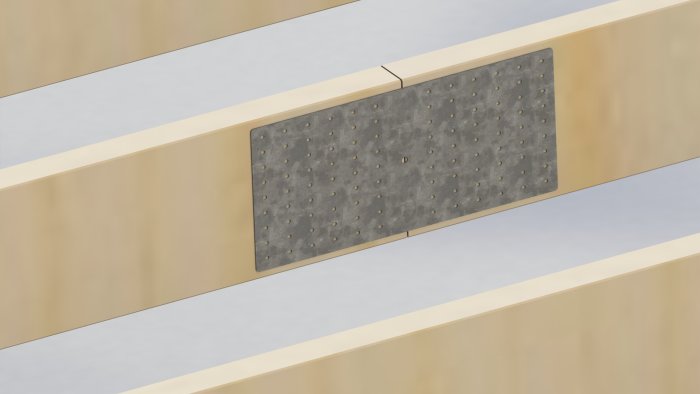
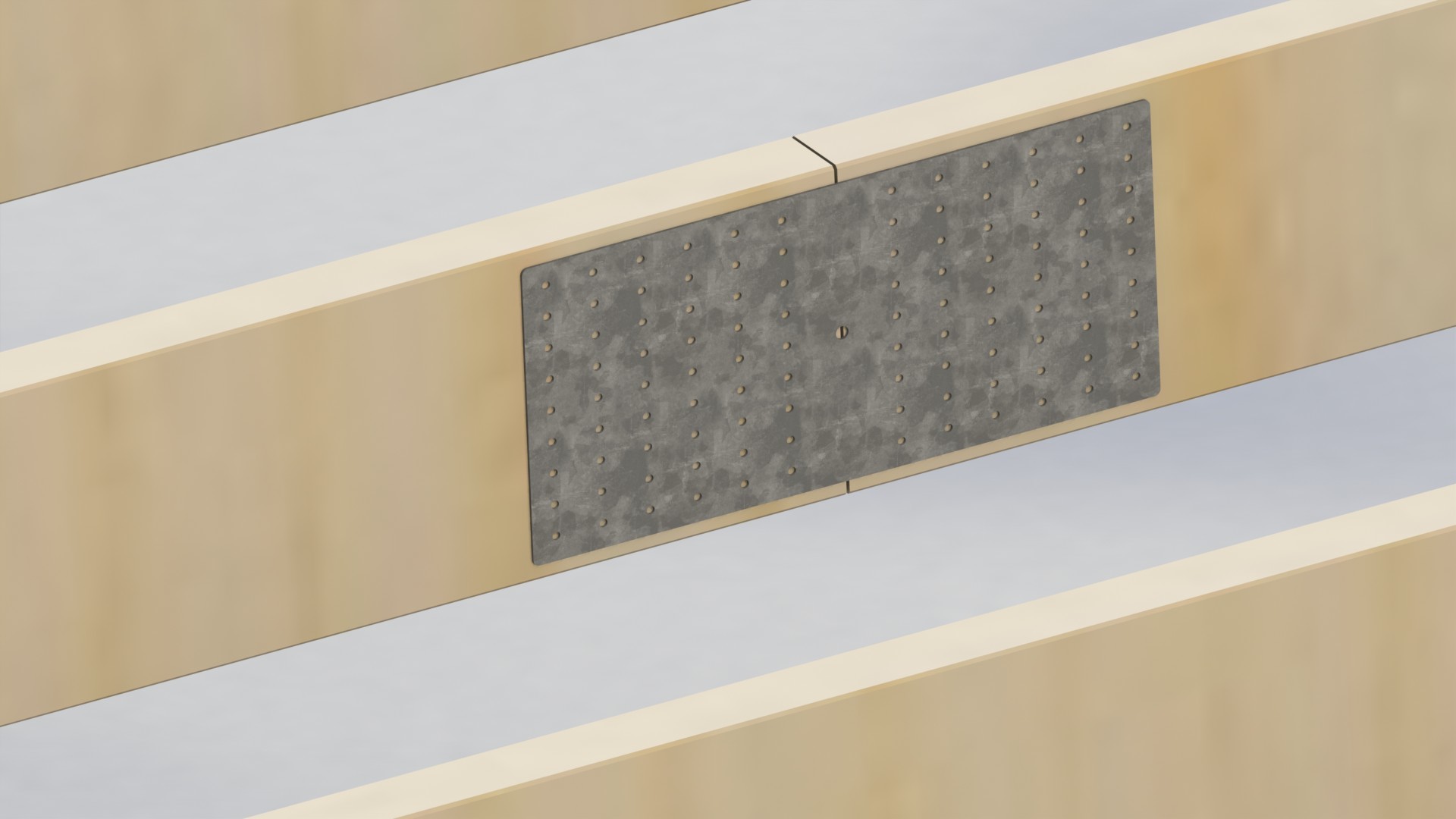
The idea was to splice the beams with perforated metal plates 180x400x2 with anchor nails 4x40. Is this feasible, and if so, how many nails per splice?
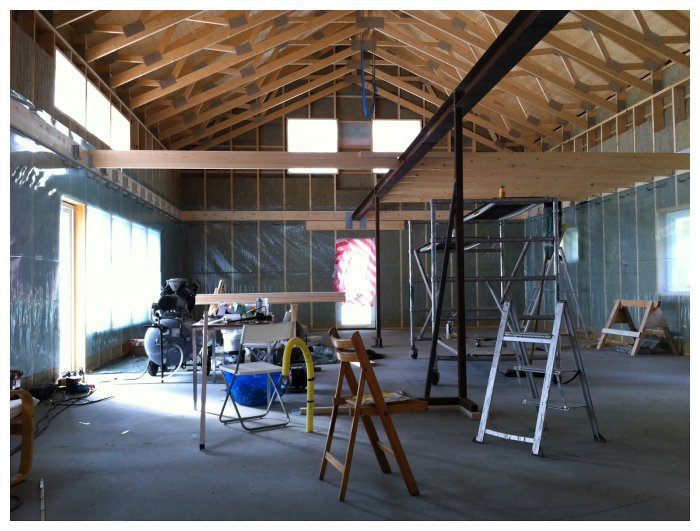
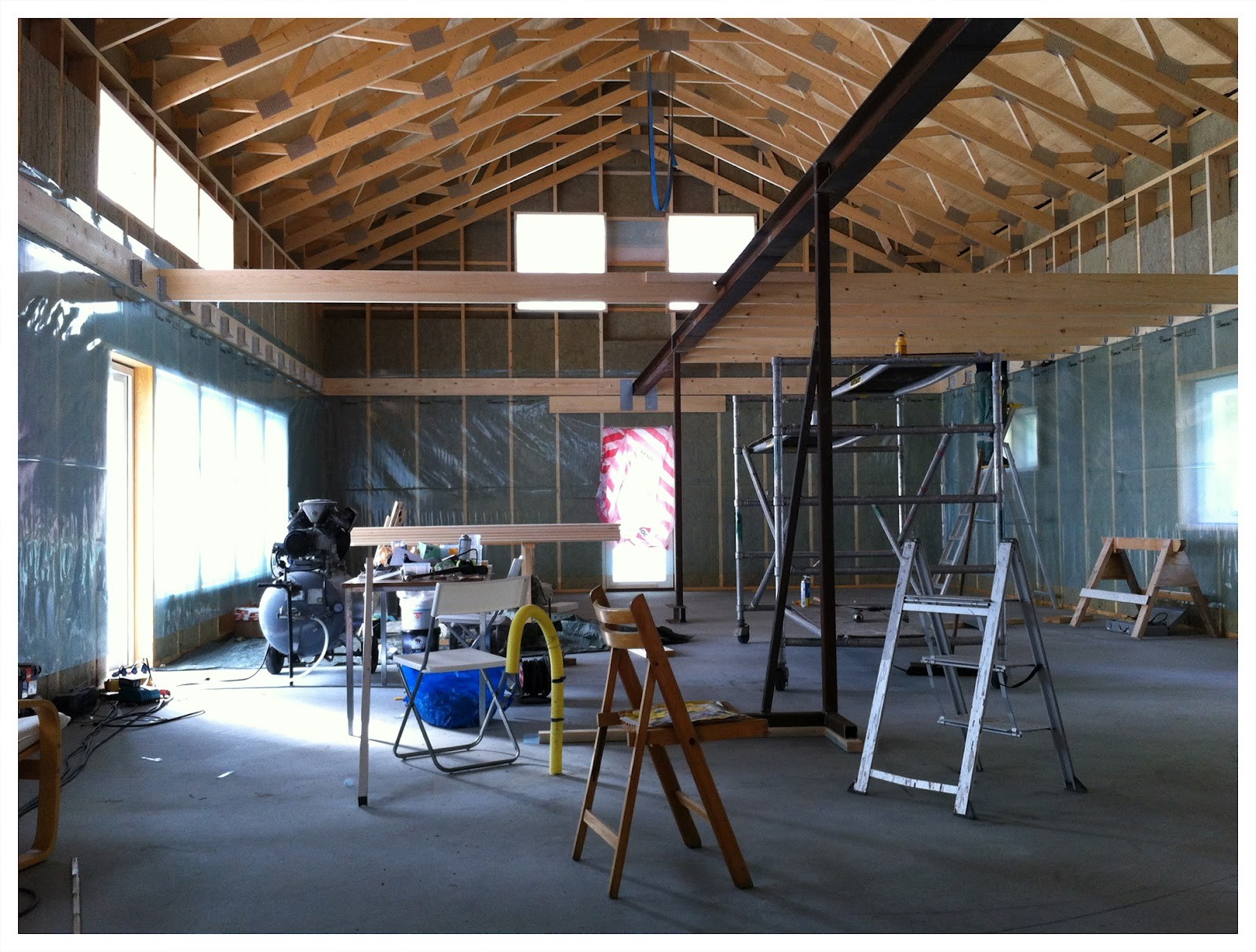
I actually have almost the same construction in my house:
Width inside of outer walls 7700 mm.
The trusses' lower chord and the intermediate floor 45x220 cc 600.
Almost in the middle, a steel beam, where all the wood in the floor is cut and spliced.
Meaning the steel beam is up in the floor and not visible in the room below.
Much more elegant solution!
Technically, there might be reasons not to splice at the support but a bit away from it,
but I'm not sure if that's considered in house construction.
Maybe in bridge construction though?
I also chose to "recess" the steel beam into the floor structure; the floor joists rest on the beam's lower flange and are then connected with a 45x70 (glued and screwed) that runs above the beam.
Why not splice at the midpoint or use full lengths?
Not a good idea to splice at the midpoint.
At the midpoint, the moment is greatest.
The proposed splice points are where the moment is significantly lower.
Anaitis is correct. The bending moment of the beam is greatest just above the central support. If a joint there is not as rigid as the unjointed material, both the deflection and the vibration in the bays will increase.
IF you use glulam in full lengths, the floor structure becomes stiffer with less deflection as there is a rigid connection in the middle, the other half of the floor structure holds against it.
Glulam is also stronger than solid wood.
It is true that a joint right over the steel beam increases the deflection in the wooden joists (for the steel beam itself, it doesn't matter).
In my case, as shown in the picture above, the floor joists on either side of the steel beam become a separate load case. I can't gain any structural advantage as I could if I had used unjointed floor joists (or with a properly executed joint). But in my case, a visible beam or a plastered box in the ceiling was not an option.
To answer the original poster's question, I would have preferred to glue and screw meter-long pieces of the same dimension as the floor joists over each joint instead of using nail plates. Personally, such a joint feels better, and it should never cause any creaking in the future.
To answer the original poster's question, I would prefer to glue-screw one-meter pieces of the same dimensions as the floor joists over each joint instead of using nail plates. Personally, such a joint feels better and it should never cause any squeaking in the future.
I also like that method, it feels much sturdier compared to nail plates. Especially since the joint length becomes longer.
An alternative is to glue-screw K-plyfa, 22mm, and 1.2m long, on both sides.
Anaitis is correct.
The beam's bending moment is greatest precisely over the middle support. If a joint there is not as rigid as the unjointed material, both deflection and flexibility in the spans will increase.
...to increase compared to full lengths, yes. But that doesn't seem to be an option. We're talking about spans under 4 m here if you joint at the middle support.
I also chose to "embed" the steel beam in the floor structure, with the floor joists resting on the beam's lower flange and then connected with a 45x70 (glued and screwed) that goes above the beam.
I have the same structure to splice the halves together.
The truss factory, which delivered the split trusses, supplied a bunch of perforated plates to hold the splice together, but the carpenter didn't use them.
Instead, as you wrote, used a 45x70 on top of the lower frames and floor joists, so the floor structure is 290 mm thick (+ceiling panel, furring strips, and floorboards).
Feels very stable to walk on!
It all depends on what function the bjälklag has?!
If the bjälklag is just a bjälklag, you can divide it into two parts where each part has sufficient flexural stiffness independently, for example with a steel beam in the middle where beams are inserted from each side.
If the bjälklag is also part of the truss construction (as for gabbe1, #4), it seems inappropriate for the bjälklag to be two separate parts that do not interact. In that case, I agree that the joint should not be in the middle but instead go with TS's suggestion.
I do not dare to comment on how well your theories align, but I do know for certain that my floor joists have no connection with the trusses.
My scissor trusses are completely self-supporting.
Vi vill skicka notiser för ämnen du bevakar och händelser som berör dig.