
173,663 views ·
223 replies
174k views
223 replies
I have torn down the knee wall now the whole house is thumping
Hello!
We have bought a 50s wooden house that we have renovated.
One thing we have done is to remove the knee walls to get "bigger rooms."
BUT
When you walk on the upper floor, it "thuds" a lot. (It didn't do that before)
The closer you get to the area where the knee wall was removed, the more it thuds.
(It thuds when my 4-year-old walks upstairs and we're sitting downstairs, so it's very sensitive)
The beams are very sturdy, I tried adding even more joists in between, but it didn't work.
Now I'm starting to think that the knee wall had a function that pressed down the beam running along the side of the house, and thereby made it "solid."
In the areas where we still have the knee walls, the floor is perfect.
Has anyone experienced the same thing?
My thought is to set up a couple of thick joists that "press down" this beam at the wall sides.
Or does anyone have a tip?
I would be very grateful for that.
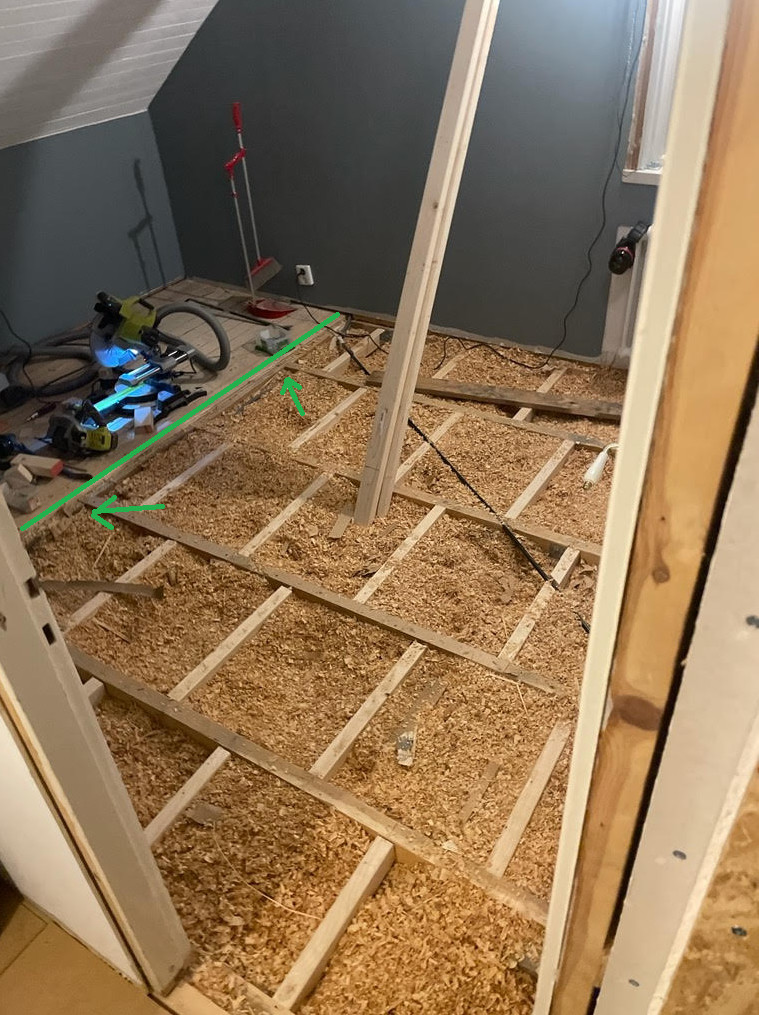
Here is a picture when the floor is open, and the green line is where the knee wall used to be.
We have bought a 50s wooden house that we have renovated.
One thing we have done is to remove the knee walls to get "bigger rooms."
BUT
When you walk on the upper floor, it "thuds" a lot. (It didn't do that before)
The closer you get to the area where the knee wall was removed, the more it thuds.
(It thuds when my 4-year-old walks upstairs and we're sitting downstairs, so it's very sensitive)
The beams are very sturdy, I tried adding even more joists in between, but it didn't work.
Now I'm starting to think that the knee wall had a function that pressed down the beam running along the side of the house, and thereby made it "solid."
In the areas where we still have the knee walls, the floor is perfect.
Has anyone experienced the same thing?
My thought is to set up a couple of thick joists that "press down" this beam at the wall sides.
Or does anyone have a tip?
I would be very grateful for that.
Here is a picture when the floor is open, and the green line is where the knee wall used to be.

Was any examination/investigation conducted regarding whether the supporting wall has any load-bearing function, which it often does?D degi said:Hello!
We have bought a 1950s wooden house that we have renovated.
One thing we have done is remove the attic crawl spaces to get "bigger rooms."
BUT
When you walk on the upper floor, there's a lot of "thudding" noise. (it didn't happen earlier)
The closer you get to the demolished attic wall, the more it thuds.
(it thuds when my 4-year-old walks upstairs and we sit downstairs, so it's very sensitive)
The beams are very sturdy; I tried adding even more joists in between, but it didn't work.
Now I start to think that the walls of the attic crawl spaces had a function of pressing down the beam running along the long side of the house, making it "rigid."
In areas where we still have the attic crawl spaces, the floor is fine.
Has anyone experienced the same?
My idea is to put up a couple of thick joists to "press down" this beam at the wall sides.
Or does anyone have a tip?
I would be very thankful for that.
Here's a picture when the floor is open, and the green line is where the attic crawl space used to be.
Difficult with a beam, I would guess, because the support legs have an interaction between the floor joist and the rafter on the truss.D degi said:
But I can't say that with certainty.
Best to hire a structural engineer to do calculations or restore the trusses.

Did it never occur to you that knee walls are there for a reason?D degi said:Hello!
We have bought a 1950s wooden house that we have renovated.
One thing we have done is remove the knee walls to get "bigger rooms"
BUT
When you walk upstairs, it "thumps" a lot. (it didn’t do that before)
The closer you get to the removed knee wall, the more it thumps.
(it thumps when my 4-year-old walks up there and we are sitting downstairs, so very sensitive)
The beams are very sturdy, I tried adding even more joists in between, but it didn’t work.
Now I'm beginning to think that the walls of the knee walls had a function in pressing down the beam that runs along the length of the house, thus making it "solid"
In the places where we still have the knee walls, the floor is in great condition.
Has anyone experienced the same?
My thought is in that case to put up a couple of thick joists to "press down" this beam at the wall sides.
Or does anyone have a tip?
I would be very grateful for that.
Here is a picture when the floor is open, and the green line is where the knee wall was before.
It’s not like they built attics for the cat, but the wall to the knee wall is a load-bearing part of the roof. They have them to be able to get a larger room between the knee walls instead of several smaller rooms.
If you get snow load on the roof now, things can happen...
The tip is to restore the beams as they were... otherwise, you will have to transfer the load in some way, but then you need a structural engineer...D degi said:

It is not clear where in the country the house is located, but you need to ensure that there is no snow on the roof, as you have significantly weakened the roof structure. Otherwise, it can have very unpleasant consequences, in the worst case, the roof may break. If there are joints in the upper arms, I would say the situation is urgent.
As for moving forward, you need to hire a structural engineer, but it will probably involve major interventions if you do not want to keep the support legs.
If you choose to restore, I advise you to hire an experienced carpenter.
As for moving forward, you need to hire a structural engineer, but it will probably involve major interventions if you do not want to keep the support legs.
If you choose to restore, I advise you to hire an experienced carpenter.
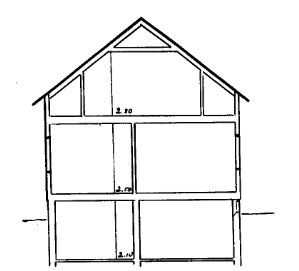
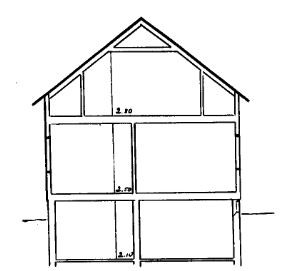
As mentioned, unfortunately, a beam won't help. The drawings show that the attic is built with truss rafters. The posts you have now removed have not only a bearing function but also a stabilizing one. You need to talk to a structural engineer to find a possible solution.
Despite the alarming responses you've received, I want to reassure you a bit. I did the same on my house from 1937, and that was in the early 80s, long before you could get answers to questions here. However, nothing negative has happened despite snowy winters. I believe that when no calculations were made on what the roof trusses could bear, they used significant dimensions, so it holds up anyway.
That being said, since you notice a difference, you should let someone knowledgeable in construction take a look at it.
That being said, since you notice a difference, you should let someone knowledgeable in construction take a look at it.