
173,649 views ·
223 replies
174k views
223 replies
I have torn down the knee wall now the whole house is thumping
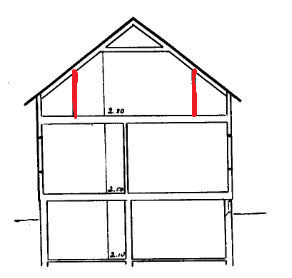
When I look at the drawing, it seems like you have attic spaces on both sides of the house that have subsequently been removed?
As a result, you have no support at all?
In addition to the load-bearing function the attic spaces provide, they also contribute to a warmer house. It's advantageous to add some insulation to them. When we, or rather the carpenters, removed parts of our attic space to build a dormer, I noticed that the temperature became significantly colder in the new room, where there is no longer an attic space, but instead a large room with three exterior walls and large windows.
If I were you, I would call construction companies as soon as possible to see if they can help you restore it or find another solution.
Good luck!
As a result, you have no support at all?
In addition to the load-bearing function the attic spaces provide, they also contribute to a warmer house. It's advantageous to add some insulation to them. When we, or rather the carpenters, removed parts of our attic space to build a dormer, I noticed that the temperature became significantly colder in the new room, where there is no longer an attic space, but instead a large room with three exterior walls and large windows.
If I were you, I would call construction companies as soon as possible to see if they can help you restore it or find another solution.
Good luck!
Member
· Västernorrland
· 12 076 posts
Before shouting oh my god, one should ask what was removed and how was it attached? There are similar spaces that are built solely to have normal walls. It doesn't necessarily mean that something load-bearing has disappeared. The dimensions of the lumber in the torn down part are quite interesting.

In the previous house, we had crawl spaces that were torn down at some point and replaced with a wall in the middle of the room instead. Had a carpenter/constructor over for other things and asked specifically about this, and in my case, the new wall was load-bearing instead of the crawl spaces. So one or the other, he meant, was needed there, but all houses are different.
The thumping or bounce is more of an indoor environment issue. It's unlikely that the beams will be damaged or break. Sure, you might get a permanent sag, etc., but probably not a structural problem. More seriously would be if the roof load-bearing capacity is affected. As already suggested, get help from a structural engineer, not a carpenter, but a real engineer who can calculate the loads. Keep all the snow away.
Since ts posted the drawings in the thread, we know they were load-bearing in ts house...S Stefan1972 said:Before shouting oh my god, you should ask what was cut away and how were they attached? There are similar spaces that are built just to have normal walls. It doesn't necessarily mean that something load-bearing has disappeared. The dimensions of the timber in what was demolished are therefore quite interesting.
So you haven't seen the drawings ts posted in the thread?S Stefan1972 said:Before shouting oh my god, you'd have to ask yourself what was cut away and how was it attached? There are similar spaces that are built just to have normal walls. It doesn't have to be about something load-bearing disappearing. The dimensions of the timber in the torn-down part are quite interesting.
It might potentially be solved with sturdy beams attached directly to the truss above and below, then vertical beams in a few places, significantly larger dimensions than previous studs, to maintain the load-bearing function while still having a more open room. However, you must discuss the exact dimensioning with a structural engineer.
Those drawings only show the walls. Whether they are load-bearing or not, we do not know. So whether the house's stability is affected without knowing which dimensions have been used remains only a guess.Nissens said:
My own very amateurish guess is that the risk of snow load damage is small considering the steep slope of the roof.
Ts. can certainly make a reasonably qualified guess based on how the removed walls were dimensioned and how they were anchored.
Minnie
As an amateur, one can often replace the engineer by over-dimensioning à la "herredjävlar".Johanbogg said:
This could potentially be solved with substantial beams attached directly to the truss both at the top and bottom, then vertical beams in a couple of places, considerably larger in dimension than the previous studs, to maintain the load-bearing function while still having a more open room. However, the exact sizing regarding this must be discussed with an engineer.
Minnie
Minnie Mesola said:
Yep, but I don't want to recommend it since I don't know if the person in question considers something like 45x90 as oversized.
I mean, I've seen people build fences with battens as posts.
That is the section drawing showing which walls are load-bearing and which cannot/must not be removed just like that. What I've marked in red are the knee wall. They are load-bearing.D degi said:
You can replace the vertical studs with a glulam beam, but it becomes quite substantial. It also requires structural calculations and a construction notification.
Simplest solution:
Put the studs back in and clad them. The space can still be used.
Example of how it looks in a former attic on Kasernhöjden in Karlstad:
https://www.bjurfors.se/sv/tillsalu/varmlands-lan/karlstad/kasernhojden/kasernhojden-13a/#bilder
Aha!Anna_H said:
So the other walls are not included in the drawing? That was like ... I've never seen such a drawing of a regular villa before. Then I'll just ignore my nonsense.
Minnie