
173,725 views ·
223 replies
174k views
223 replies
I have torn down the knee wall now the whole house is thumping
I have the impression that older roof trusses are often actually slimmer and have also been told by a designer that since the "eurocodes" came, the sizing has gone completely overboard; here on ByggaHus someone talked about being over-strong.K Kurtivan said:Despite the alarming responses you've received, I want to reassure you a bit. I did the same on my house from 1937 in the early 80s, long before you could get answers to questions here. Nothing negative has happened despite snowy winters. I believe that when no one calculated what roof trusses could bear, they used generous dimensions so it holds anyway. But that said, since you notice a difference, you should have someone with building knowledge look at it.
In my experience, older roof trusses are significantly less well-dimensioned than modern ones. Comparing the trusses of my previous house with a similar span to my current one, the current one feels a bit like toothpicks in comparison (the previous built in '80, this one in '49).F FGLIN said:
If you're not trying to fend off riots or have problems with snowdrifts, a fence is a small issue from a security standpoint but can function as a boundary marker (at least for a while).Johanbogg said:
in Norrland, by the road, it didn't last longer than the first time the snowplow drove byF FGLIN said:

just as lousy as the one about the saw, it only pinches if there is a load on it right then, so why are you getting hung up on me? It's worse to saw things apart and realize "oh, this was load-bearing" while sawing…mexitegel said:
in fact, mine is actually more sensible then, because in 99% of the cases you will never encounter a "slack" stud in either load-bearing or non-load-bearing walls, and if you do find one so slack that you can bend it freely, well, then you probably have other concerns in the house anyway as nothing larger than 45x45 would bend freely. And such a stud will basically never be load-bearing in anything other than a house for a robotic lawn mower.
so consider now. How many studs do you come across that can be bent super easily regardless if it's a load-bearing or non-load-bearing wall? Like never a single one, so what does my advice do? Well, you will never cut anything other than like 45x45 studs which in turn are never load-bearing in a HOUSE.
so my advice is basically "you will never cut anything," then whether you think that is lousy is up to you.
Even though the discussion has come to center around the serious side of the problem, i.e., weakening the structure, it would be interesting if someone could provide an analysis of the original question, i.e., the thumpiness and the acoustic side.Anna_H said:
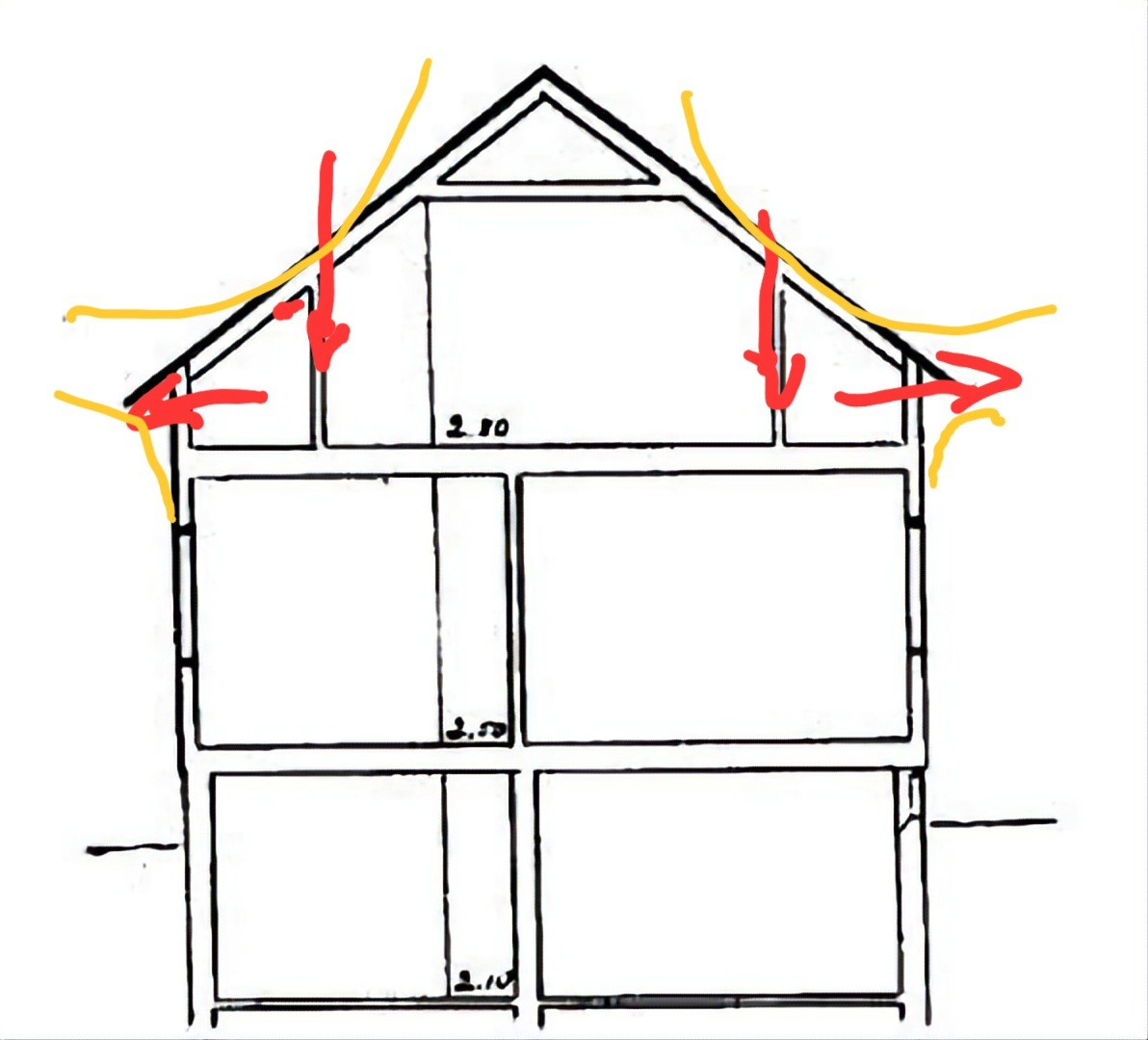
That's the section drawing showing which walls are load-bearing and cannot/should not be removed without further action. What I've marked in red are the cat wind walls. They are therefore load-bearing.
One can put in a glulam beam instead of the vertical studs, but it would be quite thick. It also requires structural calculations and a building application.
[image]
The simplest solution:
Put the studs back and cover them. The space can still be used.
An example of how it looks in a former attic at Kasernhöjden in Karlstad:
[link]
Regarding stability, the base construction already has features that make me ponder. With external walls that protrude above the floor framework, there's a risk that the roof truss' rafters (the diagonal beams) could push the walls outward. With the floor framework integrated into the truss as a lower frame, you would have a much stronger construction, and the truss would mainly transfer vertical forces to the wall. The downside is, of course, that the upstairs wouldn't be as high. The collar beam certainly helps to hold the construction together, but since it's placed rather high up, if the rafters aren't stiff enough, they might tend to bend outward. The cat wind posts should also, of course, help stabilize this to some extent but at the cost of high moments at their connections and/or load on the part of the external wall that is above the floor deck. Unfortunately, I have a similar structure (which never had cat wind posts) in an older ancillary building. Although there's a diagonal iron going from the floor beam up to the wall plate, there's still a problem because the iron tends to lift and twist the beam (it's mounted on one side of the beam and thus twists it) while the upper part of the wall post has been pressed outward.
Addition: saw that post 37 addressed roughly the same thing.
Differently dimensioned, perhaps better dimensioned, the older houses have at least stood the test of time for many years and as far as I know, not many houses have disappeared because the roof trusses didn't hold up. Over-dimensioning is expensive and takes up space.
It is often the deformations that are dimensioning. It's hard to argue against the fact that many old roofs are saggy but not so many new ones.F FGLIN said:
No, but they don't have to depend on the trusses. The pressure on the roof goes down through the entire building to the foundation. So if the foundation or any joist gives way, the roof yields.W witten said:
Our house, also from the 50s, has an unfinished attic. But the wall in your drawing is not load-bearing. Our support posts sit much further out in the unfinished attic and are not "small sticks" you cut off "by mistake." But in older houses, it more or less feels like most things become slightly load-bearing over time as it settles a bit here and there. I would guess that the wall you removed possibly provided stabilization but is not critical for load-bearing. But for safety's sake, it's worth checking. Please update us.D degi said:Hello!
We have bought a 1950s wooden house that we have renovated.
One thing we have done is remove the unfinished attic walls to get "larger rooms."
BUT
When you walk upstairs, it "thumps" a lot. (it didn't do that before)
The closer you get to the removed unfinished attic wall, the more it thumps.
(it thumps when my 4-year-old walks up there and we are sitting downstairs, so it's very sensitive)
The beams that run are very sturdy; I tried adding even more joists in between, but it didn't work.
Now I'm beginning to think that the unfinished attic walls had a function of pressing down that beam that goes the length of the house's long side and thus made it "solid."
In the places where we still have the unfinished attic, the floor is excellent.
Has anyone experienced the same?
My thought, in that case, is to install a couple of thick joists that "press down" this beam at the wall sides.
Or does anyone have a tip?
I would be very grateful for it.
Here is a picture when the floor is open, and the green line is where the unfinished attic was before.

The risk/damage correctly described. Beam exchange or a wall in the middle. Not so easy to beam exchange as the load on the columns that the glulam beam rests on must be carried down through the entire building.EddieHansson said: