
173,739 views ·
223 replies
174k views
223 replies
I have torn down the knee wall now the whole house is thumping
U
Utsliten och utdömd
Building conservationist
· 2 850 posts
Utsliten och utdömd
Building conservationist
- 2,850 posts
It is also not just about installing a beam.
Any beam must be supported on posts that in turn must stand on something capable of bearing the point loads.
What you have done requires a building permit (alteration of a load-bearing structure).
Any beam must be supported on posts that in turn must stand on something capable of bearing the point loads.
What you have done requires a building permit (alteration of a load-bearing structure).
No, the sectional drawing only shows load-bearing walls. The floor plan drawings show all walls, so when you need to demolish something, it's the sectional drawing you need.Minnie Mesola said:
Then you must know that in old houses, any wall can be more or less load-bearing. Especially thick plank walls.
A simple (but under certain circumstances risky!) test if you are unsure is to handsaw the stud or plank you want to remove. If the saw binds, it's a load-bearing stud/plank. In that case, it must be replaced in some way.

I usually go for trying to "bend" them, if it feels like they are under pressure, you leave them alone, if they feel loose, you cut them.Anna_H said:
No, the sectional drawing only shows load-bearing walls. The drawings seen from above show all walls, so when you want to demolish things, it's the sectional drawing you need.
Then you must be aware that in old houses any wall can be more or less load-bearing. Especially thick board walls.
A simple (but under certain circumstances risky!) test if you're unsure is to hand-saw the stud or board you want to remove. If the saw pinches, it is a load-bearing stud/board. Then it must be replaced in some way.
A risky advice as there are different load cases.
For example, basement walls whose purpose is not to bear vertical loads but to counteract soil pressure. Or in TS's case where the struts may not receive significant load until there's snow on the roof.
For example, basement walls whose purpose is not to bear vertical loads but to counteract soil pressure. Or in TS's case where the struts may not receive significant load until there's snow on the roof.
No, the section drawing only shows load-bearing walls.
The drawings seen from above show all walls, so when you're going to demolish something, it's the section drawing you need.
Then you must know that in old houses any walls can be more or less load-bearing. Especially thick plank walls.
A simple (but under certain circumstances risky!) test if you're unsure is to handsaw the beam or plank you want to remove. If the saw binds, it's a load-bearing beam/plank. Then it must be replaced in some way.
No, the section drawing only shows load-bearing walls.
The drawings seen from above show all walls, so when you're going to demolish something, it's the section drawing you need.
Then you must know that in old houses any walls can be more or less load-bearing. Especially thick plank walls.
A simple (but under certain circumstances risky!) test if you're unsure is to handsaw the beam or plank you want to remove. If the saw binds, it's a load-bearing beam/plank. Then it must be replaced in some way.
Is it really the case that the section drawing shows load-bearing walls?No, the section drawing only shows load-bearing walls.
The drawings seen from above show all walls, so when you're going to demolish something, it's the section drawing you need.
Then you must know that in old houses any walls can be more or less load-bearing. Especially thick plank walls.
A simple (but under certain circumstances risky!) test if you're unsure is to handsaw the beam or plank you want to remove. If the saw binds, it's a load-bearing beam/plank. Then it must be replaced in some way.
It becomes a bit tricky since not all load-bearing walls are always included, then a section drawing can vary depending on where in the house the section is taken!
I'm doubtful that it's so, but I'm not a constructor!
In this particular case, there's no doubt with the type of truss but in general?
Last edited:
Calm and steady now TS, it will be fine!
Just don't feed the 4-year-old too much now..
Just don't feed the 4-year-old too much now..
It is a framework truss with a raised wall section, there's really no doubt when it comes to the question of whether the walls were load-bearing. There should also be stabilizing struts inside the attic with that type of truss.E egge80 said:
I know that, in this case there is no doubt that type of truss requires support legs but I mean in generalW witten said:
Yep. But no more risky than cutting and seeing if the saw gets stuckmexitegel said:

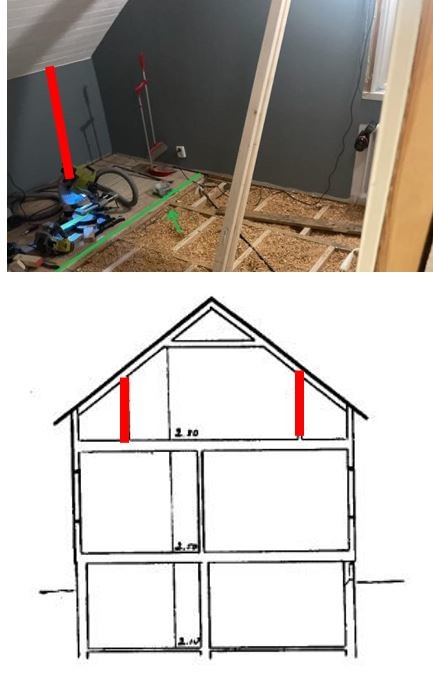


D degi said:Hello!
We have bought a 1950s wooden house that we have renovated.
One thing we have done is to remove the knee walls to get "bigger rooms"
BUT
When you walk on the upper floor, it "thuds" a lot. (didn't do that before)
The closer you get to the demolished knee wall, the more it thuds.
(it thuds when my 4-year-old walks upstairs and we sit downstairs, so very sensitive)
The beams that run are very solid, I tried to add even more studs in between, but it didn't work.
Now I'm beginning to think that the walls of the knee walls had a function that pressed down the beam running along the house's long side, thus making it "solid"
In the areas where we still have the knee walls, the floor is in prime condition.
Has anyone experienced the same?
My thought is to put up a few thick studs that "press down" this beam at the wall sides.
Or does anyone have any tips?
I would be very grateful for that.
Here is a picture when the floor is open, and the green line is where the knee wall was before.
Those walls are likely load-bearing. You should address it immediately and pray that it doesn't snow heavily before you fix it.D degi said:Hello!
We have bought a 1950s wooden house that we have renovated.
One thing we have done is to remove the knee walls to get "bigger rooms"
BUT
When you walk on the upper floor, it "thuds" a lot. (didn't do that before)
The closer you get to the demolished knee wall, the more it thuds.
(it thuds when my 4-year-old walks upstairs and we sit downstairs, so very sensitive)
The beams that run are very solid, I tried to add even more studs in between, but it didn't work.
Now I'm beginning to think that the walls of the knee walls had a function that pressed down the beam running along the house's long side, thus making it "solid"
In the areas where we still have the knee walls, the floor is in prime condition.
Has anyone experienced the same?
My thought is to put up a few thick studs that "press down" this beam at the wall sides.
Or does anyone have any tips?
I would be very grateful for that.
Here is a picture when the floor is open, and the green line is where the knee wall was before.
The reason for the thudding on the floor is that you have extended the span of the joists, resulting in flex. The support legs also function as bearings (hangers) for the floor joists. In a framework, everything interacts in several different ways.