That may be true, but that's why it would be good to verify the direction of the floor structure visually or through a floor structure plan.
Either the floor structure changes direction after the load-bearing wall ends, or the floor structure needs to be supported before it goes over the wall that TS wants to remove. Otherwise, the wall must be load-bearing.
You mean reinforcement plan since it's a cast floor structure..
Ah, sorry. I thought I read all the blue posts and looked for concrete. But both precast concrete and in-situ cast are concrete. So it can and should be investigated anyway.
Do you have any technical description or a floor slab drawing?
No, unfortunately not. Could such documents be available at the municipality? Is it worth checking there?
JJansson69 said:
Because the span is too long otherwise for a regular floor slab, whether it's cast or wooden with normal thickness. The sectional drawing shows that the load-bearing wall is supporting...
How wide is the house?
Edit: I see now that it wasn't the wall you wanted to remove...
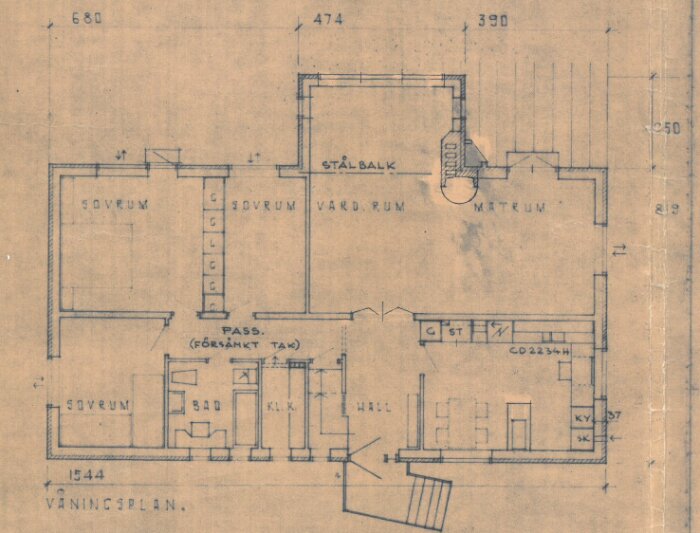
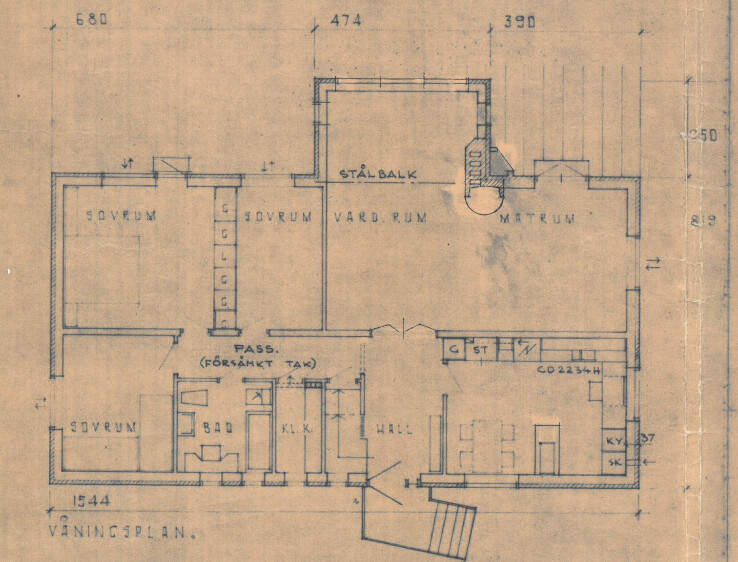
Attached is the drawing with all measurements. The house is 819 cm wide, plus 350 cm at the bay window in the living room. The wall in question is about 450 cm.
Karrock said:
I have a similar basement layout in my house from '65. The floor slab consists of concrete elements resting on the load-bearing wall. Except in the garage, where they rest on/in two welded steel profiles (probably L or U). Do you see any such type of support where the load-bearing wall should be? If so, it should be fairly safe to remove the lightweight concrete wall.
I have a ceiling in the room, so I need to make a hole in it to check. However, any such beam ends in a light inlet with glass blocks, which seems like a very poor support. This makes me think no such beam exists...
Sscorp1on said:
That might be the case, but that's why it would be good to verify the direction of the floor slab visually or through a floor slab drawing.
Either the floor slab changes direction after the load-bearing wall ends, or the floor slab needs to be braced before it goes over the wall that TS wants to remove. Otherwise, the wall would be load-bearing.
Is there any way to see it visually?
Karrock said:
Ah, sorry. I thought I read all the blue posts and looked for concrete. But both prefabricated and in-situ concrete are concrete. So it can and should be investigated anyway.
Other visible floor slabs have traces of board formwork in the ceiling, which I think indicates in-situ casting. However, I will remove some ceiling in the relevant room!
I definitely think it's worth checking with the municipality for any additional information that might be available. Unfortunately, if you want to visually check the direction of the joists and you have a ceiling, you will need to make a hole somehow, hence it might be good to check with the municipality if there are other drawings available first.
I have now checked and searched; I can't find better information on the floor structure, etc.
Is it possible with the help of a structural engineer to exclude the wall being load-bearing through an on-site visit, or will I need to use a beam regardless?

Karrock said:
I have a similar basement layout in my house from '65. The floor slab consists of concrete elements resting on the load-bearing wall. Except in the garage, where they rest on/in two welded steel profiles (probably L or U). Do you see any such type of support where the load-bearing wall should be? If so, it should be fairly safe to remove the lightweight concrete wall.