
536 views ·
3 replies
536 views
3 replies
A little moisture on one basement wall, what do I do now?
When I removed the kids' climbing wall (which was mounted on 25mm spacers), I noticed that it's a bit damp at the bottom of the wall, about 20cm up. It's definitely not wet, but not bone dry either. This side of the house is the only part that isn't drained (due to paving and geothermal heating).
Tearing up and draining these three meters isn't an option right now; I just want to make it "good enough."
Now I want to renovate here and am considering how to do it best.
Grateful for all constructive suggestions
Tearing up and draining these three meters isn't an option right now; I just want to make it "good enough."
Now I want to renovate here and am considering how to do it best.
- Attach steel studs and moisture-resistant drywall to allow airflow behind, and then apply acoustic panels or paint the drywall
- Spackle and paint with regular wall paint. If the moisture gets worse, it would be easier to notice than if it's covered.
- Something entirely different?
Grateful for all constructive suggestions
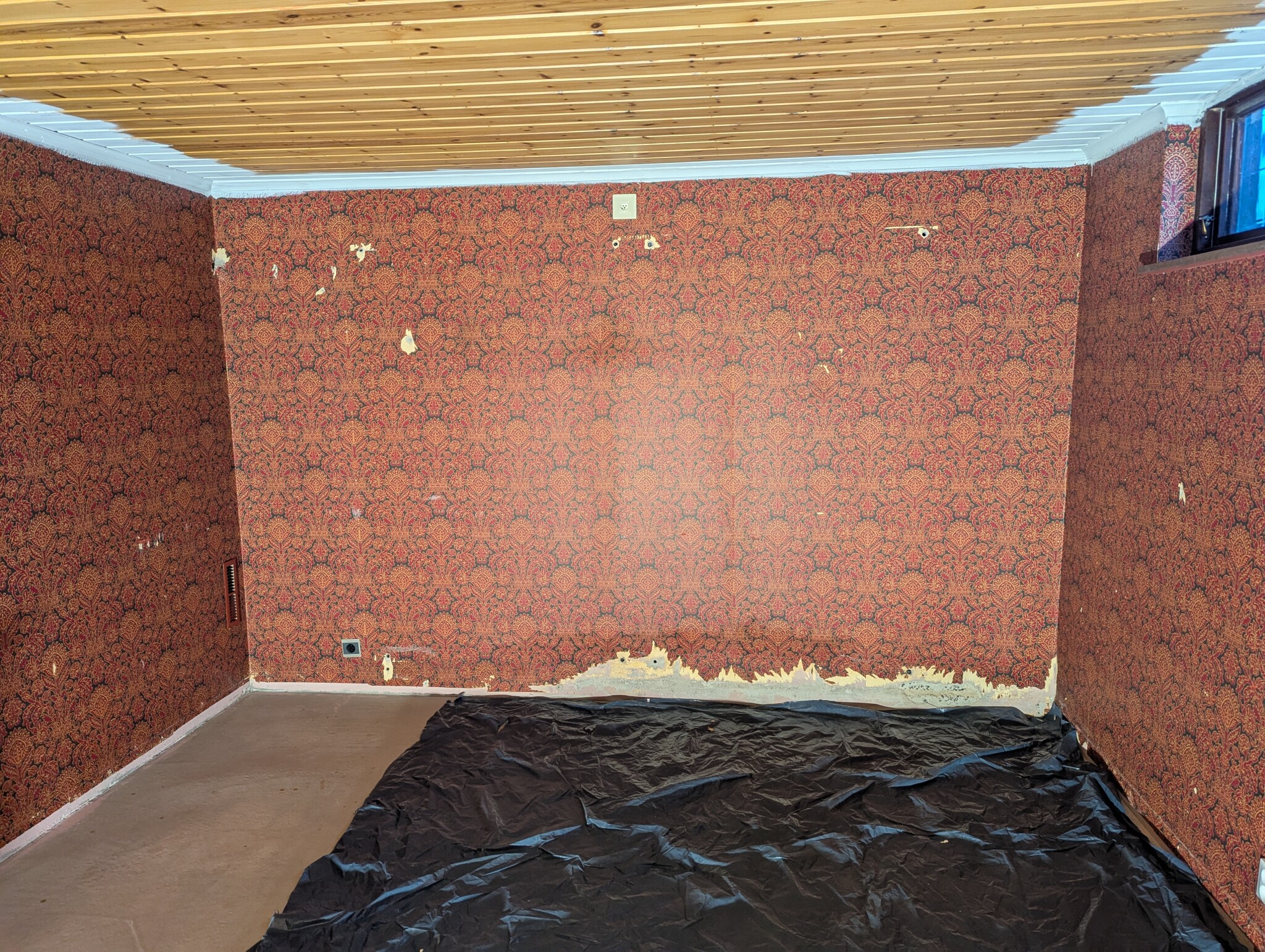
You also need to ensure that all organic material is removed from the walls with penetrating moisture, otherwise you risk microbial growth. Have you used a moisture indicator and know which walls are damp?
Yes, it's only the wall in the picture that's affected.Centano said:
In the picture, the dark area at the bottom of the wallpaper looks worse than it is.
The simplest way is to peel off the wallpaper on this moisture-affected wall and let it dry. Once it has dried, you can paint with a paint that allows moisture to pass through, and that should suffice as a measure. The small amount of moisture that migrates through should not leave any significant marks. It may be barely noticeable once it comes out.
Drainage would hardly help since you cannot drain away the ground moisture that is always present in the soil. I assess that it is the ground moisture migrating through the foundation and becoming visible at the bottom. As long as the migration is not blocked by a dense paint, filler, or other tight coating, it should hardly be noticeable. Do not place furniture tightly against that wall. Furniture on legs facilitates air circulation/drying and can be ok. I had the same phenomenon in my old basement and had much more severe damage with paint and plaster separation. After replastering with lime plaster and painting with silicate paint, I have not seen signs of moisture migration even though it continued at the moderate pace it used to.
Drainage would hardly help since you cannot drain away the ground moisture that is always present in the soil. I assess that it is the ground moisture migrating through the foundation and becoming visible at the bottom. As long as the migration is not blocked by a dense paint, filler, or other tight coating, it should hardly be noticeable. Do not place furniture tightly against that wall. Furniture on legs facilitates air circulation/drying and can be ok. I had the same phenomenon in my old basement and had much more severe damage with paint and plaster separation. After replastering with lime plaster and painting with silicate paint, I have not seen signs of moisture migration even though it continued at the moderate pace it used to.
Last edited:
Click here to reply