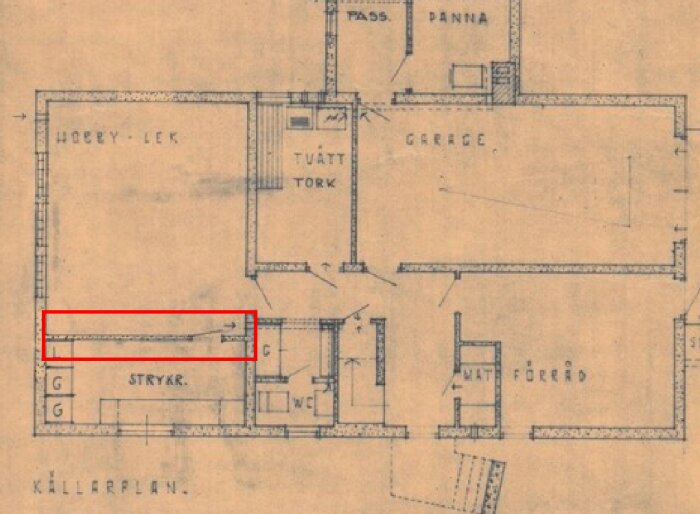
Hi, I am interested in removing a wall in the basement, but of course, I wonder if it is load-bearing in any way. The wall in question is marked on the drawing below.
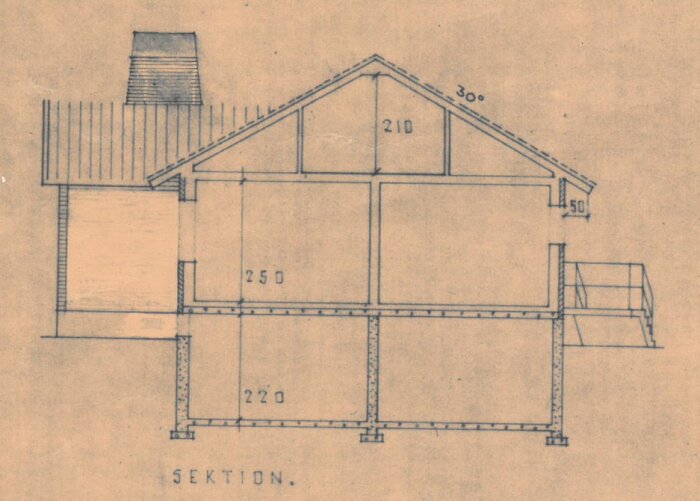
The house is from 1962 with a structure in blåbetong. The longitudinal wall in the basement is over 200 mm thick. The red-marked wall is about 100 mm thick. The section does not show the wall (but I don't have a section in the right direction), see below.
Is it possible to draw any conclusions from this, or do I need to bring in a structural engineer? Thanks in advance!
Hi, I'm eager to remove a wall in the basement, but wonder of course if it bears any load in some way. The wall in question is marked on the drawing below.
[image]
The house is from 1962 with a frame of blåbetong. The longitudinal wall in the basement is over 200 mm thick. The red-marked wall is about 100 mm thick. The section does not show the wall (but I don't have the section in the correct direction), see below.
[image]
Can any conclusions be drawn from this or do I need to bring in a structural engineer? Thanks in advance!
On the sectional drawing, you can clearly see a central wall, so normally such a wall would probably not be load-bearing.
However, on the floor plan, the central wall is missing in the hobby room, and instead, there is the wall you have marked, so it's not entirely ruled out that it has some kind of stabilizing function.
In the sectional drawing, you can clearly see a heart wall in the middle, so normally such a wall would likely not be load-bearing. However, on the plan drawing, the heart wall is missing in the hobby room, and instead, the wall you have marked is there, so it's not entirely out of the question that it has some sort of stabilizing function.
Yes, I've felt the same way, mostly wanted to check if it's obvious or if it needs to be checked on-site.
To add some info, both the longitudinal heart wall and the transverse one between hobby/play and laundry, and between ironing room and WC, are over 200mm thick.
That should mean it's load-bearing and not the marked wall.
Is the floor structure over the hobby+ironing rooms in a different direction compared to the rest of the basement?
Not as far as I can see, but it is a concrete floor structure.
I realize I haven't shown the floor plan above, it has a core wall that lies directly over the core wall in the basement (not the one the thread is about. It is about 150 mm instead of the other interior walls which are about 100 mm on the upper floor.
I realize I haven't shown the floor above, it has a load-bearing wall directly above the load-bearing wall in the basement (not the one this thread is about). It is about 150 mm instead of the other interior walls which are about 100 mm on the upper floor.
Because the span is too long otherwise for a regular joist floor, whether it's cast or wood joist with normal thickness.
The sectional drawing shows that the core wall is load-bearing.
How wide is the house?
Edit: I now see it wasn't the wall you wanted to remove..
Because the span is too long otherwise for a regular floor structure, whether it's cast or wooden joists with normal thickness.
The section drawing shows that the central wall is load-bearing.
How wide is the house?
Initially, I was going to ask how you know the span is too long when we don't know the width of the house, but I missed the steel beam in the living room, so you might have a point.
Initially, I thought about asking how you know it's too long of a span when we don't know the width of the house, but I missed the steel beam in the living room, so you might have a point.
I was a bit careless and didn't look at the first post's red wall because that's probably the one you want to remove?
It might very well be non-load-bearing!
Was a bit careless and didn't look at the first post's red wall because that's the one you want to remove, right? It could very well be non-load-bearing!
Yes, that's the wall TS wants to remove, he also writes that this wall is 100 mm compared to the heart wall which seems to be 200 mm. However, I'm considering what you said about the span over the hobby and ironing room.
I have a similar basement layout in my house from '65. The floor structure is concrete elements laid on the heart wall. Except in the garage where they rest on/in two welded steel profiles (L or U probably). Do you see any such type of support beam where the heart wall should be? If so, it's fairly safe to remove the lightweight concrete wall.
But the red-marked wall is just as thick as the load-bearing wall, so it's likely that it is used as a load-bearing structure..
That's possible, but that's why it would have been good to verify the direction of the floor joists visually or via a floor plan.
Either the floor joists change direction after the load-bearing wall ends, or the joists need to be supported before they go over the wall that the OP wants to remove. Otherwise, the wall would be load-bearing.
Vi vill skicka notiser för ämnen du bevakar och händelser som berör dig.