
4,602 views ·
10 replies
5k views
10 replies
Intermediate floor - choice of construction and soundproofing
Hello!
Here I am sharing a challenge! I am working on building permits and construction drawings for an extension and total renovation of my villa, which is a 1930s plank house with a basement and two floors. The basement is being converted into a separate apartment, and therefore a floor separating the apartment with impact sound insulation is needed. I have read extensively about impact sound insulation and have a structural engineer who is not knowledgeable about sound insulation, so I have instructed him. I am now pondering whether I can finalize the solution I have chosen for the intermediate floor or if it can be optimized.
The existing floor is 55m2 with spans of 3.1m + 3.7m (two supports) on each side of the central wall, and it will be reinforced with a new beam on each beam due to the long span and heavier load, as well as new boards over the beams. The basement ceiling is already completed. The construction will be 2x13mm gypsum, battens, 2x45x170mm cc300-450 with 170mm stone wool, screw-glued chipboard, 12mm Sylomer SR42, floating floor with 22mm chipboard with underfloor heating in grooves + 15mm self-leveling compound. The total weight of the floor will be 100 kg/m2, of which the floating layer is 40 kg/m2. The room height will be 2.35m in the basement and 2.45m on the 1st floor, which could be acceptable.
Now comes the actual question: an optimization I want to investigate is whether I can avoid the screw-glued chipboard and instead place the Sylomer strip directly on the beams. I suggested the chipboard to the designer to make the floor stronger in the longitudinal direction. But how important is it considering I have 2x45x170mm beams, and I can also cross-brace as compensation? The gain would be one less layer of chipboard, 22mm higher room height, and I would avoid having to special order or mill an excessive number of grooves (something like this https://byggkatalogen.byggtjanst.se/produkt/spanskivor/forestia-ljudgolv/126566) or drill holes in the chipboard to avoid a solid air pocket in the Sylomer layer (the Sylomer strip should actually be placed directly on the beams). I have asked the engineer to calculate it, but he doesn’t seem to have time to update the construction drawing. Is there anyone here who can advise mainly on the existence or non-existence of the screw-glued chipboard, but also other improvements in function, economy, and workload? The function is important as it is not pleasant to have impact sound for a tenant in the basement. Today, it feels like being in a drum when someone walks on the 1st floor.
Here I am sharing a challenge! I am working on building permits and construction drawings for an extension and total renovation of my villa, which is a 1930s plank house with a basement and two floors. The basement is being converted into a separate apartment, and therefore a floor separating the apartment with impact sound insulation is needed. I have read extensively about impact sound insulation and have a structural engineer who is not knowledgeable about sound insulation, so I have instructed him. I am now pondering whether I can finalize the solution I have chosen for the intermediate floor or if it can be optimized.
The existing floor is 55m2 with spans of 3.1m + 3.7m (two supports) on each side of the central wall, and it will be reinforced with a new beam on each beam due to the long span and heavier load, as well as new boards over the beams. The basement ceiling is already completed. The construction will be 2x13mm gypsum, battens, 2x45x170mm cc300-450 with 170mm stone wool, screw-glued chipboard, 12mm Sylomer SR42, floating floor with 22mm chipboard with underfloor heating in grooves + 15mm self-leveling compound. The total weight of the floor will be 100 kg/m2, of which the floating layer is 40 kg/m2. The room height will be 2.35m in the basement and 2.45m on the 1st floor, which could be acceptable.
Now comes the actual question: an optimization I want to investigate is whether I can avoid the screw-glued chipboard and instead place the Sylomer strip directly on the beams. I suggested the chipboard to the designer to make the floor stronger in the longitudinal direction. But how important is it considering I have 2x45x170mm beams, and I can also cross-brace as compensation? The gain would be one less layer of chipboard, 22mm higher room height, and I would avoid having to special order or mill an excessive number of grooves (something like this https://byggkatalogen.byggtjanst.se/produkt/spanskivor/forestia-ljudgolv/126566) or drill holes in the chipboard to avoid a solid air pocket in the Sylomer layer (the Sylomer strip should actually be placed directly on the beams). I have asked the engineer to calculate it, but he doesn’t seem to have time to update the construction drawing. Is there anyone here who can advise mainly on the existence or non-existence of the screw-glued chipboard, but also other improvements in function, economy, and workload? The function is important as it is not pleasant to have impact sound for a tenant in the basement. Today, it feels like being in a drum when someone walks on the 1st floor.

Making floating floors with chipboard is not very effective because the surface weight is too low; it can also cause parquet resonance.
Placing Sylomer strips on the joists and using a higher surface weight is a better alternative. You can completely skip the chipboard and create a solution with dovetail plates as in the link below.
http://www.lip.dk/media/173262/lewis_laxstj_rtpl_t.pdf?v=1524491783907
Placing Sylomer strips on the joists and using a higher surface weight is a better alternative. You can completely skip the chipboard and create a solution with dovetail plates as in the link below.
http://www.lip.dk/media/173262/lewis_laxstj_rtpl_t.pdf?v=1524491783907
I was considering using salmon tail plates at first. But it will weigh too much with underfloor heating coils in the leveling compound as well. Otherwise, it would have been convenient. Now I have leveling compound on the chipboard in the floating floor with a total weight of about 40 kg/m2. That should be enough, it corresponds to more than chipboard + 2 plasterboards.

Tool enthusiast
· Stockholm
· 1 399 posts
@hejhopp
Acoustically, your suggestion is absolutely correct. You seem to have a good grasp on this. Remember not to short-circuit the new floor to the wall and to run external wiring in the ceiling of the lower floor. Regarding strength, I would have cross-braced. @justusandersson has a good handle on such things.
Acoustically, your suggestion is absolutely correct. You seem to have a good grasp on this. Remember not to short-circuit the new floor to the wall and to run external wiring in the ceiling of the lower floor. Regarding strength, I would have cross-braced. @justusandersson has a good handle on such things.
Attached is a file with some measurement results on similar solutions.
The alternative solution with Sylomer strips on the beams should yield better results in terms of lower drum sound. I have a floating floor on a Stepisol mat and I find it gives quite a spongy feel, as well as high drum sound compared to a stiffer upper floor.
The alternative solution with Sylomer strips on the beams should yield better results in terms of lower drum sound. I have a floating floor on a Stepisol mat and I find it gives quite a spongy feel, as well as high drum sound compared to a stiffer upper floor.

The interesting question then becomes whether your solution works without a screw-glued chipboard? If you screw-glue a 45x170 joist to the existing one, it is enough to keep the deflection at an acceptable level (less than 1/300 of the span). On the side of the shear wall where the span is 3.7 m, however, the sag is a bit too high. Cross bracing in the middle of the floor structure is likely enough to counteract it. Note that cross bracing can have an effect in this case; however, it does not prevent deflection from an evenly distributed load.
Thanks Björn Melander for the kind reference!
Thanks Björn Melander for the kind reference!
Should I have a third glued screw beam on the half with long span Justus? The load from all the beams and boards is evenly distributed. Thus, the coverage is 30-40% beams in the floor. Lucky that I'm not having any sewer pipes there...
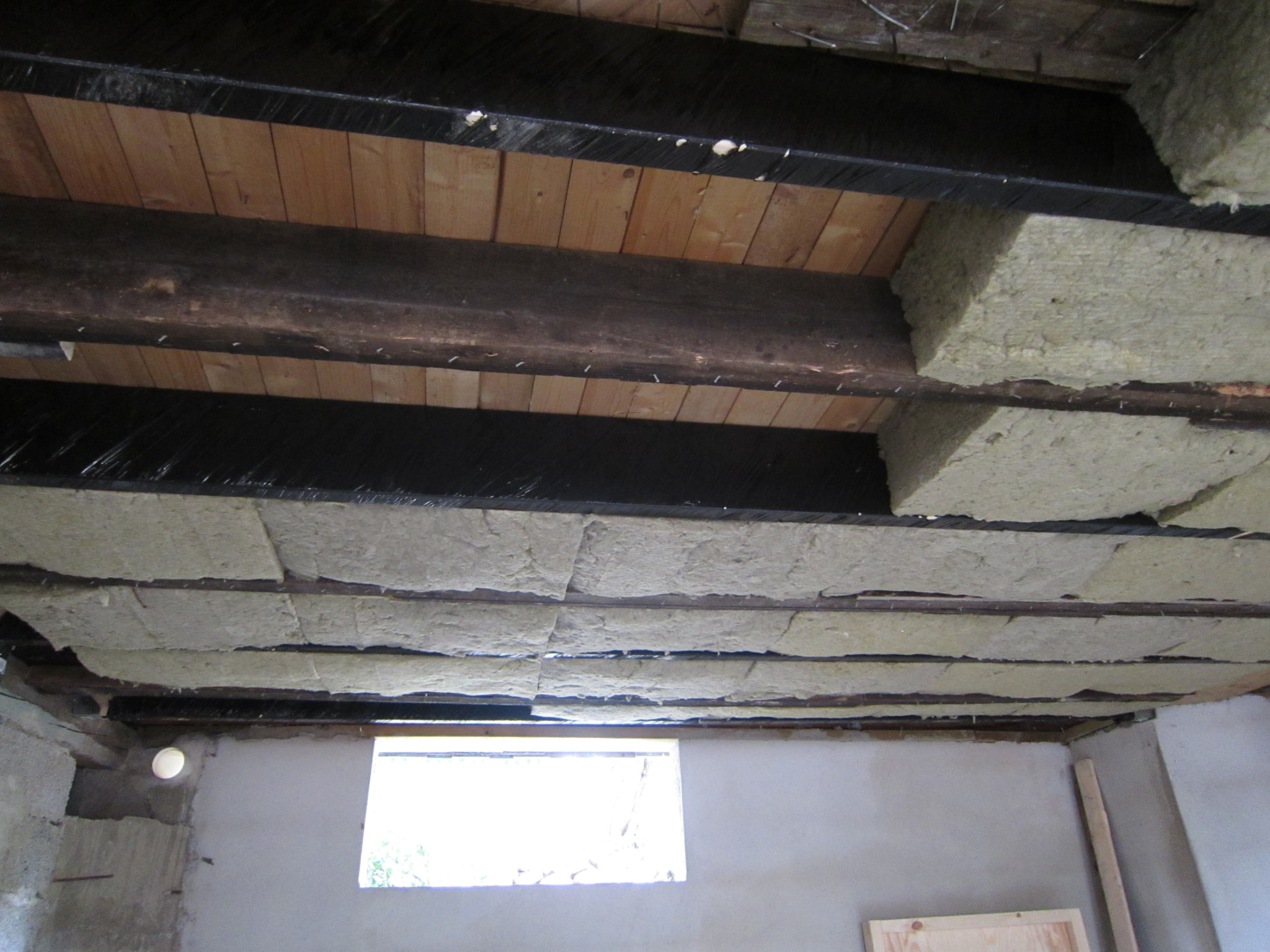
I need to add more information, haven't told the whole story. I don't have many good pictures of the floor structure from the basement renovation but in the attached image, you see the old beams with cc600-900. Most were 45mm wide but of unknown quality, and there was also a single solid beam. All 18 cm high. So I then supplemented from below with 42x180 glue-laminated timber between each old beam for future use. These are the old and semi-new beams that I now have to glue screw an additional beam to. The engineer suggested using 45x170 beams as they are 3 times cheaper than glulam. If we are at the borderline, it would be better to choose glulam to glue screw on the side with long span and c24-beams on the short side. Can I get away with not glue screwing three beams then Justus? I might try cross-bracing too, even though I'm unsure of its effect.
The extension has a span of 7.3 m with a 200mm central wall in the middle, and I'm using full beams so I get three supports. Those lengths are probably more expensive but they are likely needed. Currently, in the k-drawing, I have double plasterboard, acoustic beam, 2x45x170 cc600 and glued screw floor chipboard, Sylomer, chipboard+floating screed. Surely the deflection is so low that I can do without floor chipboard here too? Cross-bracing in four rows 1/3 from support?
I need to add more information, haven't told the whole story. I don't have many good pictures of the floor structure from the basement renovation but in the attached image, you see the old beams with cc600-900. Most were 45mm wide but of unknown quality, and there was also a single solid beam. All 18 cm high. So I then supplemented from below with 42x180 glue-laminated timber between each old beam for future use. These are the old and semi-new beams that I now have to glue screw an additional beam to. The engineer suggested using 45x170 beams as they are 3 times cheaper than glulam. If we are at the borderline, it would be better to choose glulam to glue screw on the side with long span and c24-beams on the short side. Can I get away with not glue screwing three beams then Justus? I might try cross-bracing too, even though I'm unsure of its effect.
The extension has a span of 7.3 m with a 200mm central wall in the middle, and I'm using full beams so I get three supports. Those lengths are probably more expensive but they are likely needed. Currently, in the k-drawing, I have double plasterboard, acoustic beam, 2x45x170 cc600 and glued screw floor chipboard, Sylomer, chipboard+floating screed. Surely the deflection is so low that I can do without floor chipboard here too? Cross-bracing in four rows 1/3 from support?
FG, your diagrams indicate that I will end up in sound class C if a short circuit is avoided. The weight of my floating floor corresponds to their "heavy". For the extension, I will also use acoustic studs in the ceiling.
I also believe it would be best to use surface-mounted cables for the ceiling lighting in the extension to minimize drilling, Björn. I'll see if I can come up with a solution to run electric above the plaster without touching the ceiling joists and maintain soundproofing. The existing basement ceiling, however, has electrical boxes and spotlights. I plan to bury these from above with plaster mortar  , both for soundproofing and fire protection purposes. I will seal the plaster ceiling with fire sealant, need to check if it's elastic enough. Christian Berner has an air gap between the floating floor and wall in his instructions. Isn't it better to fill the gap with something that doesn't short-circuit the dampening but still blocks air noise somewhat? Can one safely fill it with acoustic sealant or some type of mineral wool?
Best regards, Christian
, both for soundproofing and fire protection purposes. I will seal the plaster ceiling with fire sealant, need to check if it's elastic enough. Christian Berner has an air gap between the floating floor and wall in his instructions. Isn't it better to fill the gap with something that doesn't short-circuit the dampening but still blocks air noise somewhat? Can one safely fill it with acoustic sealant or some type of mineral wool?Best regards, Christian
There are many balls in the air... It is always advantageous to use whole beams that span over two bays with three supports. This results in what is usually called continuous beams. The bending moment that occurs over the middle support is greatest and also directed upwards, thus counteracting the deflection in the middle of the bays.
Solutions with glulam are often better than those with regular construction timber. Glulam is stiffer at the same cross-section and is also available in many widths. If I were to renovate an old joist with relatively low beams (e.g., 180 mm high), I would insert new glulam beams between the old ones and use the width measurement (I would naturally calculate it first), preferably 90x180.
Cross bracing to counteract floor flex should primarily be placed at the midpoint of the beams.
This may not have answered all the questions, but perhaps it cleared up some uncertainties?
Solutions with glulam are often better than those with regular construction timber. Glulam is stiffer at the same cross-section and is also available in many widths. If I were to renovate an old joist with relatively low beams (e.g., 180 mm high), I would insert new glulam beams between the old ones and use the width measurement (I would naturally calculate it first), preferably 90x180.
Cross bracing to counteract floor flex should primarily be placed at the midpoint of the beams.
This may not have answered all the questions, but perhaps it cleared up some uncertainties?
The basement walls are up on the extension, and I am in the process of ordering floor joists, etc., for the frame construction next week. I've thought about it a few more times and have decided on 90x180x8000 laminated wood in the lower floor of the extension after all (the heavy one with about 100kg/m2 self-weight and a total span of 7350mm, s600 and three supports including the load-bearing wall). This instead of glue-screwing 8-meter 170 joists in winter climates. I will remove the extra cm by cutting out an additional cm towards the sill and removing some leca. The ten beams cost a bit extra, but it will be a better and faster solution in all ways. The upper floor (normal self-weight) I am changing from 2x45x170 s600 to 45x170 s300, so I avoid glue-screwing there as well. I'm ordering a few extra joists for glue-screwing in the bathroom floor, so I'll get to test how it goes as well. I will probably use Wurth wood glue D3/D4 PVAc, which can be used down to -10C. The existing floor that needs renovation will be a later problem.
Click here to reply