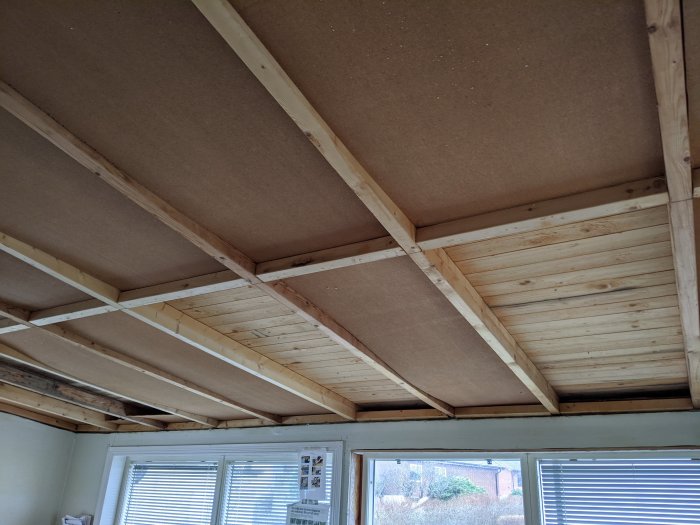
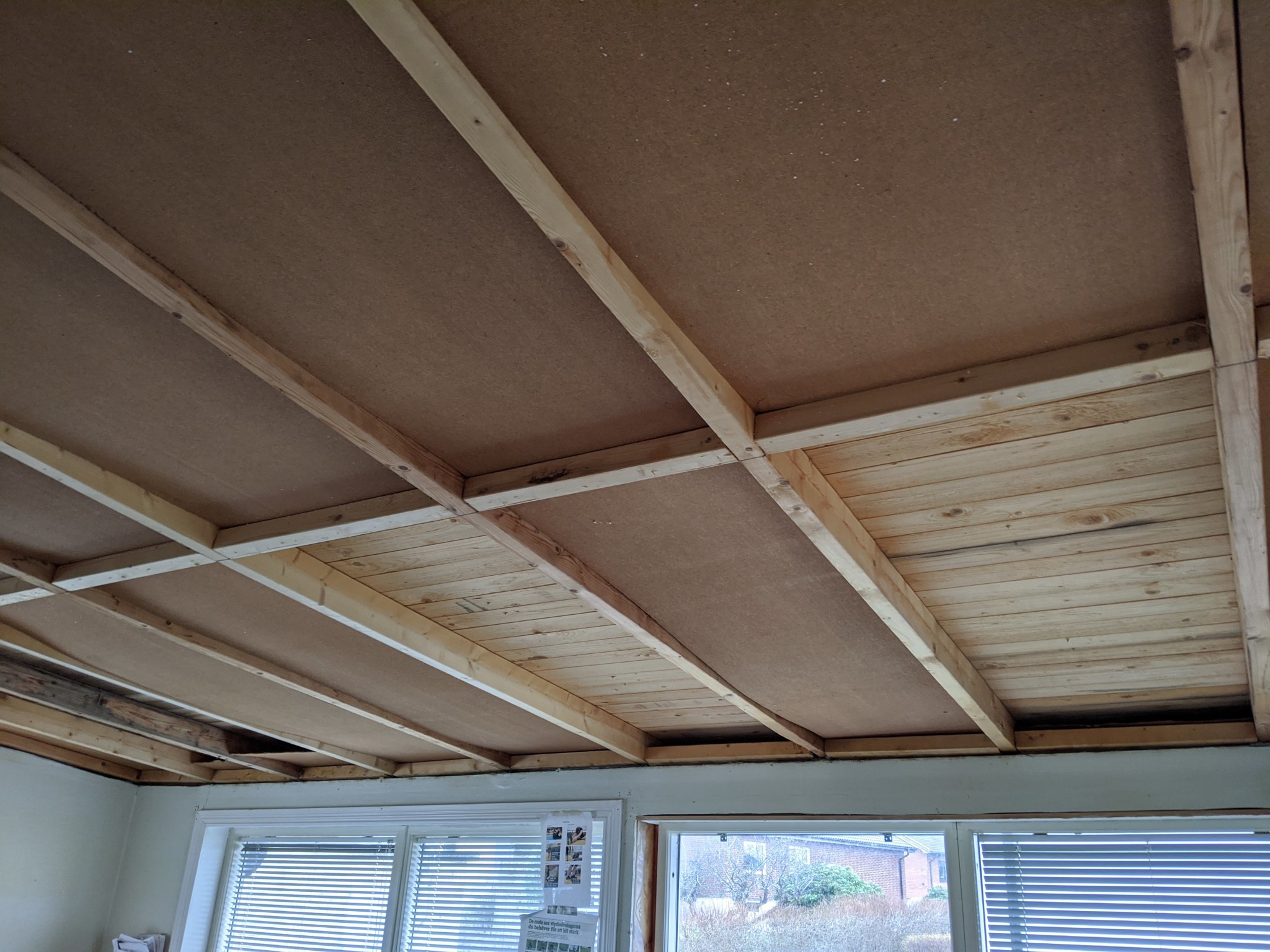
We have started a project to replace a ceiling in an insulated (but unheated) sunroom. The now-removed ceiling was a nailed tongue-and-groove. Directly under this, there was insulation with Styrofoam panels between the beams and under these a thin board panel that lay "loosely" against the outer roof. I guess it was to create an air gap! See picture!
We were thinking of installing ready-made ceiling panels, like https://www.byggmax.se/innertak-p1026 as a new ceiling, but we're considering what kind of insulation we should use.
Our idea is regular glass wool panels like: https://www.byggmax.se/isoleringsskiva-lambda-37-isover-p16265 which we fit between the joists and a layer of building foil on this before nailing new battens for the ceiling panels across the beams.
Questions: Should the board panels remain, i.e., the air gap, or maybe we can skip the building foil, it wasn't there before? If we put the building foil, i.e., "vapor barriers," do we also need to arrange ventilation? I can mention that the room is also an exit to the patio, so there is a patio door.
hmm, it looks pretty weird, I don't understand how you're supposed to create an air gap at that small height. The transverse battens effectively stop all airflow, unless there's a gap above them?
Yes, I think it's the outer roof outside, or the inner part of it, the outside is metal-covered, sloping about 5-7 degrees.
The studs are 95 cm and about 3.5m
Yes, I think it's the outer roof outside, or the inner part of it, the outside is sheet clad, slopes about 5-7 degrees. The beams are 95 cm and about 3.5m
SStefNo said:
Yes, I think it's the outer roof outside, or the inner part of it, the outside is sheet clad, slopes about 5-7 degrees. The beams are 95 cm and about 3.5m
95 mm I assume? Are they 45x95 mm? Sorry, a bit off topic. But I'm a bit worried if it can handle its own weight and the snow load.
In snow zone 1, for example, a minimum of 45x145mm with cc600mm with a maximum span of 3.5m is required. Sloped roof 5 degrees with light cladding.
We have started a project to replace a ceiling in an insulated (but unheated) sunroom. The ceiling that has been taken down was nailed tongue and groove. Directly beneath it, there was insulation with polystyrene boards between the beams and below these a thin board that lay "loosely" against the outer roof. I guess it was to create an air gap! See picture!
[image]
We were thinking of putting up pre-made ceiling panels, like [link], as the new ceiling but are considering what insulation to use.
Our idea is regular glass wool boards, like: [link], which we fit between the beams and a layer of construction plastic on this before nailing up new battens for the ceiling panels across the beams.
Questions: Should the board sheets remain, i.e. the air gap, or can we maybe skip the construction plastic, which wasn’t there before? If we put up the construction plastic, i.e. "vapor barriers", do we need to arrange ventilation? I can mention that the room is also an exit to the terrace, so there is a patio door.
That ceiling is not approved for snow load plus its own weight!
The reason Eps was chosen as insulation was weight and diffusion openness!
Of course, use Eps (for weight reasons) insulation in the new ceiling and outdoor gypsum for fire protection but reinforce the ceiling so that in winter you can use props or set them up if it snows heavily!
You need an air gap to avoid plastic!
Ok thanks for the answers! Yes, of course, I mean 95mm x 45mm!
Why do you need an air gap to avoid plastic?
Bbyggarätt said:
That roof is not approved for snow load plus its own weight!
The reason Eps was chosen as insulation was weight and vapor permeability!
Of course, use Eps (due to weight reasons) insulation in the new roof and exterior gypsum for fire protection but reinforce the roof so that you can set a prop or can set a prop if it snows heavily in the winter!
You need an air gap to avoid plastic!
Ok thanks for the answers! Yes, of course, I mean 95mm x 45mm!
Why do you need an air gap to avoid plastic?
Condensation always occurs and it needs to be ventilated out... Eps is diffusion open so in the summer the moisture will be heated out, but in the winter you get condensation that needs to be vented, which is not possible with plastic film...
If the roof had been stronger, I would have chosen cellulose, which is superior in your use case.
No diffusion barrier in spaces that are not to be heated, there will be moisture precipitation inside the insulation in the roof in the spring when the sun heats the roof and the cold of the night remains in the room. If you have a barrier, the moisture cannot be aired out into the room.
Kind regards.
/CC
Click here to reply
Vi vill skicka notiser för ämnen du bevakar och händelser som berör dig.