
9,474 views ·
12 replies
9k views
12 replies
How to moisture-proof an interior brick wall that lets through moisture?


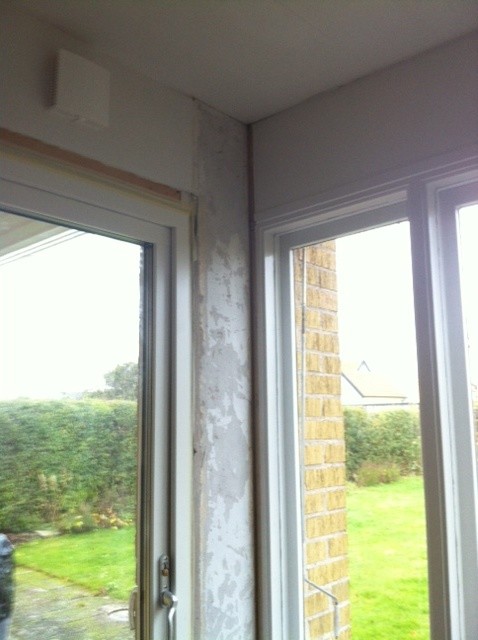

Hello everyone!
I've got some black mold at the top and bottom due to moisture migration through the brick wall.
The house was built in 1964 and in this corner, wallpaper is applied directly to the plaster with the brick wall underneath (only plaster/filler in between). I have sealed the corner between the brick and the window properly outside with construction sealant.
I'm wondering if I should "paint" the wall inside with a moisture barrier, then apply filler over this and then wallpaper?
Or how should I do it to make sure it doesn't come back?
Should I first treat the upper and lower corners with Borakol (anti-mold agent)?
A neighbor with the same problem glued tar paper and then glued a thin gypsum board and then wallpapered. Sounds a bit "old-fashioned".....
Help me! Please!!


The battens have "punched holes" in the roofing felt almost everywhere they go down.
I have sawed off the battens (see picture) and then applied/filled a thick layer of repair tar. This has been done along the entire roof. Also replaced with new gutters/downpipes this summer. So it should be watertight.
But what should I do with the inner wall..??
The mold will not return if you have addressed the moisture issues.
I would tear out the wallpaper and mechanically remove all the black mold behind it.
Let it dry out thoroughly if there is any risk of remaining moisture.
Then just putty and paint/wallpaper.
I would tear out the wallpaper and mechanically remove all the black mold behind it.
Let it dry out thoroughly if there is any risk of remaining moisture.
Then just putty and paint/wallpaper.
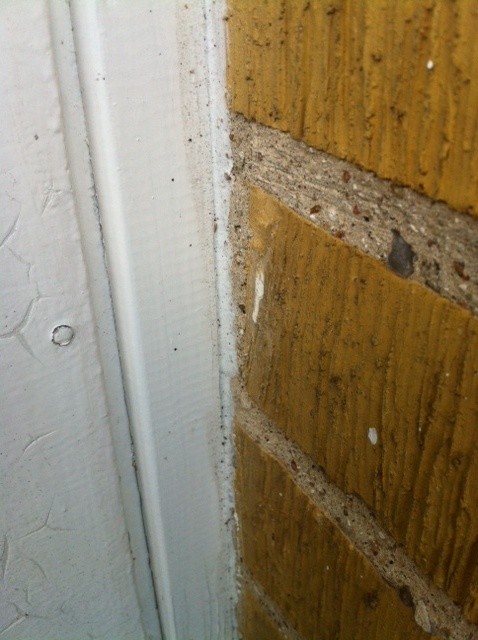


The yellow piece of wall that sticks out is very exposed, that's probably where most of the moisture is coming from, there is no overhang there even though it's otherwise good. At the same time, it's not possible to just remove that wall, right?
No - that section of wall can't just be "removed," but it's that brick wall that might be the remaining issue, you know... It's said that brick can conduct moisture. So I'm wondering if it would be best to "moisture-proof" that section from the inside (which I've cleaned of wallpaper and mold - see previous picture) and then plaster and wallpaper it?? "Both suspenders and a belt," so to speak.....
Yes, you should treat the wall as if it were a basement wall in that case, meaning you need to ensure there is an air gap between the brick and the interior, otherwise, you will still have moisture problems. Remember to also do this between the window frames and the wall, otherwise, you will eventually get rot there! Personally, I think it seems difficult, which is why I believe you need to address the root cause, i.e., make sure the wall is not exposed to moisture. This is partially from above as rain hits directly due to the lack of overhang, and partially from ground moisture as you have pavement directly up to the house at floor level. You need to lower the ground around the wall so that rain does not splash against the wall and moisture-proof the foundation from the outside so that moisture is not absorbed.
Thanks for all the tips. I think we'll just putty and paint with some "breathable" paint so that part of the wall can air out, and we'll skip the wallpaper to hopefully keep the mold away......... If that doesn't work, we'll have to start working from the outside and moisture-proof the brick wall there.

All uninsulated exterior walls should "breathe." The easiest to work with is gypsum filler or gypsum plaster if there are larger holes. Common filler contains cellulose and is therefore unsuitable.
If it is "wet," gypsum-based render won't work, but if it's just damp, it will be fine. If it's wet, you need real plaster!
Then you simply paint with a plaster paint (diffusion-open).
If it is "wet," gypsum-based render won't work, but if it's just damp, it will be fine. If it's wet, you need real plaster!
Then you simply paint with a plaster paint (diffusion-open).
Wet room filler is also suitable for "dry" environments. It should be behind the waterproofing where it's dry, so I wouldn't use it either.
Indoors, one should use silicate paint which is diffusion-open. It is sometimes also called "Plaster paint."
Indoors, one should use silicate paint which is diffusion-open. It is sometimes also called "Plaster paint."
Click here to reply