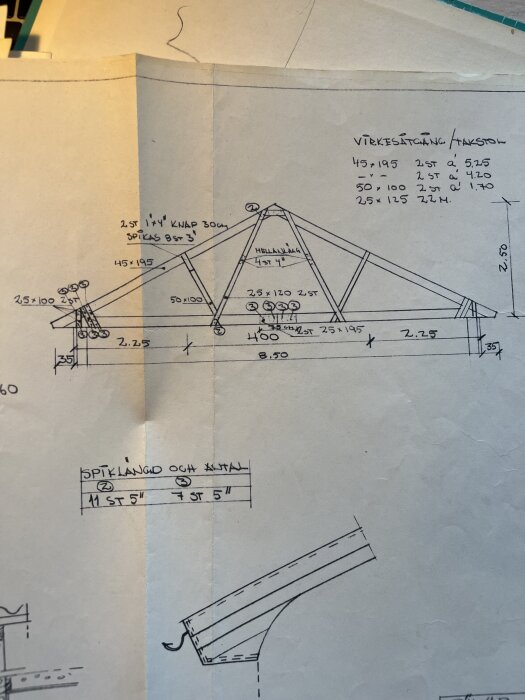
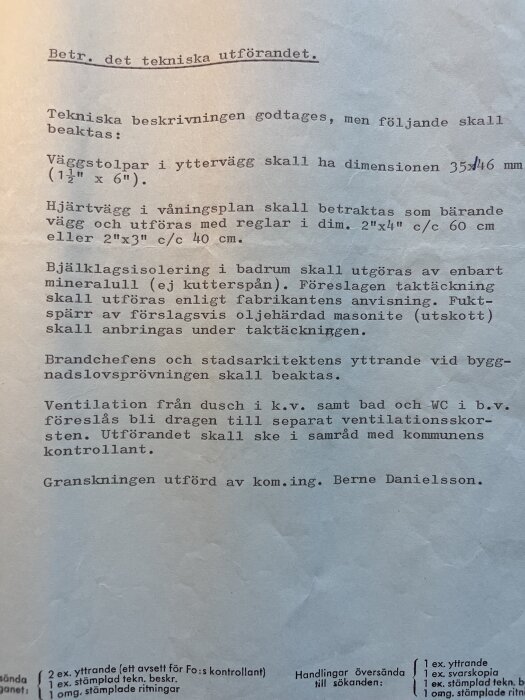
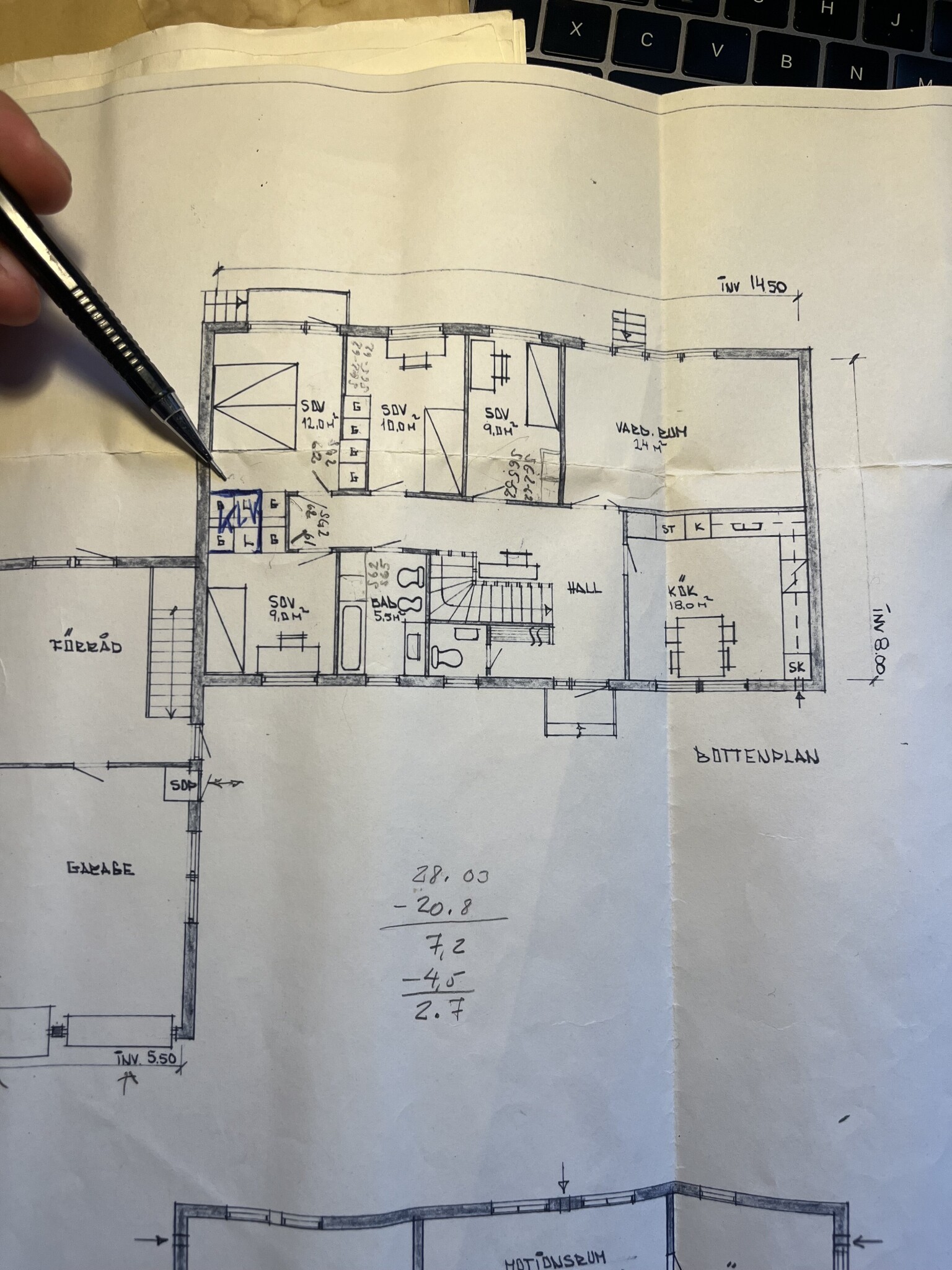
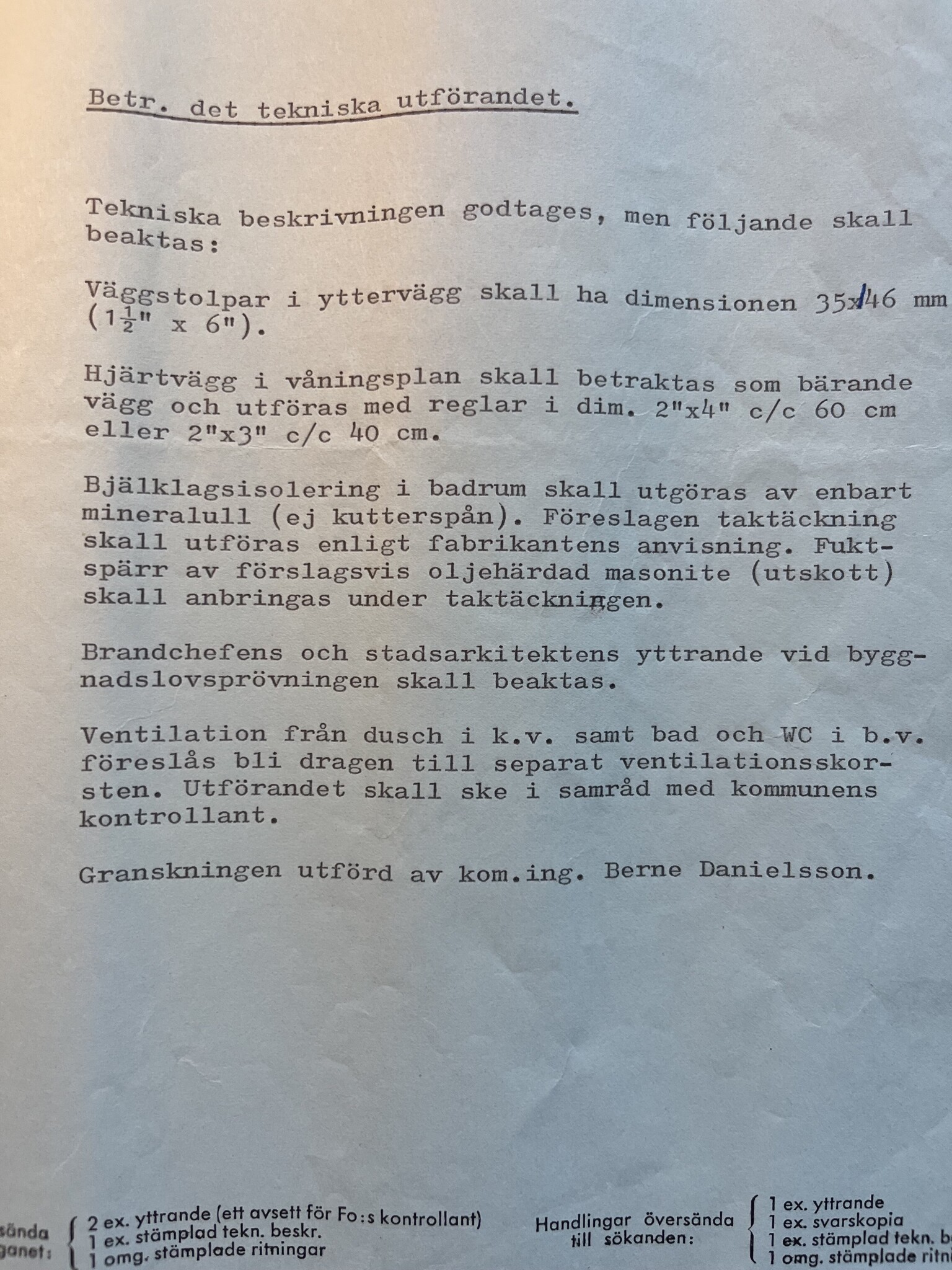
Recently moved into a house built in '73, and I would like to understand how my belongings work. The plan is to create an opening to a walk-in closet in what I thought was a load-bearing wall. After taking down the paneling, I see that the ceiling was built before the wall, which to me suggests it doesn't have a load-bearing function. I start digging into blueprints and building permits and find a statement from the municipality that the heart wall should be considered load-bearing. I interpret it as the trusses being self-supporting but the municipality at the time didn't think so?
How should one interpret blueprints? Do I have self-supporting trusses? Planning to remove 1 stud for an opening of 70 cm, so a stud of 195x45 on edge should be sufficient as a support over the opening, right?
I understand your reaction to the statement, as both the drawing of the truss construction and your discovery that the wall is built after the finished surface on the ceiling point to the opposite. What is the formal status of the document? Is it specifically issued due to a question/dispute/problem that has arisen in this house? Or is it a standard form where this was included due to inattention?
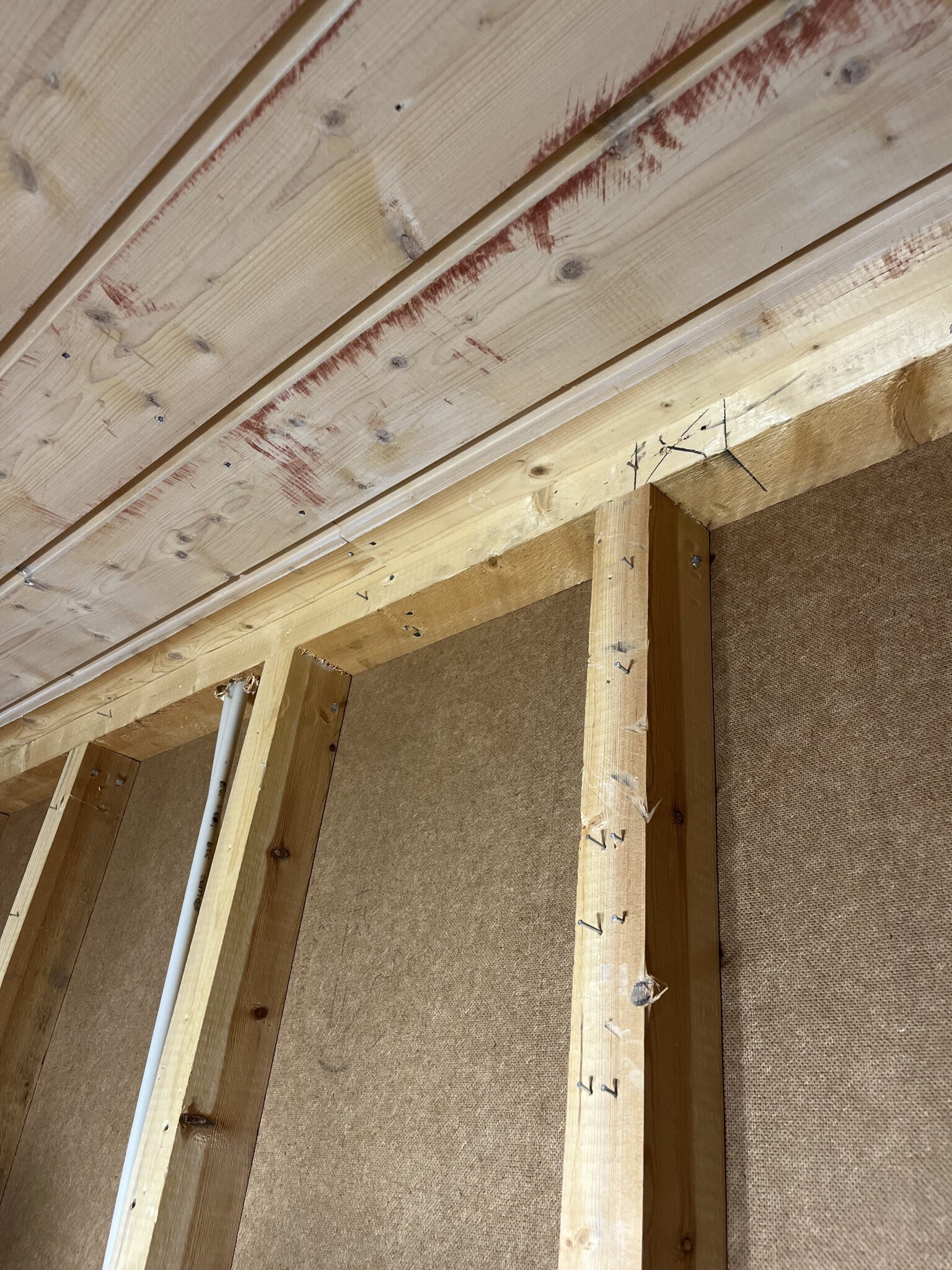
On the other hand, for some reason, there are double headers up to the ceiling (and I have difficulty interpreting how they and the ceiling panel meet), and over time, sagging may have caused some load to rest on the wall.
Regardless, a 70 cm opening can be supported without issues even if the wall were load-bearing. If the studs are c/c 600, then your "supporting" involves increasing the span between studs by just over 12 cm It's even easier if you can settle for the existing free measure between the studs (if the placement happens to fit). But don't remove entirely up to the top; instead, place a nogging above door height and use rigid boards (like plywood) as wall cladding on both sides, and you'll have a good "light beam" over the opening and continued lateral stability. You can (should...) also safely crawl up into the attic and check if the trusses appear to rest on the wall, as well as the position of the nearest trusses—your opening might not be under any of them, but if the wall is unexpectedly load-bearing, you'll want to know if there will be a point load right in your new opening.
However, understand that - regardless - it might become a matter of formality, because if it states "load-bearing" in any legally binding document, then this trivial matter will require a building notice. If you want to cover yourself, have a structural engineer look at it, and in the best case, issue a certificate that the wall is not load-bearing (which you just file away), and in the worst case, provide a hand-drawn sketch of stud dimensions and fasteners with accompanying calculations on how it should be supported, to be attached to a building notice.*
* personally, after checking in the attic as mentioned above, I would just install the new upright stud (or two if none of the existing ones are in the correct position), then carefully remove the stud that needs to go, and see what happens (at worst, a small subsidence). After that, add noggings and rigid boards over the opening. But I don't dare write that publicly
I understand your reaction to the statement, because both the drawing of the truss construction and your discovery that the wall is built after the ceiling finish point to the opposite. What is the formal status of the document? Was it issued specifically due to some issue/dispute/problem that arose in this particular house? Or is it a standard form where this slipped in due to inattention?
On the other hand, there are still double headers up against the ceiling for some reason (and I find it hard to interpret how they and the ceiling panel meet), and over time, sagging might have caused some load to rest on the wall.
But regardless, a 70 cm opening can be bridged without issues even if the wall were load-bearing. If the studs are at c/c 600, your "bridging" deals with a local, slightly over 12 cm larger spacing between the studs
It becomes even easier if you can settle for the existing free distance between the studs (if by chance it fits). But don't tear all the way up; instead, put a short piece above door height and use rigid boards (like plywood) as wall covering on both sides, and you'll have a good "light beam" over the opening and maintained lateral stability. You can (should...) also crawl up into the attic for safety's sake and check if the roof trusses seem to rest on the wall, as well as the location of the nearest relevant roof trusses – your opening might not fall under any of them, but if the wall is unexpectedly load-bearing, you'd want to know if there's a point load in the middle of your new opening or not.
However, I understand that it – regardless – could become a matter of formality, because if it says "load-bearing" in any legally applicable document, this trifle will require a building notification. If you want to cover your back, have a structural engineer look into this, ideally issue a certificate stating that the wall is not load-bearing (which you just file away), and at worst provide a hand-drawn sketch of stud dimensions and fasteners with an accompanying calculation on how it should be bridged, to be attached to a building notification.*
* Personally, after checking in the attic as above, I would just fix the new upright stud (or two if the existing ones aren't in the right location), then carefully remove the stud that needs to go, and see what happens (at worst a slight settling). After that, put on short pieces and rigid boards over the opening.
But I dare not write that publicly
It is a single header towards the ceiling, now it seems like double where the ceiling molding was. Cc 40 on the studs so one disappears, and 2 studs are added to get the correct dimension of the opening.
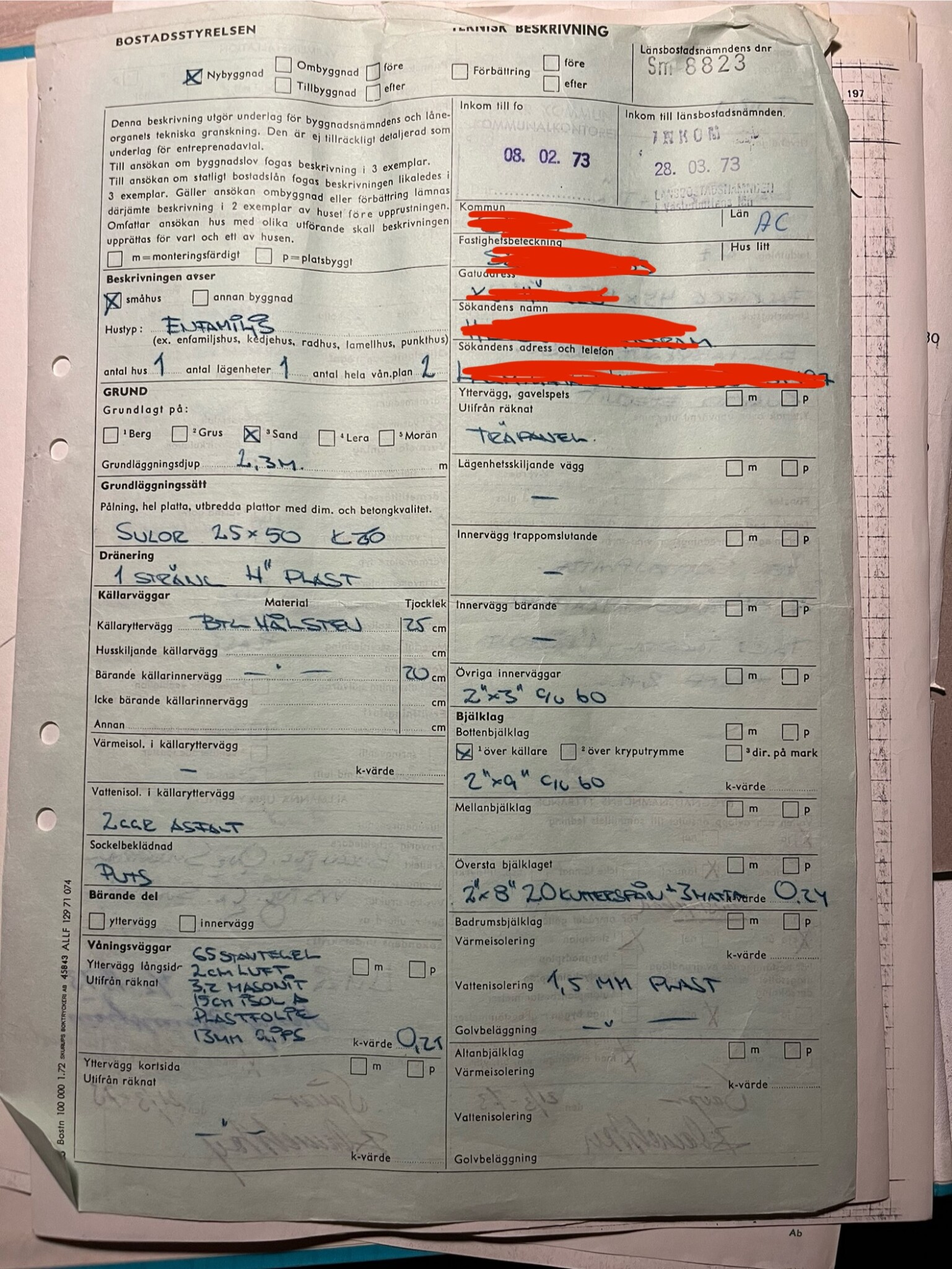
Regarding the document, I have very poor understanding of how the process looks and what is final and applicable. But what I attached earlier seems to be a response to the technical description for the building permit? So it's approved, but... keep this in mind, something like that? Legally applicable or not, one could ask
OK, looks even more non-load-bearing, and carelessly pierced right through for double (?) VP pipes
The short c/c distance is logical because of the weak hardboard as the surface layer and doesn't necessarily have anything to do with a (vertical) load-bearing function. As mentioned, check for safety how it looks in the attic.
The statement appears to be the building inspector's approval after reviewing the technical description, with some remarks. So yes, the wall should be "considered" as load-bearing, but that doesn't change anything in essence. In fact, in the best case, it's the opposite, because if the designer dimensioned the attic floor (and thus the truss rafters) for wood shavings and the shavings were replaced with mineral wool due to this statement, the trusses have significant overcapacity
Do you have the technical description? It should be archived together with the other building permit documents.
OK, looks even more non-load-bearing, and carelessly pierced right through for double (?) VP pipes
The short c/c distance is logical due to the weak masonite as the surface layer and need not have anything to do with any (vertical) load-bearing function. As I said, check how it looks in the attic for safety's sake.
The statement seems to be the building inspector's approval after reviewing the technical description, with some remarks. So yes, the wall should be "considered" load-bearing but that doesn't change anything in substance. In fact, in the best case, the other way around, because if the designer dimensioned the ceiling joists (and thus the truss roof trusses) for wood shavings and due to this statement the wood shavings were replaced with mineral wool, the trusses have a significant overcapacity
Do you have the technical description? It should be archived together with the
CChrzan said:
OK, looks even more non-load-bearing, and carelessly pierced right through for double (?) VP pipes
The short c/c distance is logical due to the weak masonite as the surface layer and need not have anything to do with any (vertical) load-bearing function. As I said, check how it looks in the attic for safety's sake.
The statement seems to be the building inspector's approval after reviewing the technical description, with some remarks. So yes, the wall should be "considered" load-bearing but that doesn't change anything in substance. In fact, in the best case, the other way around, because if the designer dimensioned the ceiling joists (and thus the truss roof trusses) for wood shavings and due to this statement the wood shavings were replaced with mineral wool, the trusses have a significant overcapacity
Do you have the technical description? It should be archived together with the other building permit documents.
Now there is only wool over the bathroom and shavings everywhere else though. It exists, there was better order with papers back in the day! Some parts deviate from it though; there are concrete tiles instead of asbestos cement, masonite instead of plasterboard, etc.
And I now read that it says at the signature "according to the attached statements". Thus, they should also be legally valid.
Haha, yes, "approved with comments according to the attached statement" and then you build as you want: keep the wood shavings, replace gypsum with (cheaper) masonite, but also asbestos cement tiles with concrete - so it's a bit of plus and minus (the wood shavings are not necessarily a minus - in some respects quite the opposite, if the house is healthy otherwise).
If you're very concerned about formality, invest in an hour of engineer's fee for either a certificate of "non-load-bearing" or an A4 with specifications for "reinforcement," and submit the building application in the latter case (though I'm sure it'll be the former once the engineer sees the truss drawing).
Or just do it where I'm not allowed to write
EDIT
Are there more drawings in the building permit, preferably those of the engineer and ideally sections?
Haha, yes, "approved with comments according to attached statement" and then you build as you like: keep the wood shavings, replace plasterboard with (cheaper) masonite, but also asbestos tiles with concrete - so it's a bit of plus and minus (wood shavings are not necessarily a minus - in some respects quite the opposite, if the house is healthy otherwise).
If you're very concerned about formality, invest in an hour of an engineer's fee for either a certificate of "non-load-bearing" or an A4 with instructions for "reinforcement", and submit a building notification in the latter case (though I'm sure it will be the former after the engineer sees the truss drawing).
Or just do that which I can't write
EDIT
Are there more drawings in the building permit, preferably the engineer's and preferably a section?
It's strongly leaning towards the simple way 😉
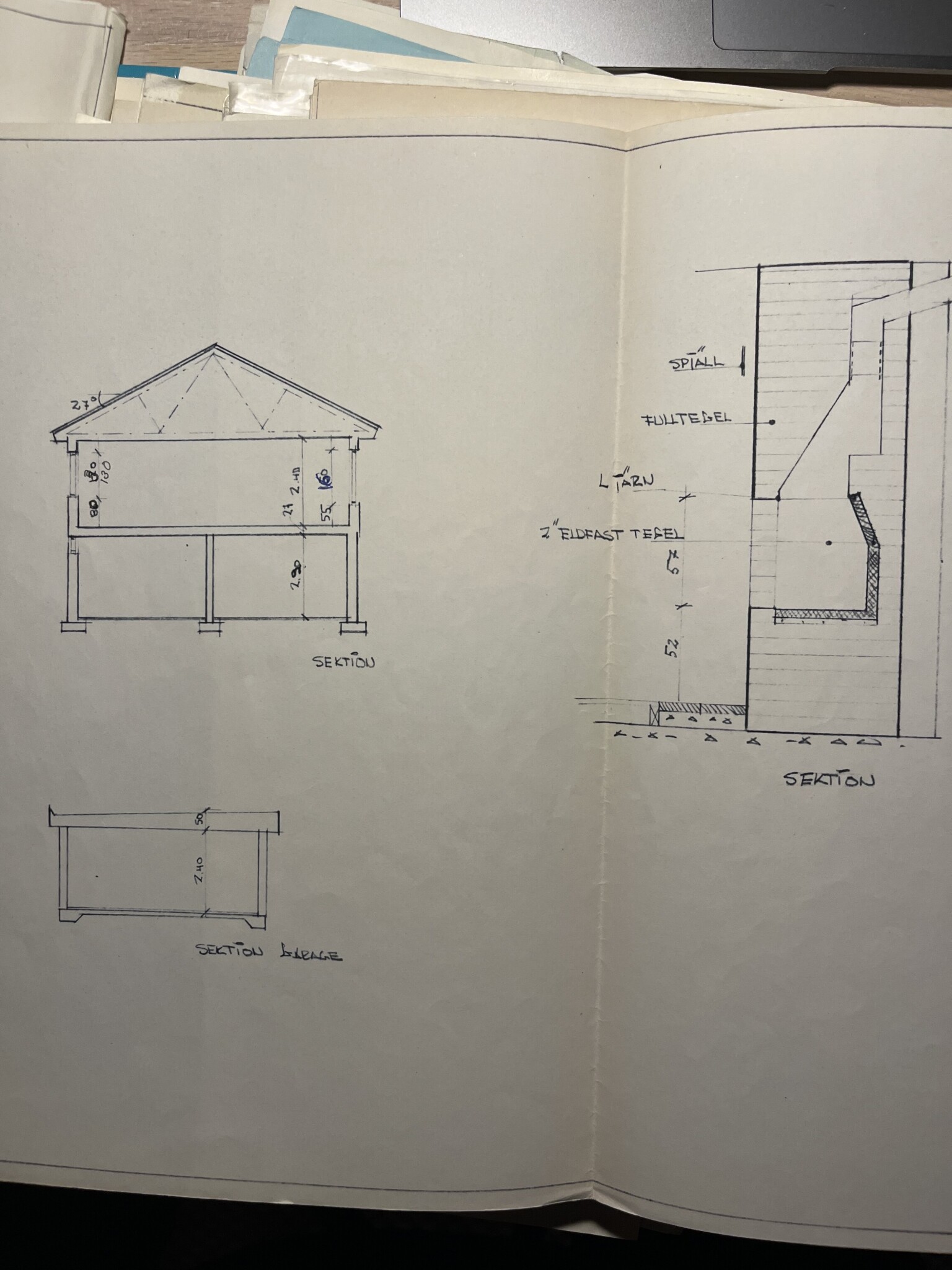
Something like this you mean? Looks fairly wall-less.
What a trip down memory lane
The section on the drawing with the fireplace is admittedly schematic and only meant to show height levels, but if there had been a load-bearing heart wall, it would probably have been included (such a wall is present in the basement).
Are there more K-drawings (i.e., the engineer's)? Who drew it should be listed in the drawing box at the bottom right, and K-drawings in this case should come from the same person/firm who drew the roof truss (it could be the same person who did everything else, meaning no division between architect/engineer).
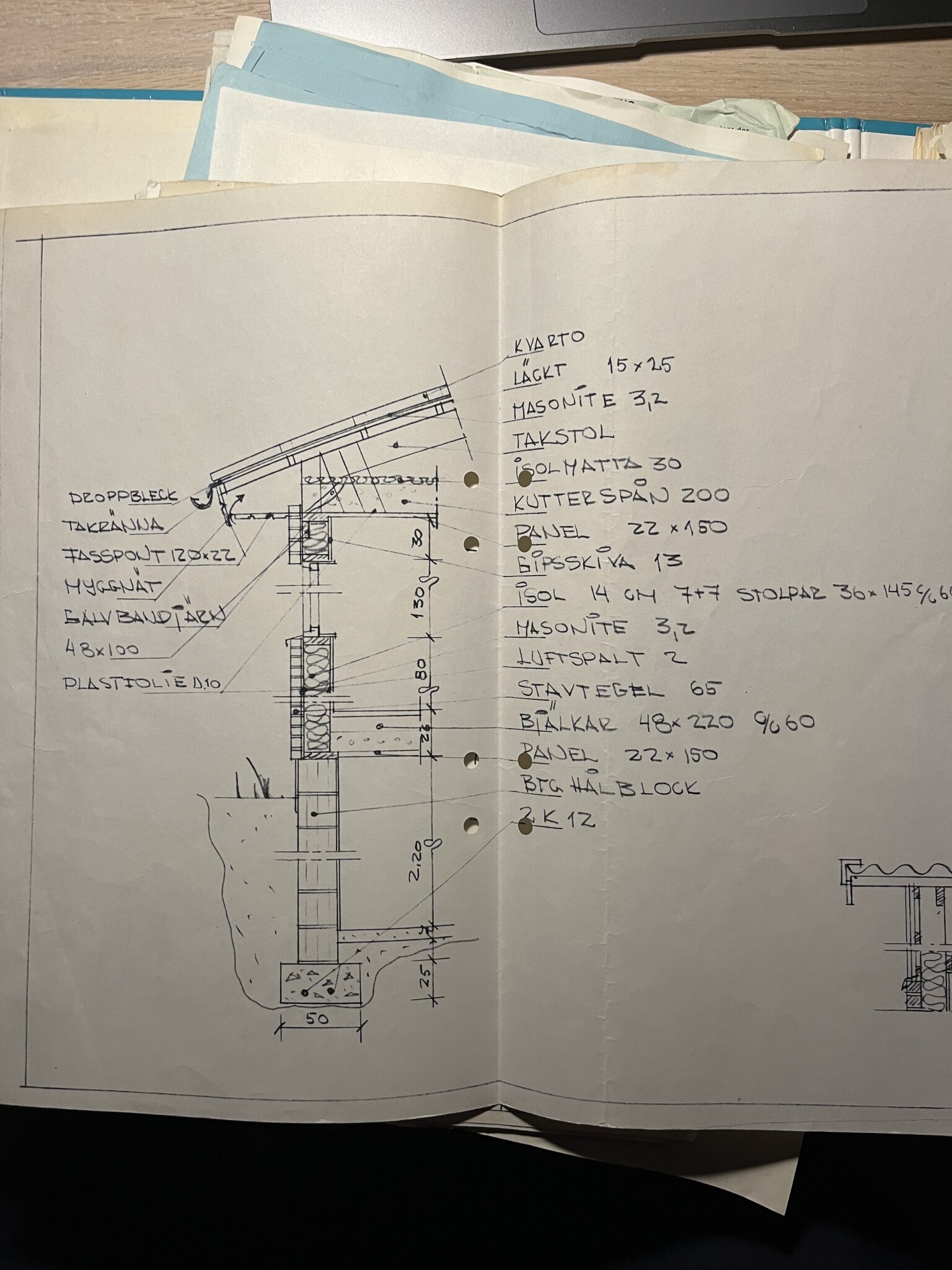
Before 2011, the concept of "startbesked" did not exist, for which now more detailed documents are required, but this still seems a bit more thoroughly drawn with roof truss and facade section, so maybe there are also plans and/or sections showing the building's load-bearing structure?
What a nostalgic trip
The section in the drawing with the fireplace is schematic and only intended to indicate plumb levels, but if there had been a load-bearing heart wall, it would probably be included (such a wall exists in the basement).
Are there more K-drawings (i.e., from the constructor)? The person who drew them should be listed in the drawing box at the bottom right, and K-drawings in this case should come from the same person/firm that drew the truss (it can be the same as the one who drew everything else, so no division architect/constructor).
Before 2011, the concept of a "start notice" did not exist, for which more detailed documents are now required, but this still seems a bit more thoroughly drawn with the truss and elevation section, and then there might also be plans and/or sections showing the house's load-bearing structure?
Haven't seen any other drawings except plumbing and electrical, otherwise, it's mostly floor plans and exterior sketches. But there's a lot of paper, and I can check a bit more closely later 😊
How does the weight of concrete tiles compare to asbestos cement?
I'm thinking about whether this change has resulted in the truss roof frames being undersized.
Yes, of course, they weigh a bit more. I will install a surely over-dimensioned beam for relief to sleep well, and if I ever make a bigger alteration, I will seek help from a structural engineer.
What about the weight of concrete tiles compared to asbestos? I'm thinking if this change has led to the trusses being undersized.
Unforgivably sloppy of me to miss the clear info; partly that it was only above the bathroom one would switch to mineral wool, and also the change to a heavier roof material. Thank you for pointing that out.
That said, I was reassured enough when I saw the truss drawing that it didn't feel necessary for further scrutiny - if one has followed the drawings, it is built with safe margins (in all snow zones, so I didn't even ask about that).*
But as I mentioned, I wanted to guard against the potential mishap that a truss had "settled" on the wall, with a point load right over the planned opening, so that would've been the first thing I checked. Otherwise, a header with (narrow) door width is not complicated anyway, and you just carry it out "as if" the wall were load-bearing - the effort isn't much worse than just adding the door opening, which anyway needs to be done.
* provided timber class C24 and above in the worst snow zone, but even in the '70s, they didn't cheat with worse timber than that.
Last edited:
Click here to reply
Vi vill skicka notiser för ämnen du bevakar och händelser som berör dig.





 It's even easier if you can settle for the existing free measure between the studs (if the placement happens to fit). But don't remove entirely up to the top; instead, place a nogging above door height and use rigid boards (like plywood) as wall cladding on both sides, and you'll have a good "light beam" over the opening and continued lateral stability. You can (should...) also safely crawl up into the attic and check if the trusses appear to rest on the wall, as well as the position of the nearest trusses—your opening might not be under any of them, but if the wall is unexpectedly load-bearing, you'll want to know if there will be a point load right in your new opening.





BirgitS said: