
713 views ·
2 replies
713 views
2 replies
How to insulate and moisture-proof bathroom with thin outer walls
I have tried to read up on how to best and safest solve the walls, floors, and ceiling in my bathroom that will be completely renovated. However, I would like input on whether my thoughts are somewhat correct and, of course, am also open to opinions and other suggestions. Despite my long post, I hope for sensible answers and viewpoints.
The condition unfortunately is that the walls are only 70 cm, and I have limited ability to add insulation due to space constraints. I am aware that this is a risk-construction and the most important thing is to avoid future moisture problems, even if it has to be at the expense of energy and heating costs.
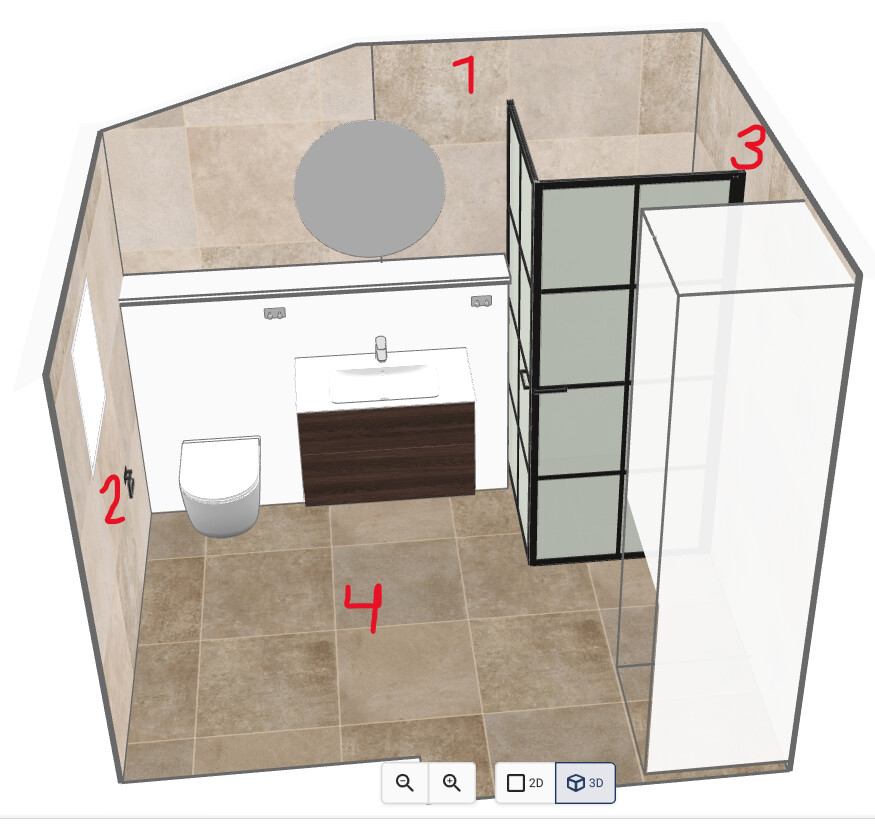
A condition is to be able to run water pipes in the outer walls. Therefore, these must be run on the warm side of the walls. I am thinking of adding 2.5 cm, which will result in walls with 9.5 cm insulation (wood fiber). Here I will place a vapor barrier and then build on with 4.5 cm studs for installation space where I will run electricity and water pipes. I attach a basic picture of the bathroom.
Below I describe how I envision the walls, floor, and ceiling.
Note that I choose wood fiber insulation in the outer walls with a vapor barrier. This is because I do not want to risk trapping moisture between the waterproofing and vapor barrier.
Note that I have a crawl space where I will install a dehumidifier. In the bathroom, I ventilate the entire house's exhaust air with a fan placed in the sloped ceiling.
Outer Wall (1 and 2 in the picture) wall from outside to inside:
Clapboard 22 mm - building paper (unfortunately no air space) - stud 70 mm (existing) - build on with 25 mm stud Insulated with 95 mm wood fiber insulation - Vapor barrier - build on with 45 mm stud (installation space) - Structural plywood P30 15 mm - Wet room drywall 12.5 mm - waterproofing - tiles 10 mm
Interior wall from outside to inside:
Drywall (kitchen side) - stud 70 mm (existing) Insulated with fiberglass insulation - Structural plywood 15 mm - Wet room drywall 12.5 mm - waterproofing - tiles 10 mm
Sloped Ceiling from outside to inside:
Roofing - rough board 22 mm - air space with Masonite - 45 mm stud (existing) - build on with 45 mm stud Insulated with fiberglass insulation 2x45 mm - durable vapor barrier - build on with additional 45 mm stud (installation space) - Huntonit ceiling panel
Ceiling from outside to inside:
stud 120 mm Insulated with 120 mm fiberglass insulation against the cold attic, which is additionally insulated (I don't know exactly how much) - durable vapor barrier - build on with additional 45 mm stud (installation space) - Huntonit ceiling panel
Floor from underneath and up (will install dehumidifier in crawl space):
Asfaboard 13 mm - stud 145 mm (alternatively up to 220 mm) Insulated with insulation board 145 - 220 mm fiberglass? - durable vapor barrier - Floor Chipboard V313 22 mm - floor leveling compound (with underfloor heating) - waterproofing - tiles
The condition unfortunately is that the walls are only 70 cm, and I have limited ability to add insulation due to space constraints. I am aware that this is a risk-construction and the most important thing is to avoid future moisture problems, even if it has to be at the expense of energy and heating costs.
A condition is to be able to run water pipes in the outer walls. Therefore, these must be run on the warm side of the walls. I am thinking of adding 2.5 cm, which will result in walls with 9.5 cm insulation (wood fiber). Here I will place a vapor barrier and then build on with 4.5 cm studs for installation space where I will run electricity and water pipes. I attach a basic picture of the bathroom.
Below I describe how I envision the walls, floor, and ceiling.
Note that I choose wood fiber insulation in the outer walls with a vapor barrier. This is because I do not want to risk trapping moisture between the waterproofing and vapor barrier.
Note that I have a crawl space where I will install a dehumidifier. In the bathroom, I ventilate the entire house's exhaust air with a fan placed in the sloped ceiling.
Outer Wall (1 and 2 in the picture) wall from outside to inside:
Clapboard 22 mm - building paper (unfortunately no air space) - stud 70 mm (existing) - build on with 25 mm stud Insulated with 95 mm wood fiber insulation - Vapor barrier - build on with 45 mm stud (installation space) - Structural plywood P30 15 mm - Wet room drywall 12.5 mm - waterproofing - tiles 10 mm
Interior wall from outside to inside:
Drywall (kitchen side) - stud 70 mm (existing) Insulated with fiberglass insulation - Structural plywood 15 mm - Wet room drywall 12.5 mm - waterproofing - tiles 10 mm
Sloped Ceiling from outside to inside:
Roofing - rough board 22 mm - air space with Masonite - 45 mm stud (existing) - build on with 45 mm stud Insulated with fiberglass insulation 2x45 mm - durable vapor barrier - build on with additional 45 mm stud (installation space) - Huntonit ceiling panel
Ceiling from outside to inside:
stud 120 mm Insulated with 120 mm fiberglass insulation against the cold attic, which is additionally insulated (I don't know exactly how much) - durable vapor barrier - build on with additional 45 mm stud (installation space) - Huntonit ceiling panel
Floor from underneath and up (will install dehumidifier in crawl space):
Asfaboard 13 mm - stud 145 mm (alternatively up to 220 mm) Insulated with insulation board 145 - 220 mm fiberglass? - durable vapor barrier - Floor Chipboard V313 22 mm - floor leveling compound (with underfloor heating) - waterproofing - tiles
Hi.T tobbe6505 said:I have tried to read up on how to best and safest solve the walls, floor, and ceiling in my bathroom that is to be completely renovated. However, I would like input on whether my thoughts are somewhat correct and of course also open for opinions and other suggestions. Despite my long post, I hope for sensible answers and comments.
Unfortunately, the condition is that the walls are only 70 cm, and I have limited ability to add insulation because of space. I'm aware that it's a risk-construction, and the most important thing is to avoid future moisture problems, which may have to be at the expense of energy and heating costs if necessary.
A prerequisite is to be able to run water pipes in the outer walls. Therefore, these must be run on the warm side of the walls. I imagine putting on 2.5 cm, which would then be walls with 9.5 cm of insulation (wood fiber). Here I place a vapor brake and then add 4.5 cm of studs for installation space where I will run electrical and water pipes. Attached is a principle diagram of the bathroom.
Below, I describe how I envision the walls, floor, and ceiling.
Note that I choose wood fiber insulation in the outer walls with a vapor brake. This is because I do not want to risk trapping moisture between the waterproofing layer and vapor barrier.
Note that I have a crawl space where I will install a dehumidifier. In the bathroom, I ventilate the whole house exhaust air with a fan placed in the sloped ceiling.
Outer wall (1 and 2 in the picture) wall from outside to inside:
Clapboard 22 mm - building paper (unfortunately no air gap) - stud 70 mm (existing) - build on with 25 mm stud Insulate with wood fiber insulation 95 mm - Vapor brake - build on with 45 mm stud (installation space) - Construction plywood P30 15 mm - Wet room gypsum board 12.5 mm - waterproof layer - tile 10 mm
Inner wall from outside to inside:
Gypsum (kitchen side) - stud 70 mm (existing) Insulated with glass wool insulation - Construction plywood 15 mm - Wet room gypsum board 12.5 mm - waterproof layer - tile 10 mm
Sloped ceiling from outside to inside:
Outer roof sheet metal - sheathing board 22 mm - air gap with masonite - 45 mm stud (existing) - build on with 45 mm stud Insulate with glass wool insulation 2x45 mm - aging-resistant vapor barrier - build on with an additional 45 mm stud (installation space) - Huntonit ceiling panel
Ceiling from outside to inside:
stud 120 mm Insulated with 120 mm glass wool insulation towards the cold attic that is additionally insulated (do not know exactly how much) - aging-resistant vapor barrier - build on with an additional 45 mm stud (installation space) - Huntonit ceiling panel
Floor from underneath and up (will install dehumidifier in the crawl space):
Asfaboard 13 mm - stud 145 mm (alternatively up to 220 mm) Insulated with insulation board 145 - 220 mm glass wool? - aging-resistant vapor barrier - Floor chipboard V313 22 mm - floor leveling compound (with underfloor heating) - waterproof layer - tile
I would be very grateful if I could get some clarity as I know there are many here who have a lot of knowledge that I hope you can share. I understand my post was long, so I'm breaking it down into smaller questions.
So the first question is how I should solve my outer walls. Today, I have 70 cm studs with glass wool insulation and then a vapor barrier, gypsum, waterproof layer, and then tile. To be able to run water pipes on the warm side, I need to build on with 4.5 cm studs. I have read that at least 2/3 of the insulation must be on the cold side, and therefore I build on with 2.5 cm, so it becomes 9.5 cm before the vapor brake and installation studs. I thus choose a vapor brake (not a vapor barrier) and insulation of wood fiber so that the walls can handle any moisture?
Does this sound sensible?
Is there any risk in also insulating in the installation space, i.e., 4.5 cm between the vapor brake and construction plywood?
So it becomes like this:
Outer wall (1 and 2 in the picture) wall from outside to inside:
Clapboard 22 mm - building paper (unfortunately no air gap) - stud 70 mm (existing) - build on with 25 mm stud Insulate with wood fiber insulation 95 mm - Vapor brake - build on with 45 mm stud (installation space) - Construction plywood P30 15 mm - Wet room gypsum board 12.5 mm - waterproof layer - tile 10 mm
Click here to reply