Would be interesting to know what kind of bend and template it is?
Protte
I don't know if you saw the picture. But it's a boat with a rounded hull. In the picture, the section I want to template is outlined in red. If you think it looks like a straight line, it's because the red line is on top. What do you mean by 'what kind of template it is'?
Yes, it is the forepeak on a boat, I don't know if boats are suitable here. However, I think you use the same technique regardless of where the bend is located.
Now I see that it is a boat, at first I thought it was a wet room.
Isn't it like cutting out Christmas elves, fold the cardboard in half and cut both sides at the same time?
Don't have a red pen, so thick line=red.
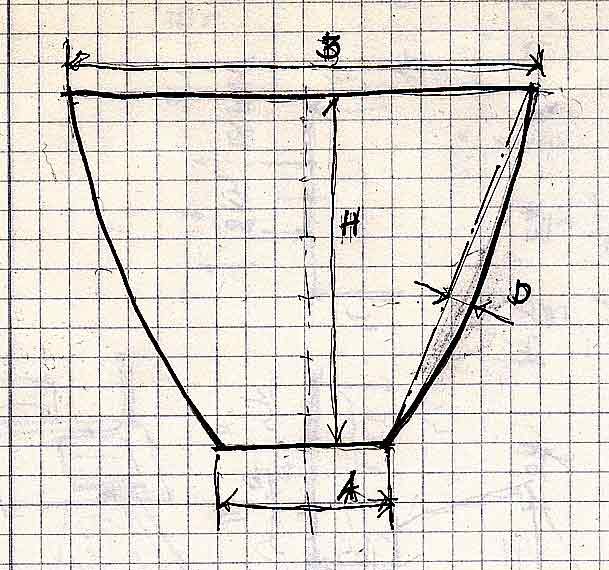
Measure the height H and the widths A and B, see attached sketch.
Place a ruler along the dashed line, measure the largest bulge D.
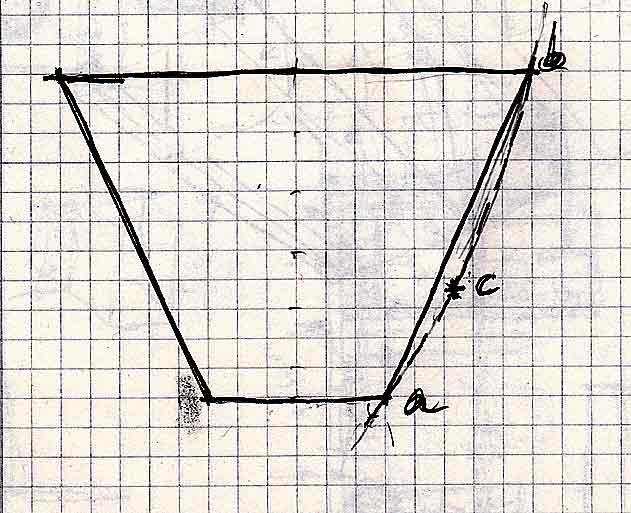
Draw the parallelogram according to the next sketch.
Mark point c, where the bulge was largest according to the measurement.
Place a ri (a long slender flexible slat) between a-c-b and draw the curve line.
The simplest way is if you use the cardboard and make it in two sections, i.e., from the middle out towards the planking. You can roughly cut so that you are as close as possible. Then take a compass, preferably one with a point and pencil (so you can draw), and drag the point along the planking because then you will have drawn on the paper exactly where you should cut.
Then do the same on the corresponding side and tape the two templates together when you have cut along the pencil line, pushed the templates towards the planking, and tested so that they are exact.
You already have a straight line in the bunk bottom, so you don't need to template that part, just place your cardboard pieces against it from the start.
Boats are rarely completely symmetrical in places like these.
Cut out a piece of cardboard (like protective board/milk carton, not corrugated) roughly and slightly smaller than what needs to be patterned. Attach it with hot glue or double-sided tape onto the bulkhead.
Then pattern it with small pieces that you trim with scissors and then fix onto the rough template with hot glue. This way you can capture every irregularity.
I assume you're going to cut out a teak ply and place it there.
I have paper for my hobby boats and have used cardboard for a boat, but that was a long time ago (yes, there are RC boats in fiberglass and even carbon fiber)
Boats are rarely completely symmetrical in places like this.
Cut out a piece of cardboard (like protective board/milk carton, not corrugated) roughly and slightly smaller than the area to be templated. Attach it to the bulkhead with hot glue or double-sided tape.
Then template with small pieces that you trim with scissors and then attach to the rough template with hot glue. That way you can capture every irregularity. I assume you're going to cut out a teak plywood and put it there.
That's why you use a compass to trace the whole thing. I've never seen anyone at the shipyard dabble with hot glue and paper bits
Click here to reply
Vi vill skicka notiser för ämnen du bevakar och händelser som berör dig.