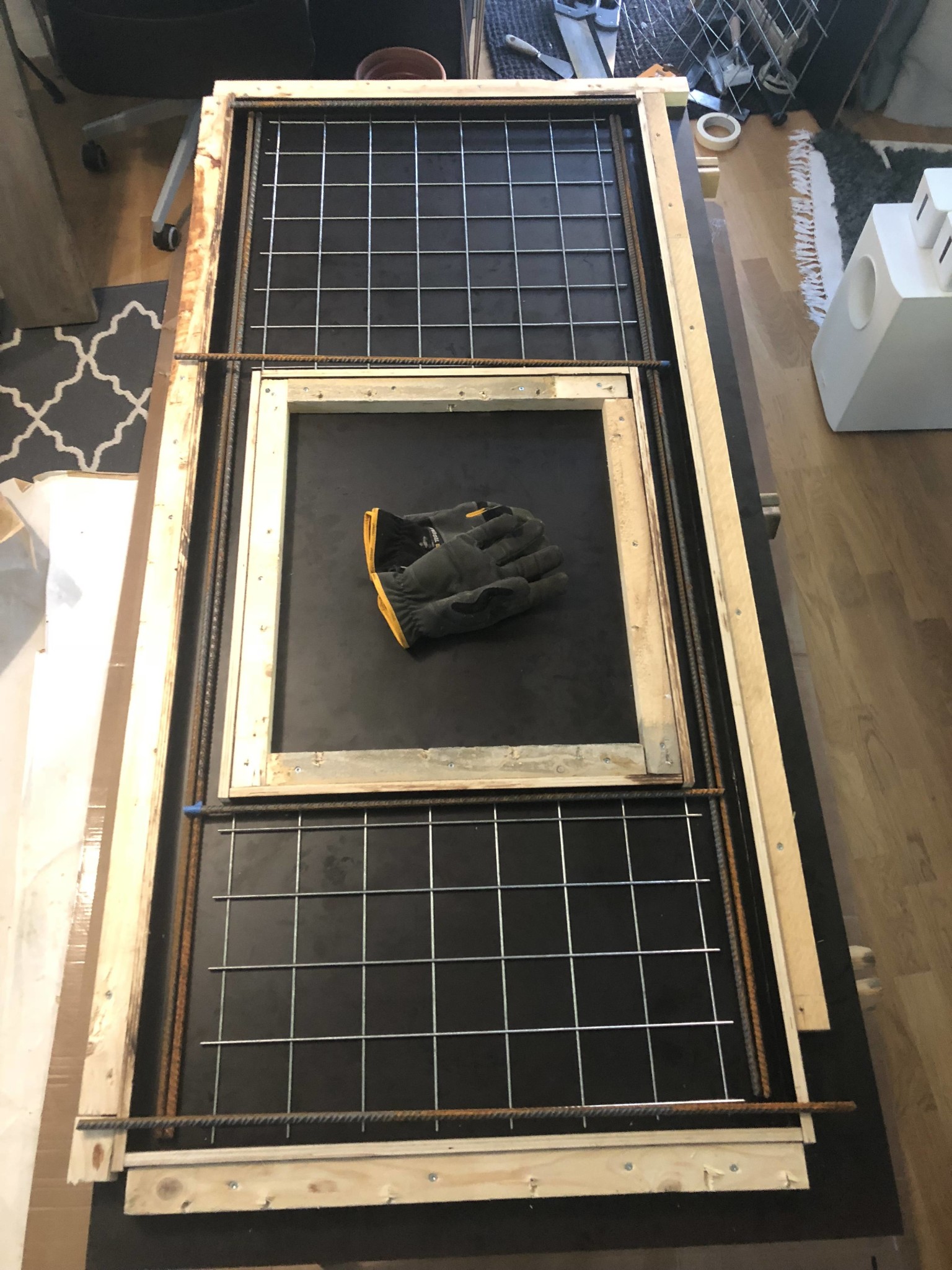
Have also been and bought 8mm iron. Will cut it down. Picture coming later. However, I think it will be difficult to fit two parallel in the same narrow channel if it has to be 2 cm in each direction.
The iron is rusty from the beginning by the way. Hopefully, that won't make the concrete rusty on the surface?
Isn't 8mm needed on the other sides of the cutout too? I have some pieces left over. Thought it might be good to reinforce extra there since the stove weighing a few kg will be placed there?
Yes, it's needed there too. Your mesh is only crack reinforcement. You should place 4 pcs of 8mm iron across as well. One at each end and one on each side of the stove.
Yes, it is needed there as well. Your mesh is only crack reinforcement. You should lay 4 pieces of 8mm iron across as well. One at each end and one on each side of the slab.
Yes, but 8mm was primarily for the narrow sections at the cutout. But you mean it's just as bad everywhere?
Edit: The thing about 2 cm from the edge. Is it for more reasons than just the aesthetic so that the iron doesn't ghost through?
It's so that moisture doesn't reach the reinforcement steel, which causes it to rust. When it rusts, it expands and cracks the concrete. That's another reason to have a thicker slab than 30mm .
The reason I think you should tie it is because you have such small margins, so you can be sure it's where you intended it to be.
Yeah, I mean, I wish I could have a thicker countertop but then I would need to rebuild the entire kitchen.
Stainless rebar would have been nice...
You have your constraints clear and there is of course a reason why it looks the way it does. The hole was for a cooktop, how do you attach the cooktop in the concrete slab?
You have your constraints clear, and there is naturally a reason that it looks the way it does. The hole was for a cooktop, how do you attach the cooktop to the concrete countertop?
Yep. But in this case, probably nothing will happen anyway. I think they generally say 30mm coverage on reinforcement.
When I cast my countertops, I dug into that because I nerd out on details, and I seem to recall that there had been a change in the minimum recommended coverage from 30 to 20 mm. Now when I'm looking for where I saw this, I can't find it again, of course.
Now the countertop will be indoors, so it matters less; I had mistakenly assumed it would be outside.
When I cast my countertops, I delved into that because I geek out on details and I seem to remember that there had been a change in the minimum recommended coverage from 30 to 20 mm. Now, when I'm looking for where I saw this, I can't find it again, of course.
Now, the countertop is going to be indoors, so it matters less; I had mistakenly assumed it would be outside.
There are different rules depending on what you are casting.
Once you have cast your slab, allow it to cure LONG, the longer, the greater the chance that the concrete has achieved full strength. You will need this when you dismantle the form and move the slab to its proper place. If you dismantle too early, it will crack at the transition to the narrow sections. Don't forget to keep the slab moist/wet during curing, as it "strengthens" the concrete.
Vi vill skicka notiser för ämnen du bevakar och händelser som berör dig.

peterwesterlund said:
Have also been and bought 8mm iron. Will cut it down. Picture coming later. However, I think it will be difficult to fit two parallel in the same narrow channel if it has to be 2 cm in each direction.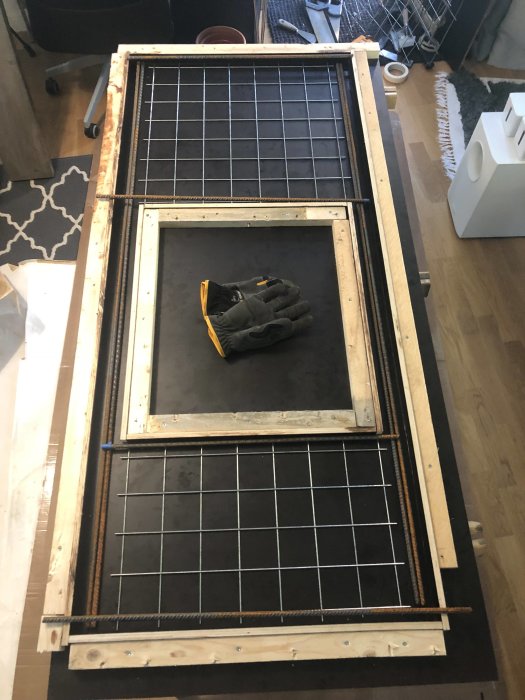
 .
.

mexitegel said:
When I cast my countertops, I delved into that because I geek out on details and I seem to remember that there had been a change in the minimum recommended coverage from 30 to 20 mm. Now, when I'm looking for where I saw this, I can't find it again, of course.