If more reinforcement is needed, I almost have to buy a denser mesh. Then it will have to be a thinner mesh with that kind of floor reinforcement.
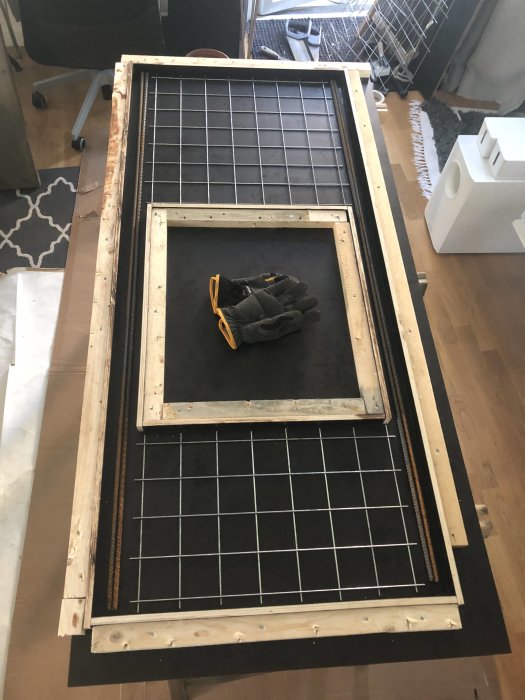
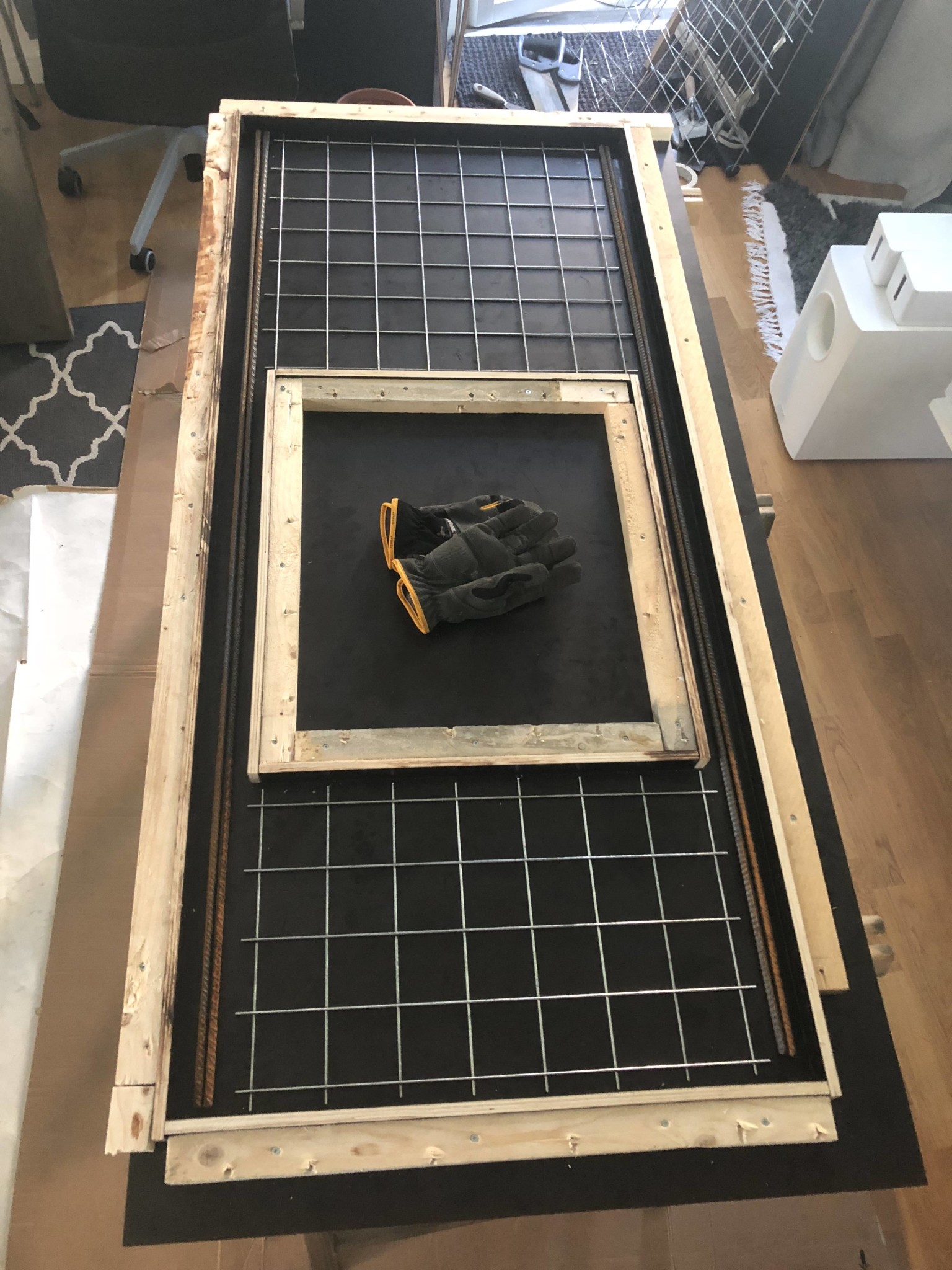
You have a concrete slab weighing how many kg when it's finished? In the middle of it, you have a larger hole, and what remains are two tiny strips of concrete measuring 8x3cm or something like that on each side? It's primarily not mesh you need there but rebar.
But go ahead, I've been wrong before and will be again.
Before you carry it around, I would screw a 45x95 on each side (top/bottom, front/back edge) so it doesn't completely fold.
But I'm skeptical.
EDIT: I came in second on that one, but it was cool that we wrote pretty much the same thing.
Isn't the mesh made up of bars that are assembled? I've cut out two straight ones on each side.
Anyway, earlier in the thread it sounded like it looked good? Just that, as mentioned, it needed doubling on each side of the notch. But now that's not good enough?
You have a concrete slab weighing how many kg when it's finished? In the middle of it, you have a larger hole and what's left are two tiny concrete strands around 8x3cm or something like that on each side? Primarily, you don't need mesh there but rebar.
But go ahead, I've been wrong before and will be again.
Before you carry it around, I would screw a 45x90 on each side (top/bottom, front/back) so it doesn't completely buckle.
But I'm skeptical.
It is 5.5 cm at its narrowest.
As I said: What is the difference between rebar and the bars in reinforcement mesh?
As said: What is the difference between rebar and the bars in a reinforcement mesh?
Whole bars are stronger; try to place e.g., 2 pieces of 6s on top of the mesh lengthwise and beyond the thin parts, and it might work. However, as mentioned, during moving, put a rule on each side of the narrow parts and clamp them.
Maybe also an idea to turn it over once it's burned to see how the surface is; with formply and oil, it usually becomes a smooth surface. Just keep in mind that the concrete is not sealed against waste from vegetables or other materials, it needs to be prepared.
Does it matter if the mesh 'ghosts' through on the underside of the board? Place the reinforcement a bit closer to the bottom than the top.
If you have read earlier, that's how I plan to do it. But with both mesh and iron on top of each other it doesn't matter how close to the bottom it gets; on a 3cm board, it's still too close to the top. I want to avoid working on the height with the reinforcement as much as possible.
If you read earlier, that's how I planned to do it. But with both netting and iron on top of each other, it doesn't matter how close to the bottom it is; on a 3cm slab, it's still too close to the top. I want to avoid working at height with the reinforcement as much as possible.
Everything has been said. Mix the concrete and go.
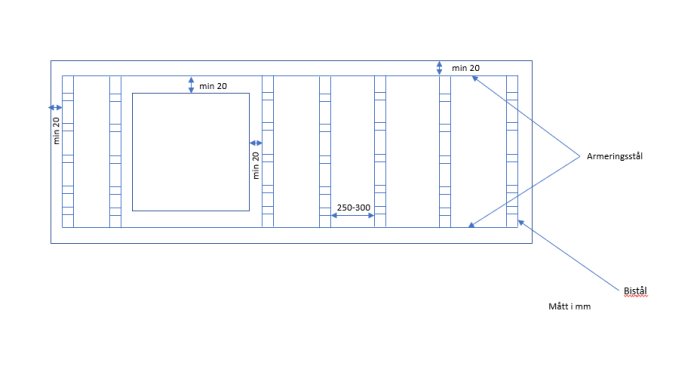
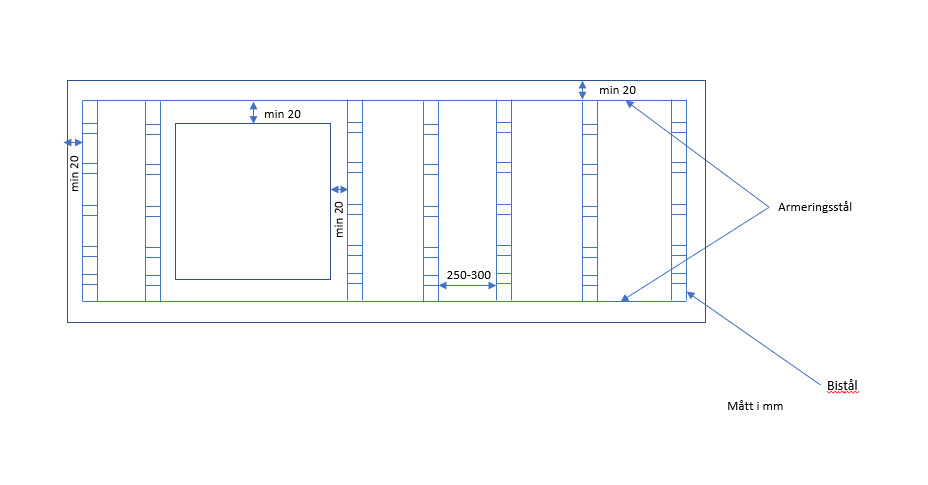
The reinforcement mat, as mentioned, does not add anything for your countertop. Reinforce like this and you will have done what can be done. No reinforcement should be shallower than 20mm from the edge. And don't forget to tie the reinforcement together properly.
Concrete's weakness is that it cannot withstand any tensile stress; that's where the reinforcing steel helps. The optimal situation would be to place two bars vertically with a couple of centimeters in between. This would make the slab incredibly stronger; since you cannot do that, you must support it as described when lifting it into place, otherwise, it will inevitably crack.
I've heard about naja in articles and here on the forum, but I haven't exactly understood what it entails. More than that, it's about joining two parts together. But does it have to be done with thread, or is it enough to overlap?
Edit: That thing about 2 cm from the edge. Is it for more reasons than just the aesthetic one that the iron shouldn't ghost through?
Naja is to tie the rebar together with steel wire. It's not necessary if you are careful when pouring the concrete on this project. Naja does not transfer any forces; it's solely for assembly/keeping the rebar in place during casting.
By the way, I have also been out to buy 8mm iron. Will cut it down. Picture coming later. However, I believe it will be difficult to fit two parallel in the same narrow channel if there has to be 2 cm in each direction.
The iron is rusty from the start. Hopefully, it won't make the concrete rusty colored on the surface?
Isn't 8mm needed on the other sides of the notch as well? I have some pieces left over. I was thinking if it's good to reinforce extra there since the hob, which weighs a few kg, will be placed there?
Vi vill skicka notiser för ämnen du bevakar och händelser som berör dig.

peterwesterlund said:
mexitegel said:

useless said: